Quick Answer
Choose a biconvex lens when you are imaging at finite conjugates over a narrow spectral range and want the two surfaces to share the refraction work. Choose a plano-convex lens when you need a single-element focuser for a laser or a collimated source, especially where one flat surface simplifies mounting or coating. Neither shape wins universally; the decision follows your conjugate ratio, wavelength band, and aberration budget.
The Shape Difference That Actually Changes Performance
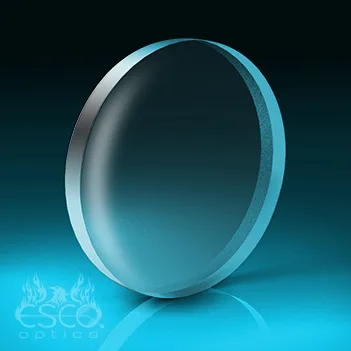
A biconvex lens curves both surfaces outward, so the optical power is split between two refracting surfaces. That symmetry is why biconvex lenses are commonly specified for finite conjugate imaging: when the object and image distances are comparable, each surface contributes roughly half the bending, which helps keep spherical aberration lower than a single-surface design at the same focal length. Esco manufactures biconvex lenses from G1 commercial grade fused quartz with fine ground and beveled edges, and every lens is pitch polished for surface quality and low-cost imaging performance across a variety of light sources.
A plano-convex lens puts all the power on one curved surface and leaves the other flat. That geometry is efficient for collimating a point source or focusing a collimated beam, because the flat face can be oriented toward the beam to minimize spherical aberration. In laser systems, that single curved surface is also easier to coat uniformly, which matters when you are trying to resist thermal damage at high power.
How Focal Length Selection Interacts With Lens Shape
Focal length selection is not independent of shape. For a given focal length, a biconvex lens distributes curvature across two surfaces, so each surface has a longer radius than the single curved surface of an equivalent plano-convex lens. Longer radii generally mean gentler bending angles and less spherical aberration at the same aperture, which is why biconvex designs hold up better when you need a fast, wide-aperture imaging path at finite conjugates.
Plano-convex lenses, by contrast, are most comfortable at longer focal lengths relative to their diameter. If you push a plano-convex lens to a very short focal length with a large clear aperture, the single curved surface has to do all the bending and spherical aberration grows quickly. That is the practical reason a lens selection guide should always pair a focal length with a conjugate ratio, not just a diameter.
Where Each Shape Earns Its Place
Biconvex lens applications cluster around finite conjugate imaging, relay systems, and narrow-band illumination where you want symmetric performance and a compact form factor. Because both surfaces are curved, orientation is less critical than with a plano-convex element, which simplifies assembly when a lens may be flipped during prototyping.
Plano-convex lens uses cluster around laser focusing, beam collimation, and any setup where the flat surface can be mounted flush against a holder or window. Esco's industrial laser lenses are a specialized example: they are plano-convex elements made as replacement parts for industrial Nd:YAG lasers operating at 1.06 micrometers, built from high homogeneity fused silica and multilayer AR-coated to resist thermal damage. Custom focal lengths are also available, which matters when an original equipment focal length is no longer stocked.
Aberration Control: What Each Shape Can and Cannot Fix
A single biconvex or plano-convex element cannot eliminate chromatic aberration, because both rely on the dispersion of one glass type. If your application needs diffraction-limited performance across a broad band, you are past the point where lens shape alone solves the problem and should be looking at an achromatic doublet. Esco's achromatic lenses use optical crown and flint glass and are computer optimized to minimize chromatic and spherical aberrations simultaneously, which is the correct upgrade path when a singlet's color error is the limiting factor.
Where a singlet still wins is cost and simplicity. A biconvex element in G1 fused quartz gives you good transmission and a low-cost path for narrow-band imaging, while a plano-convex laser lens gives you a coated, damage-resistant focuser for a specific wavelength. The trade-off is that you accept either chromatic error or a restricted spectral window in exchange for a much lower part count.
Trade-Offs at a Glance
- Biconvex: symmetry versus spectral range: Splitting power across two surfaces lowers spherical aberration at finite conjugates, but a single glass type still disperses, so performance holds only over a narrow spectral range. Pick biconvex when your object and image distances are comparable and your source is narrow-band.
- Plano-convex: laser efficiency versus aperture limits: One curved surface is easier to coat uniformly and is efficient for collimation and focusing, but pushing a short focal length at a large aperture drives spherical aberration up fast. Pick plano-convex for collimated or point-source work at moderate to long focal lengths relative to diameter.
- Singlet versus achromat: cost versus color correction: A single biconvex or plano-convex element is cheap and simple but cannot correct chromatic aberration; an achromatic doublet adds a second glass type to fix it. If color error is your limiting factor, stop comparing singlets and move to an achromat.
Relevant Esco Optics Products
- Bi-Convex Lenses, G1 Commercial Grade Fused Quartz: Bi-Convex Lenses are ideal for finite conjugate imaging over a narrow spectral range, manufactured from G1 commercial grade fused quartz with fine ground, beveled edges and pitch polished surfaces. This is the shape to start with when object and image distances are comparable and your source is narrow-band, because the symmetric curvature keeps spherical aberration in check without adding a second element.
- Industrial Laser Lenses, S1-UV Grade Fused Silica: Industrial laser lenses are plano-convex replacement elements for industrial Nd:YAG lasers operating at 1.06 micrometers, made from high homogeneity fused silica and multilayer AR-coated to resist thermal damage, with custom focal lengths available. This shows the plano-convex shape at its strongest: a single-surface focuser with a coating and substrate chosen for laser power handling, where a generic biconvex singlet would be the wrong tool.
- Achromatic Lenses, Optical Crown and Flint Glass: Achromatic lenses provide diffraction-limited performance over nearly their entire clear aperture and are computer optimized so chromatic and spherical aberrations are simultaneously minimized. If your biconvex or plano-convex singlet is limited by color error rather than shape, this is the honest upgrade rather than swapping between singlets.
- Commercial Quality Windows, Circular, N-BK7 Optical Glass*: Commercial quality circular windows are available in N-BK7 optical glass with diameter and thickness tolerances of plus or minus 0.125 mm, surface quality of 60-40 scratch-dig or better, and parallelism under 15 arc minutes. When your setup needs a flat protective or sight-glass element rather than a focusing element, this is the companion part that keeps the plano surface flat without adding optical power.
Which Shape Fits Your Setup
Best for
- Finite conjugate imaging systems where object and image distances are comparable
- Narrow-band illumination setups using a single glass type
- Laser focusing or collimation where one flat surface simplifies mounting and coating
- Prototype assemblies where lens orientation may change and symmetry is an advantage
Not for
- Broadband imaging where chromatic aberration must be corrected, which calls for an achromatic doublet
- Very short focal lengths at large apertures with a plano-convex singlet, where spherical aberration grows quickly
- High-power laser paths that need a substrate and coating specified for thermal damage resistance