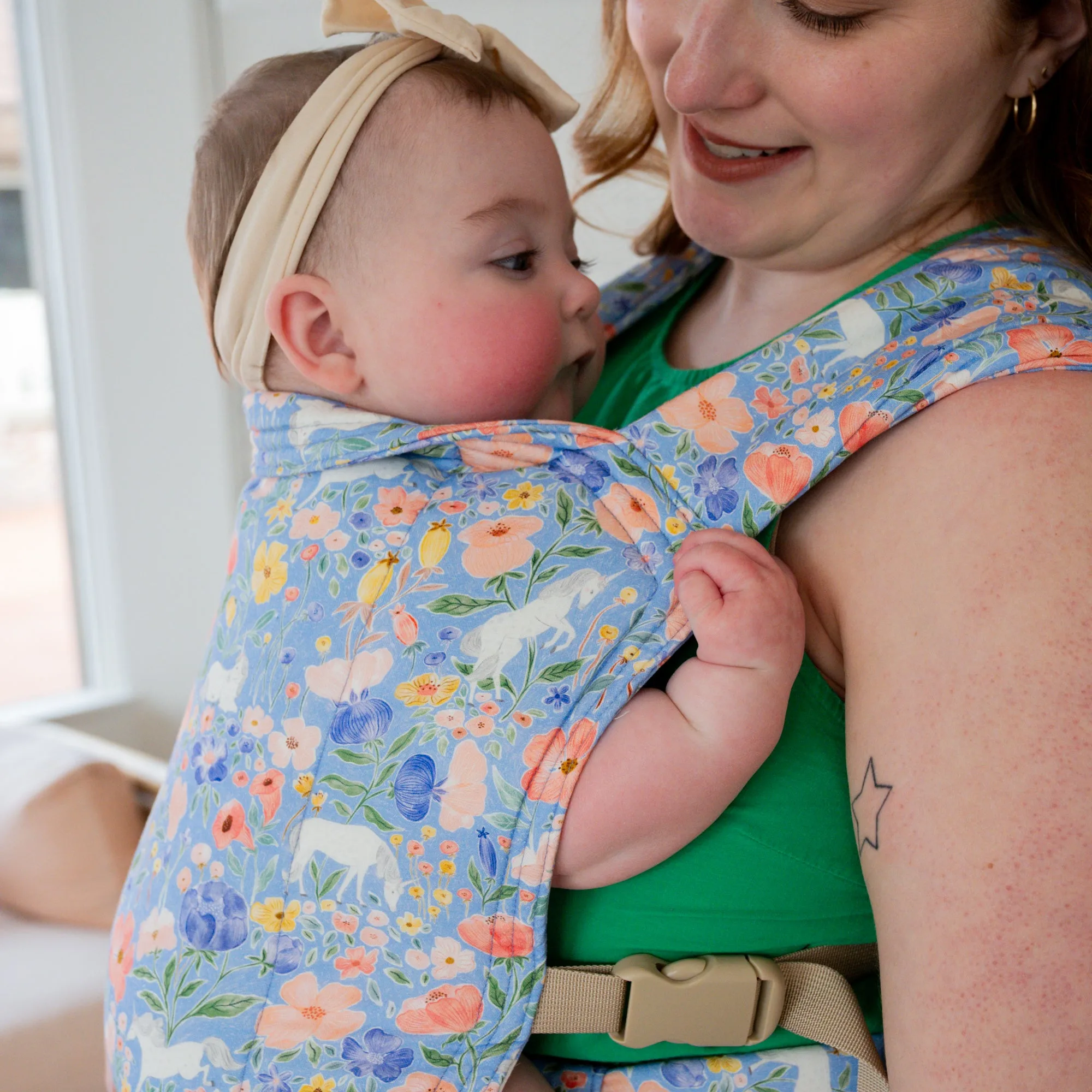
Before you start: the two choices that shape your setup
A front carry with the Bluebird Lark Baby Carrier starts with two decisions you make before any strap goes over your shoulder: the carrier length and your baby's fit range. The Lark comes in Short, sized for adult clothing XXS through L, and Long, sized for adult clothing XL through 6X. If you are between sizes or unsure which length fits, the 30-day return policy makes it easy to exchange, so you are not stuck guessing.
For your baby, the Lark carries from 10 to 45 lbs, starting at size 3-6 month clothing. No infant insert is needed. That matters for setup because you are not adding a separate insert layer before buckling; you are adjusting the carrier you have.
Bluebird Lark specs that affect front carry setup
-
Bluebird Lark Baby Carrier: Made from a breathable linen-cotton blend with no foam and no synthetic mesh, just breathable natural fiber construction that softens with every wash. A fabric carrier with no foam layer sits and adjusts differently than a structured, padded carrier, so expect the linen-cotton blend to mold as you tighten straps rather than hold a rigid shape.

Bluebird Lark Baby Carrier
-
Bluebird Lark Baby Carrier: The apron-style waistband adjusts to your torso while wide cross-back straps distribute weight evenly across your shoulders for all-day comfort, and the wide, adjustable seat supports a natural hip-healthy seated position for your baby. These are the three adjustment zones you will work with in a front carry: the waistband around your torso, the cross-back straps over your shoulders, and the seat under your baby.
-
Bluebird Lark Baby Carrier: Front and back carry make it easy to switch between errands, travel, and everyday wear as your baby grows. Front carry is one supported mode, so you can set it up now and later switch to back carry without changing carriers.
Front carry setup, step by step
The supplied product record does not include a manufacturer step sequence, so the steps below organize the confirmed adjustment points into a practical order. Follow the carrier's own instructions for any detail not covered here.
- 1. Confirm your length and your baby's range: Check that you have the Short (XXS-L) or Long (XL-6X) length that matches your clothing size. Then confirm your baby is within the listed 10 to 45 lbs range and starting at size 3-6 month clothing. No infant insert is needed.
- 2. Fasten the apron-style waistband around your torso: The apron-style waistband adjusts to your torso. Set it at a height that feels secure and comfortable for a front carry, then tighten it so the carrier body is supported before you add your baby's weight.
- 3. Settle your baby into the wide, adjustable seat: The wide, adjustable seat is designed to support a natural hip-healthy seated position. Place your baby in the seat and check that the fabric supports under both thighs rather than letting them hang straight.
- 4. Bring the wide cross-back straps over your shoulders: The wide cross-back straps distribute weight evenly across your shoulders. Bring them over your shoulders and cross them at your back as the carrier's design intends, keeping the straps flat rather than twisted.
- 5. Tighten for front carry strap adjustment: Work through the strap adjustments so your baby is held close and high on your front. Tighten the cross-back straps evenly so one shoulder is not carrying more than the other, and recheck the waistband after the straps are set.
- 6. Do a final fit check before you move: Confirm your baby's weight is within the listed range, the seat supports the thighs, the waistband is snug around your torso, and the cross-back straps sit flat. The Lark meets ASTM F2236-24 safety standards for structured carriers, but that standard does not replace your own fit check each time you put it on.
Front carry strap adjustment: what to check when it feels off
The Lark gives you three adjustment zones, and most front carry discomfort traces back to one of them. Use these checkpoints to narrow it down.
- Weight pulling on one shoulder: Recheck the cross-back straps. They are designed to distribute weight evenly across your shoulders, so uneven tension usually means one strap is tighter or sitting higher than the other.
- Waistband digging in or sliding: The apron-style waistband adjusts to your torso. Reset it, then retighten after the shoulder straps are set, since tightening the top can shift the waistband.
- Baby sitting too low or too far from you: Recheck the seat and the strap tension together. A wide, adjustable seat supports a natural hip-healthy position, but it still needs the straps snug enough to hold your baby close.
- Fabric feels stiff on the first few wears: The linen-cotton blend has no foam and no synthetic mesh and softens with every wash. Expect the carrier to feel different after washing, and recheck your adjustments then.
Choosing Short or Long before you set up
Length is the one option you select at purchase, so get it right before your first front carry. Short is sized for adult clothing XXS through L, and Long is sized for adult clothing XL through 6X. If you are between sizes or unsure which length fits, the 30-day return policy makes it easy to exchange.
The Bluebird print itself is a blue-and-white gingham check, described as classic without being boring and cheerful without being loud. It is a look that works across seasons, but the practical decision is still the length, because that determines whether the waistband and cross-back straps land where they should on your body.
Bluebird Lark at a glance
- Bluebird Lark Baby Carrier: The Lark carries babies from 10 to 45 lbs, starting at size 3-6 month clothing. This is the range to confirm before your first front carry, and the reason no infant insert is part of the setup.
- Bluebird Lark Baby Carrier: It comes in two lengths: Short, sized for adult clothing XXS through L, and Long, sized for adult clothing XL through 6X. Choose your length before adjusting straps, since the wrong length will make every other adjustment harder.
- Bluebird Lark Baby Carrier: Meets ASTM F2236-24 safety standards for structured carriers. A confirmed safety standard for the carrier itself, separate from the fit check you do each time you put it on.
- Bluebird Lark Baby Carrier: Sewn by fairly paid sewing teams in Saint Paul, Minnesota. Useful context if where and how your carrier is made matters to your purchase.