Start with the box contents, not the border
The Blush Lotus Kingdom puzzle is a 1000-piece hidden task puzzle, so the usual border-first approach leaves most of the challenge untouched. The box includes 223 hidden objects to find while assembling, a 2-hour immersive audio story, and two secret envelopes with bonus tasks. Before you tip out the pieces, decide whether you are solving for the picture, the hidden objects, or both. That choice shapes how you sort.
The finished puzzle measures 31.5 x 23.5 inches. Clear a surface at least that large, and keep the two secret envelopes aside until the main build is underway. The audio story is designed to play as you work, so have a way to listen nearby without handling your phone with puzzle-dust fingers.
What the box gives you to work with
-
1000 Pcs Puzzle for Adults with Hidden Tasks | Blush Lotus Kingdom: 1000-piece puzzle with 223 hidden objects to find while assembling. The hidden objects are part of the build, not a separate afterthought, so your sorting and scanning routine needs to accommodate them.
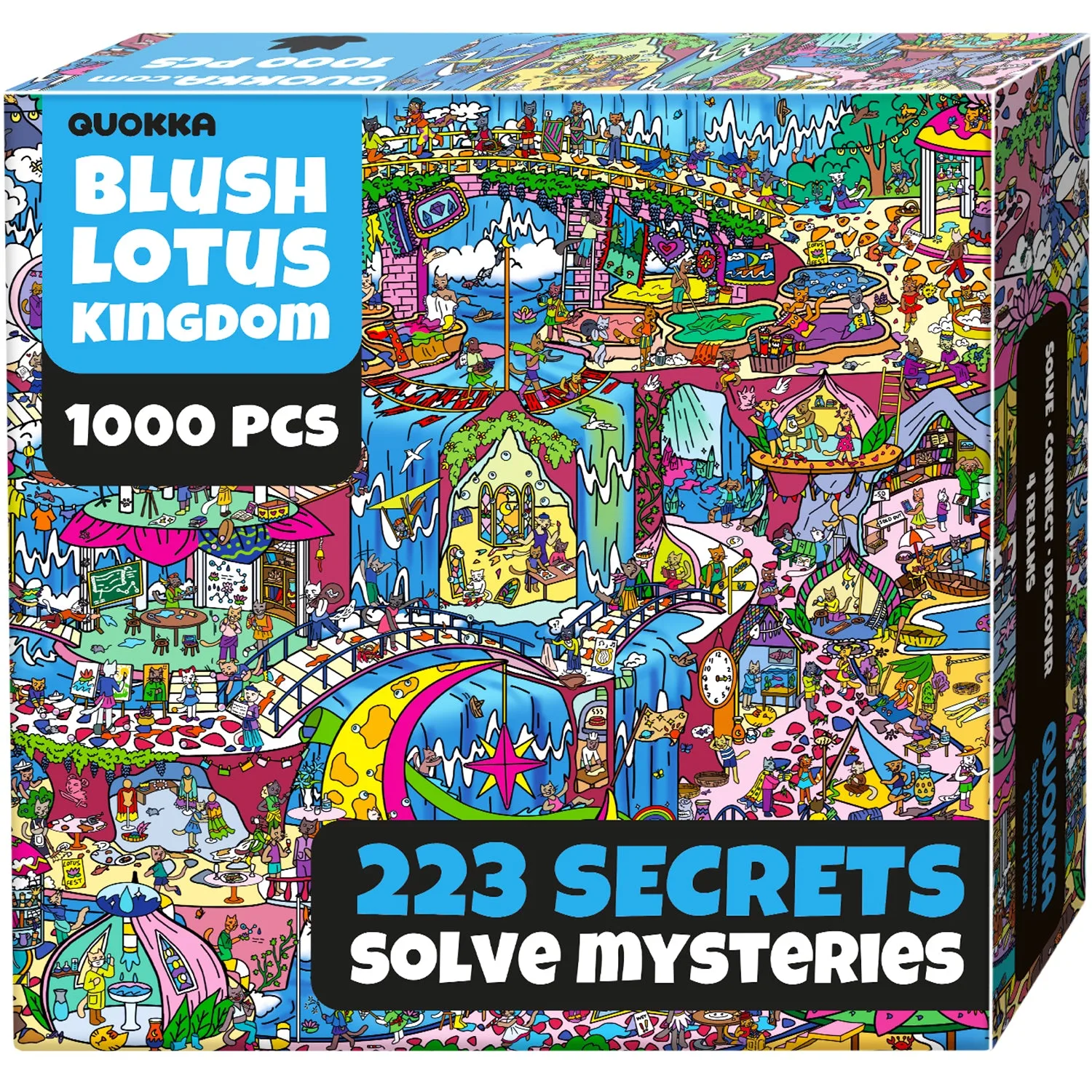
1000 Pcs Puzzle for Adults with Hidden Tasks | Blush Lotus Kingdom
-
1000 Pcs Puzzle for Adults with Hidden Tasks | Blush Lotus Kingdom: Includes a 2-hour immersive audio story and 2 secret envelopes with bonus tasks. These extras give the puzzle a paced, story-led structure and optional bonus challenges after the main build.
-
1000 Pcs Puzzle for Adults with Hidden Tasks | Blush Lotus Kingdom: Finished size is 31.5 x 23.5 inches. This tells you how much table or floor space to clear before you start sorting.
A four-pass build for a hidden object jigsaw
This sequence keeps the hidden object search integrated with assembly rather than saving it all for the end. Adjust the passes to your own pace; the goal is a repeatable routine, not a race.
- Pass 1: Sort by edge, color, and text: Separate edge pieces, then group interior pieces by dominant color and any visible text or distinct motifs. Because the artwork is a floating garden with lily paths and blooms, expect large soft-color regions that need finer sorting later. Keep a small tray for pieces that clearly show a hidden object or an unusual detail; these become your first scan pile.
- Pass 2: Build the border and anchor regions: Assemble the frame, then pick two or three high-contrast areas from the box image and build those clusters. Anchors give you reference points for placing soft-color pieces and for judging where hidden objects are likely to sit.
- Pass 3: Fill the middle while scanning for hidden objects: As you place pieces, keep the 223 hidden objects in mind. When a piece shows a tiny secret, set it in your scan tray rather than forcing it into the puzzle immediately. This keeps the search active without turning every piece into a decision.
- Pass 4: Final scan and bonus envelopes: Once the puzzle is complete, do a deliberate scan for any hidden objects you noted but did not place. Then open the two secret envelopes and work through the bonus tasks. The audio story can run across any of these passes; it does not require a separate session.
Sorting strategy that suits a 1000-piece hidden task puzzle
A good sorting strategy reduces the number of times you rescan the same pieces. Use these categories, and combine them when a piece fits more than one.
- Edge pieces: Set aside first. The border is a small fraction of 1000 pieces, so do not let it consume the whole first session.
- Color families: Group by the dominant colors in the floating garden artwork. Soft pinks, greens, and water tones will each form large families; split them further by shade as you go.
- Hidden object candidates: Any piece with a tiny, distinct detail that looks like a secret goes into a separate tray. This is the core of the hidden object jigsaw for adults: the search is part of the sort.
- Text and pattern: Pieces with lettering, repeating motifs, or strong lines are easy to place and make good anchors for Pass 2.
Using the audio story and secret envelopes without breaking your rhythm
The 2-hour audio story is long enough to cover a substantial build session, but you do not have to finish it in one sitting. Start it when you begin Pass 2 or 3, and pause when you need to concentrate on a tricky section. The story is part of the box, not a rule; use it as background or as a guided companion, whichever suits you.
The two secret envelopes are best opened after the main puzzle is complete. They contain bonus tasks, so they extend the life of the puzzle rather than interrupting the build. If you are solving with someone else, agree before you start whether to open them together or save them for a second session.
What the supplied information does not settle
The supplied product record does not include care instructions, piece thickness, or a recommended age range. It also does not specify whether the hidden objects are listed on a separate sheet or only shown in the artwork. Treat these as open questions rather than assuming a feature is present or absent. If you need those details before buying, check the retailer's full listing or the manufacturer's documentation.
The record also does not describe how the four puzzles in the Four Kingdoms Saga connect into a single panoramic scene. If you plan to collect all four, confirm the connection method from the packaging or the manufacturer rather than guessing from the box image.