Quick answer
A boom stand gives you overhead or angled lighting by extending a horizontal arm, while a standard light stand holds a light vertically on a straight pole. Use a boom stand for hair lights, top-down product shots, or positioning a light over a set without a floor stand in the way. Use a standard light stand for most key, fill, and background lights.
Key differences between boom stands and light stands
A standard light stand is a straight vertical pole with a base and a mounting stud at the top. It holds a light fixture directly above the base. A boom stand adds a horizontal arm that extends outward from the vertical pole, letting you position the light over a subject or at an angle without the stand itself being in the shot. The trade-off is that a boom stand requires a counterweight or sandbag to stay stable, while a standard light stand is simpler and more stable for basic positions.
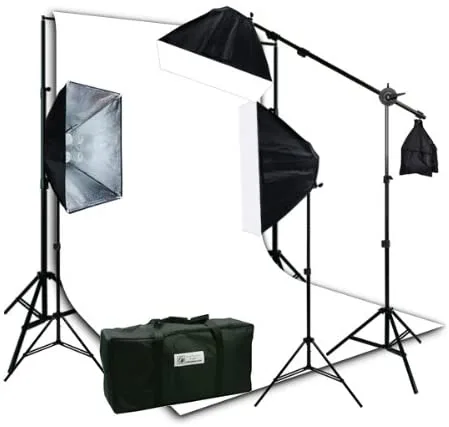
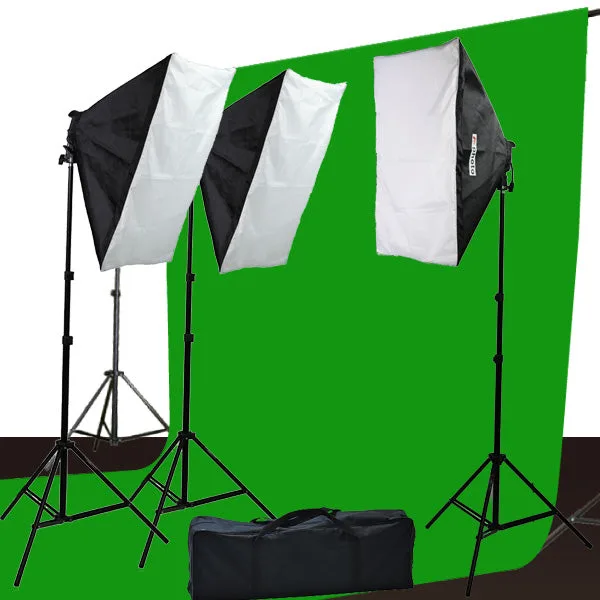
For example, the H9004SB2-1012W Photo Video Studio Boom Stand Lighting Kit includes a dedicated 6.5ft boom stand with a boom arm and clamp, plus a lightweight sandbag for stability. This kit is designed for setups where you need a hair light or overhead key light. In contrast, the 2400 Watt Continuous Video Photography Studio Chromakey Green Screen Lighting Kit comes with three standard 6.5ft light stands, which are ideal for evenly lighting a backdrop or subject from the sides.
When to choose a boom stand
A boom stand is your best choice when you need to position a light directly over a subject, such as a hair light in portrait photography or a top-down light for product shots. It also helps when you want to angle a light from above without a stand appearing in the frame. The boom arm lets you reach across a table or set. However, boom stands take up more floor space due to the counterweight and require careful balancing to prevent tipping.
When to choose a standard light stand
Standard light stands are the workhorses of studio lighting. Use them for key lights, fill lights, and background lights where the stand can sit off to the side. They are simpler to set up, more stable, and take up less floor space. For most three-point lighting setups, two or three standard stands are sufficient. The 2400W green screen kit, for instance, includes three standard stands, making it a practical choice for even backdrop illumination.
Boom stand vs light stand trade-offs
- Overhead reach: A boom stand can position a light directly over a subject or at an angle, which a standard light stand cannot do without a separate arm. Choose a boom stand for hair lights or top-down product shots.
- Stability and setup: Standard light stands are inherently more stable because the load is centered. Boom stands need a counterweight or sandbag to prevent tipping. Standard stands are simpler and safer for basic lighting positions.
- Floor space: A boom stand requires extra floor space for the counterweight and extended arm. A standard light stand has a smaller footprint. If your studio is tight, standard stands are more space-efficient.
- Versatility in a kit: Some kits, like the H9004SB2-1012W, include both a boom stand and standard stands, giving you flexibility. Others, like the 2400W kit, only include standard stands. Consider a combined kit if you need both types of stands.
Product facts
- H9004SB2-1012W Photo Video Studio Boom Stand Lighting Kit with Complete 10 x 12 White Background Stand Kit: Includes 1 x 6.5ft boom stand, 1 x Boom Arm with Clamp, 1 x Clamp, lightweight sandbag, plus 2 x 6.5ft light stands and softboxes. This kit gives you both a boom stand for overhead or angled lighting and standard stands for key/fill lights, all in one package. The included sandbag adds safety when using the boom arm.
- 2400 Watt Continuous Video Photography Studio Chromakey Green Screen Lighting Kit: Includes 3 x light stands able to extend to 6.5ft height, 3 x 16x24" softboxes, and 12 x 45W 5500K bulbs. All three stands are standard light stands, making this kit ideal for symmetrical side lighting or evenly lighting a green screen backdrop. It does not include a boom arm, so overhead lighting would require an additional purchase.
Which setup fits you?
Best for
- Photographers who need overhead or angled lighting for portraits, product shots, or video
- Users who want a complete kit with both a boom stand and standard light stands
Not for
- Photographers who only need basic key and fill lighting and want the simplest, most stable setup