Quick answer
For 532 nm laser applications, choose a narrowband Maximum Reflecting (MAX R) coating on a substrate like Borofloat 33. This combination offers nearly complete reflection and high durability, but be aware of increased polarization sensitivity compared to metal reflectors.
Coating types for 532 nm
For a specific laser wavelength like 532 nm, a narrowband MAX R coating is the standard choice. These coatings provide >99% reflectivity over a narrow range, absorbing negligible energy. They are designed to meet MIL durability standards, making them suitable for demanding environments.
The trade-off is that MAX R coatings are more polarization-sensitive than broadband metal reflectors. If your laser output polarization varies or is unknown, you may see reflectivity changes. Also, the coating cost is higher than a simple aluminum mirror.
Substrate material considerations
Borofloat 33 is a common substrate for visible laser mirrors. It offers good thermal stability and low expansion, which helps maintain alignment during laser operation. For 532 nm, its transmission is negligible, so it acts purely as a reflector.
If your application involves high power (e.g., >10 W continuous), consider fused silica for better thermal management. Borofloat 33 is adequate for most laboratory and industrial pulsed lasers.
Angle of incidence and diameter
Laser mirrors are typically designed for a specific angle of incidence (AOI), commonly 45° for turning mirrors. Using a mirror at an AOI far from its design can reduce reflectivity and increase polarization effects.
Diameter and thickness affect mounting and beam size. Standard diameters include 25.4 mm and 50.8 mm. Thicker substrates reduce flexure but add weight.
Decision rules for 532 nm laser mirror selection
- Match coating to wavelength: Use a narrowband MAX R coating centered at 532 nm. Avoid broadband metal mirrors if you need >99% reflectivity.
- Consider polarization sensitivity: MAX R coatings are polarization-sensitive. If your laser has random or unknown polarization, test reflectivity at your actual AOI or consider a broadband alternative. If polarization varies, request a polarization-insensitive coating or measure reflectivity at operating conditions.
- Select substrate by power level: For <10 W average power, Borofloat 33 is sufficient. For higher powers, choose fused silica to avoid thermal distortion. Check your laser's average power and duty cycle before finalizing substrate.
- Specify angle of incidence: Order the mirror with the exact AOI you will use (e.g., 45°). Using a 0° mirror at 45° reduces reflectivity.
Product facts
-
Borofloat 33 Mirror, MAX R 532 nm: Narrowband Maximum Reflecting Coating (MAX R) designed for 532 nm, meeting MIL durability requirements. This coating provides nearly complete reflection with negligible absorption, making it ideal for high-efficiency laser beam steering.
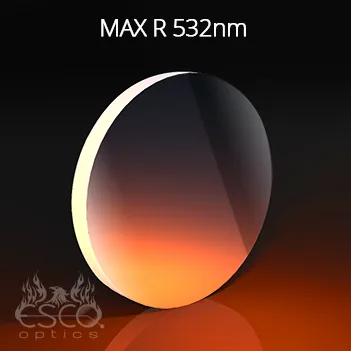
Borofloat 33 Mirror, MAX R 532 nm
Who should use this approach
Best for
- Laboratory setups with 532 nm pulsed or CW lasers under 10 W
- Industrial laser steering where high reflectivity and durability are critical
Not for
- Broadband or multi-wavelength applications where a dielectric broadband mirror or metal reflector is more practical