Quick answer
For beam expander setups, choose a vibration isolation table that matches the expander's footprint and provides passive isolation legs. The 4.3 m x 1.5 m table with a dedicated hole pattern for mounting is a practical choice for 24-inch beam expanders.
Why table size and hole pattern matter
Beam expanders, especially large aperture models like a 24-inch unit, require a table that accommodates their physical length and provides a stable mounting interface. A table that is too short or lacks the correct hole pattern forces you to adapt with custom brackets, adding cost and alignment risk.
The 4.3 m x 1.5 m vibration isolation table includes a dedicated hole pattern for mounting a beam expander (BEX), but the rest of the table surface is unholed. This is a deliberate design: it gives you a secure mounting zone for the expander while leaving the rest of the table as a clean work surface for other equipment.
Passive isolation legs: a trade-off
Passive isolation legs are simpler and more reliable than active systems for most optical metrology labs, but they have a fixed resonance frequency. If your lab floor has low-frequency vibrations (below about 2 Hz), passive legs may not fully isolate them. For typical lab environments, however, they provide excellent damping without the complexity of active control.
The table includes eight passive isolation legs and a valve kit for inflation. This setup is effective for beam expander work where the primary vibration sources are building-borne (e.g., HVAC, foot traffic).
Decision rules for choosing a beam expander table
- Match table length to expander length: Measure the total length of your beam expander (including any mounts) and add at least 300 mm on each end for clearance and alignment. A 4.3 m table suits expanders up to about 3.7 m long.
- Check the hole pattern compatibility: If your beam expander has a specific bolt pattern, verify that the table's dedicated mounting zone matches it. The 4.3 m x 1.5 m table has a hole pattern for BEX mounting; for other expanders, you may need an adapter plate. If your expander's footprint differs, plan for a custom adapter plate.
- Evaluate isolation leg type: Passive isolation legs are sufficient for most labs. If your floor has persistent low-frequency vibration (e.g., near heavy machinery), consider active isolation or a pneumatic upgrade. The included valve kit allows you to adjust leg pressure. Test your lab floor vibrations before finalizing the leg type.
- Consider future flexibility: An unholed table surface (except for the expander zone) lets you reposition other optics without drilling. If you anticipate frequent reconfiguration, this design is advantageous.
Product facts
-
Vibration Isolation Table , 4.3 m x 1.5 m, for Beam Expander: Includes 4.3 m x 1.5 m vibration isolation table, (8) passive isolation legs, and valve kit for isolation legs. Hole pattern for mounting BEX, but the rest of the table does not have holes. This table is purpose-built for a 24-inch beam expander, providing a dedicated mounting zone while leaving the rest of the surface unholed for flexible lab use.
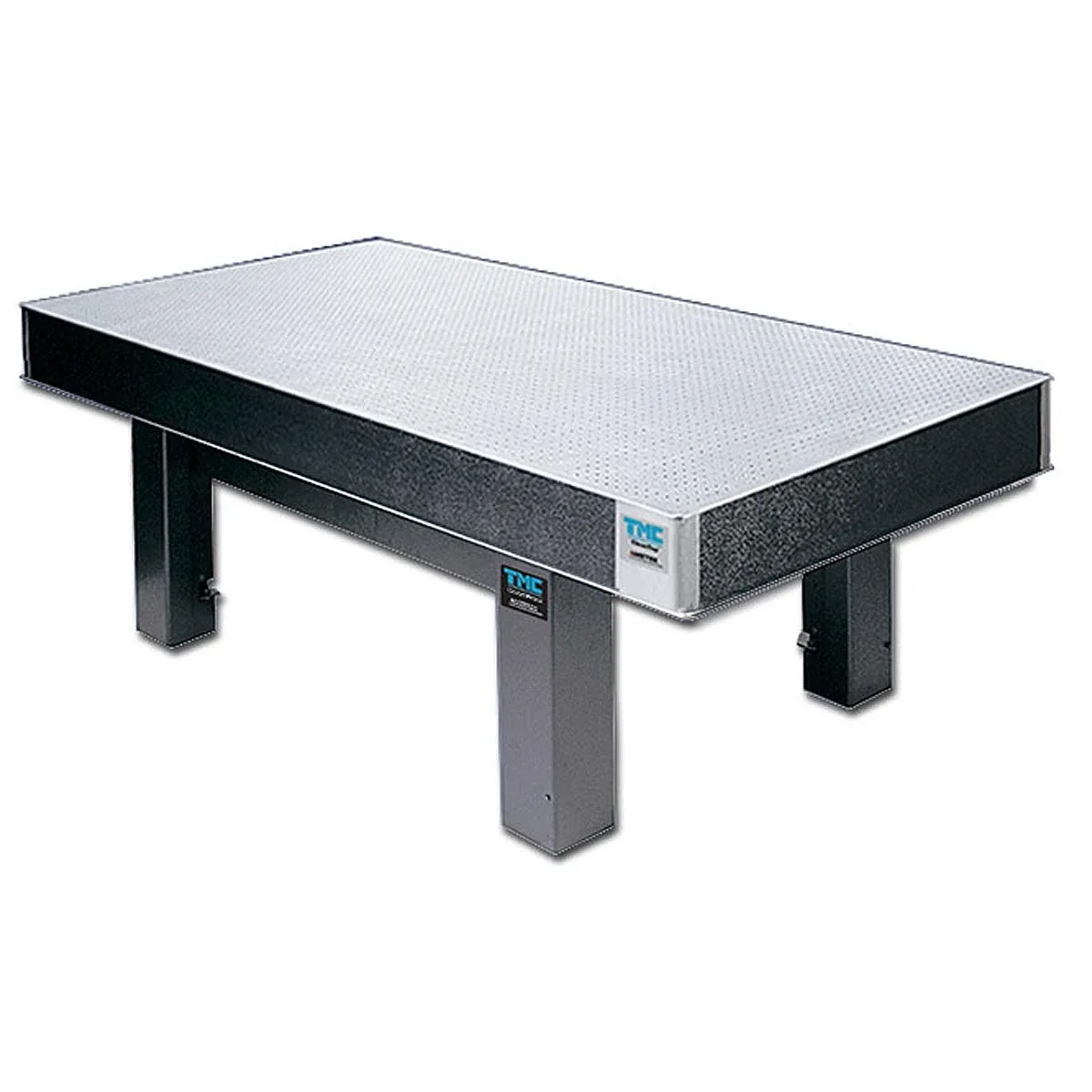
Vibration Isolation Table , 4.3 m x 1.5 m, for Beam Expander
Who this table is for
Best for
- Labs using a 24-inch beam expander that needs a dedicated mounting zone
- Users who want a clean, unholed table surface for other optical components
Not for
- Applications requiring a fully holed table surface for dense component mounting
- Labs with severe low-frequency floor vibrations that need active isolation