Quick answer
Magnetic tiles are a smart STEAM toy investment, but not because they teach coding or physics lessons. Their value comes from open ended play: kids build, test, fail, and rebuild, which is exactly how early STEAM thinking develops. The marketing language around STEAM toys often oversells what any single toy can do. Here are five common claims, with honest verdicts.
Myth 1: Magnetic tiles teach real engineering
Verdict: Partly true, but not in the way the label suggests. Magnetic tiles do not teach formal engineering concepts like load calculations or structural analysis. What they do teach is spatial reasoning and cause-and-effect: a tall tower falls if the base is too narrow, a bridge needs support in the middle, and a ramp changes how a ball rolls. That is engineering thinking in its earliest form. The difference is that the child discovers these rules by building, not by being instructed. A set like the House 28 Piece Set includes unique door and staircase pieces, which introduce simple architectural ideas like entryways and level changes without any lesson plan.
Myth 2: More pieces always mean more learning
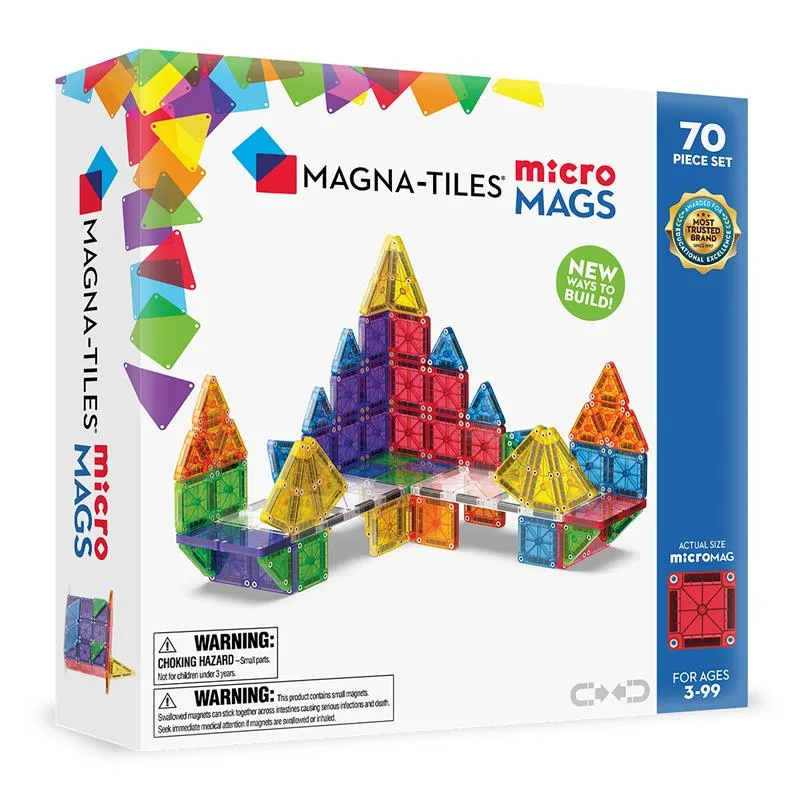
Verdict: False. Piece count is a poor proxy for educational value. A 100-piece set does not automatically teach more than a 28-piece set. What matters is how the pieces invite different kinds of play. The microMAGS 70 Piece Set is a useful counterexample: its pieces are 75% smaller than traditional MAGNA-TILES, so the building challenge shifts from large-scale structures to detailed, portable creations. That constraint can actually deepen focus and fine motor work. The honest tradeoff is that smaller pieces are harder for very young children to handle, and they can be easier to lose. More pieces help only when they add a new building possibility, not just volume.
Myth 3: STEAM toys need to be high-tech
Verdict: False. A toy does not need batteries, screens, or sensors to support STEAM learning. Magnetic tiles are a low-tech tool that supports the same core skills: observing, predicting, testing, and revising. The Rail Racers Max 80 Piece Set is a good example. It includes trapdoor tiles, curved and short track pieces, quarter arcs, and classic tiles, so kids can experiment with height, momentum, and cause-and-effect by building multi-level raceways and ball runs. There is no app and no instruction manual required. The learning comes from adjusting the track when the ball flies off. That is real experimentation, just without a screen.
Myth 4: Open ended play means no guidance is needed
Verdict: Misleading. Open ended play benefits are real, but they do not mean adults should disappear. Younger children often need a starting point: a suggested goal, a challenge, or a model to copy. Without any scaffolding, some kids build the same simple shape repeatedly and miss the broader possibilities. The practical move is to offer a prompt, not a prescription. Ask a child to build a house with a working door, or a track that makes a ball turn twice. Then step back and let them solve it. The House 28 Piece Set supports this approach because it includes reusable stickers with 20 home-related images, which can spark a specific building idea without dictating the whole build.
Myth 5: Magnetic tiles are only for young children
Verdict: False, but the play changes with age. The same tiles that a four-year-old stacks into a tower become a material for a ten-year-old building a working ball run or a multi-room floor plan. The microMAGS 70 Piece Set is explicitly designed to combine with every MAGNA-TILES set, so older kids can expand existing builds rather than start over. The limitation is that the complexity comes from the child, not the toy. A bored older child will not suddenly become engaged because the box says STEAM. The tiles reward curiosity and experimentation; they do not manufacture it.
Verdicts on common STEAM toy claims
- Magnetic tiles teach engineering: They teach spatial reasoning and cause-and-effect, not formal engineering concepts. Verdict: Partly true
- More pieces mean more learning: Piece count matters less than whether new pieces add new building possibilities. Smaller pieces can deepen focus but are harder for young children to handle. Verdict: False
- STEAM toys need to be high-tech: Low-tech tools like magnetic tiles support the same core skills: observing, predicting, testing, and revising. Verdict: False
- Open ended play needs no guidance: Prompts and challenges help younger children discover possibilities they might otherwise miss. Scaffold, then step back. Verdict: Misleading
- Magnetic tiles are only for young children: The play changes with age, but the complexity comes from the child. The tiles reward curiosity; they do not manufacture it. Verdict: False
Sets that match the STEAM claims
- House 28 Piece Set: The House 28 Piece Set includes unique door and staircase pieces plus a sheet of reusable stickers with 20 home-related images. The door and staircase introduce simple architectural thinking, while the stickers give younger builders a concrete starting idea without dictating the whole build.
- microMAGS™ 70 Piece Set: microMAGS pieces are 75% smaller than traditional MAGNA-TILES pieces and combine with every MAGNA-TILES set. Smaller pieces shift the challenge toward fine motor control and detailed builds, and the cross-compatibility means they add new possibilities to a collection instead of replacing it.
- Rail Racers Max 80 Piece Set: Rail Racers Max 80 Piece Set includes trapdoor tiles, curved and short track pieces, quarter arcs, and classic tiles. These pieces let kids test height, momentum, and cause-and-effect by building multi-level raceways and ball runs, which is hands-on experimentation rather than a scripted lesson.