Quick answer
Measure your dog's neck snugly with a soft tape, then add 2 inches (5 cm) for comfort. Compare that total to the collar's listed adjustment range. Buy the size whose range includes your dog's neck measurement plus the 2-inch allowance. If your dog is between sizes, size up.
Why the collar's adjustment range matters more than the size label
A dog collar sizing chart usually shows a size name (S, M, L) and an adjustment range in inches or centimeters. The range is the real guide. A collar only fits safely when your dog's neck measurement falls inside that range, not at the very edge. If your dog measures 15 inches, a collar that adjusts from 14 to 17 inches will fit, but a collar that adjusts from 15 to 18 inches will be tight at the smallest hole and leave no room to grow or for a winter coat. Always check the range, not just the letter.
What you need before you measure
Use a soft fabric tape measure. If you don't have one, use a piece of string or a shoelace, then lay it flat against a ruler. You'll also want a pen and paper to write down the number. Treats help keep your dog still. Measure at the middle of the neck, not right behind the ears and not down at the shoulders. For dogs with thick fur, measure over the fur but not so tight that you compress it.
How to measure your dog's neck in three steps
First, stand or kneel beside your dog and loop the tape around the middle of the neck. Second, pull it snug enough that it touches the fur but doesn't dig in. You should be able to slide one finger under the tape. Third, read the number where the tape meets. Write it down. Repeat the measurement once to check for accuracy. If the two numbers differ by more than half an inch, measure a third time and use the average.
How to read a dog collar sizing chart without guessing
Once you have your dog's neck measurement, add 2 inches for comfort and movement. That total is your target collar circumference. Find the size on the chart whose adjustment range includes that target. For example, if your dog measures 16 inches, your target is 18 inches. A collar that adjusts from 17 to 20 inches will fit well. A collar that adjusts from 14 to 17 inches would be too tight. If your target falls exactly on the boundary between two sizes, choose the larger size. You can always tighten a larger collar, but you cannot stretch a smaller one.
Check the fit after the collar arrives
Put the collar on your dog and adjust it so you can fit two fingers between the collar and the neck. It should be snug enough that it won't slip over the head, but loose enough that it doesn't pinch. Watch your dog walk, sit, and lie down. The collar should stay in place without riding up or causing your dog to scratch. If you see redness or bald spots, the collar is too tight. If it slides off during a walk, it's too loose. A proper fit is a balance.
Step-by-step: measure once, fit right
- Measure the middle of the neck: Loop a soft tape around the middle of the neck, not behind the ears. Pull snug but not tight. You should fit one finger under the tape. Common mistake: measuring too high or too low. Checkpoint: the tape sits where a collar naturally rests.
- Add 2 inches for comfort: Take your neck measurement and add 2 inches (5 cm). This gives room for breathing, movement, and a thick coat in winter. Write down the total. Common mistake: skipping the allowance, which leads to a collar that's too tight. Checkpoint: your target number is neck + 2 inches.
- Match your target to the collar's adjustment range: Look at the sizing chart for the collar you want. Find the size whose range includes your target number. If your target is at the edge, size up. Common mistake: buying by breed or weight alone. Checkpoint: your target number is inside the range, not on the boundary.
- Test the fit on your dog: Put the collar on and adjust it so two fingers fit between the collar and the neck. Watch your dog move. The collar should not slip or pinch. Common mistake: leaving it too loose so it slides off. Checkpoint: two fingers fit, and the collar stays in place during a short walk.
Collars built for real-world fit and easy care
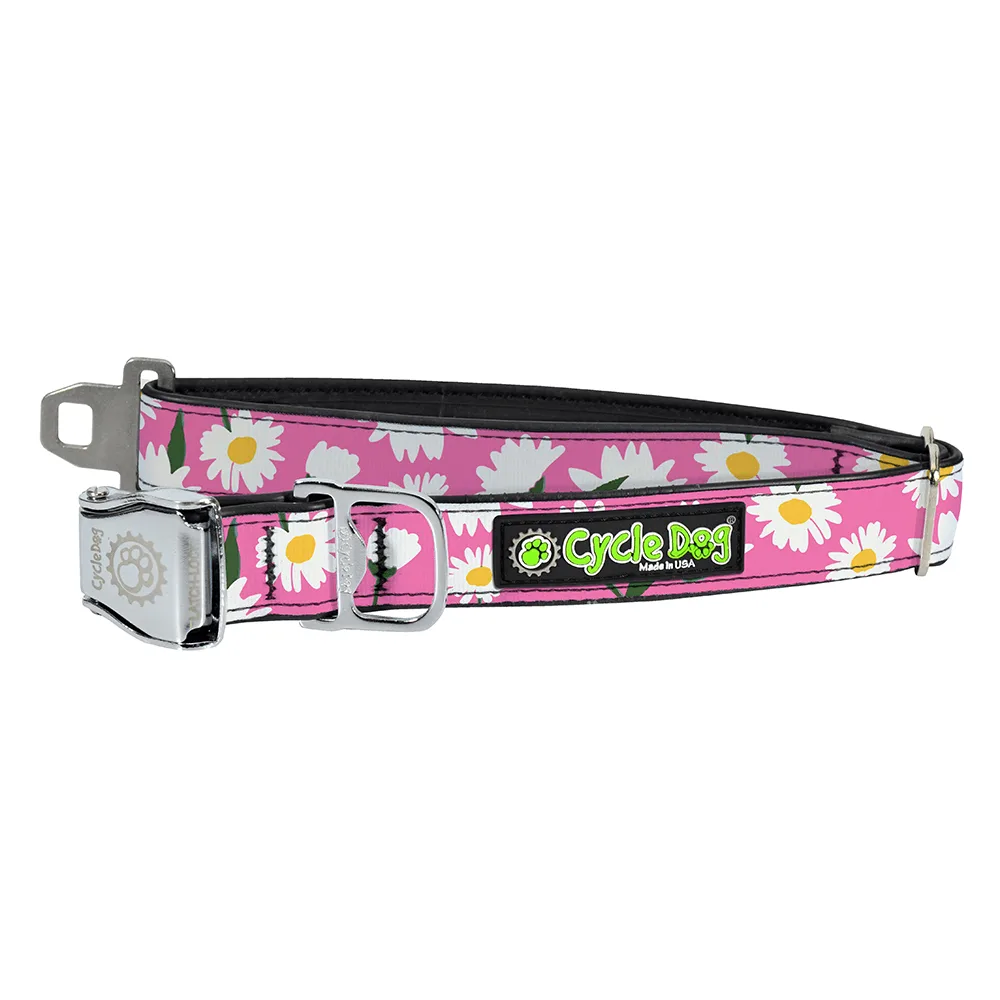
- Daisy Dog Collar: Daisy Dog Collar is made in USA and handcrafted in Portland, Oregon, with a waterproof, no-stink upcycled backing and a Latch-Lock metal buckle. The waterproof backing means you can measure once and not worry about the collar shrinking or holding odor after swims or rainy walks. The metal buckle stays secure, so the fit you set stays put.
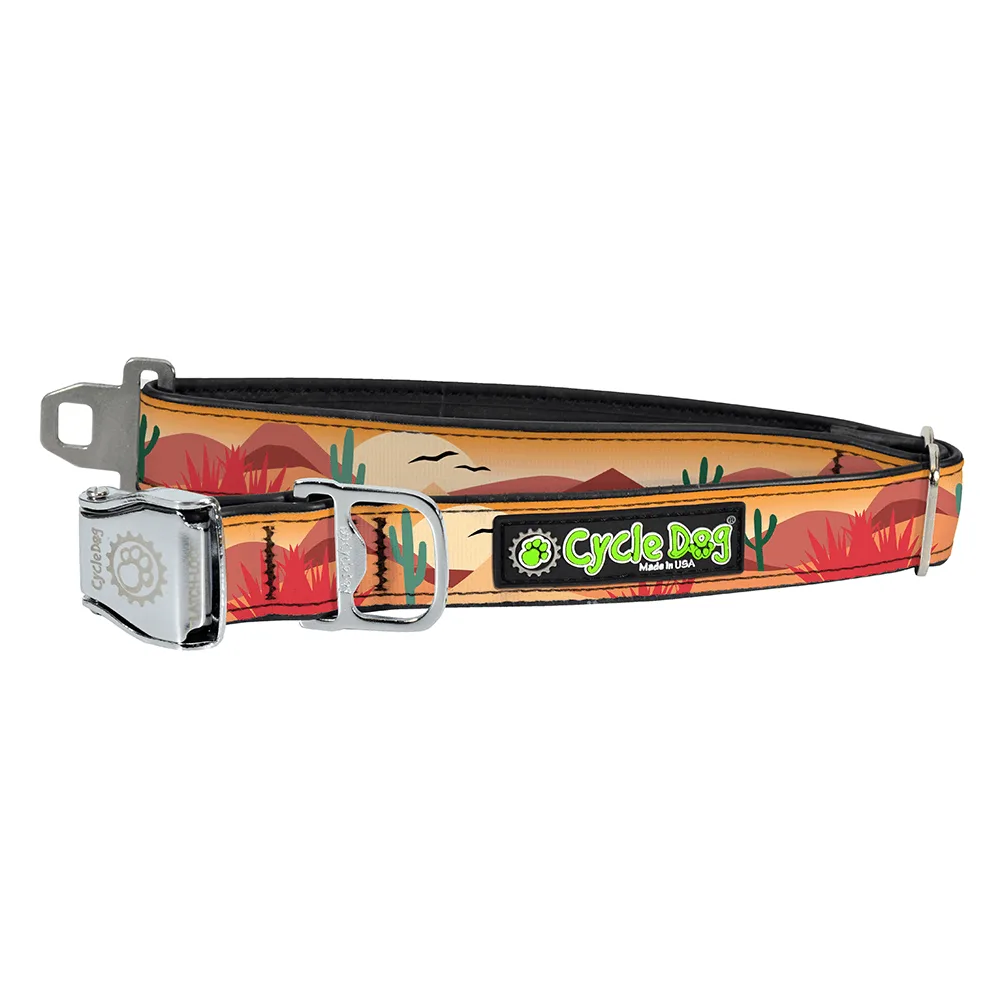
- Desert Landscape Dog Collar: Desert Landscape Dog Collar has the same no-stink, waterproof upcycled backing, is made in USA, and includes a leash attachment that doubles as a bottle opener. The bottle opener adds a practical extra for outings, and the waterproof material means the collar won't stretch or get smelly, so your sizing stays accurate over time.