Quick answer
Buy from brands that publish where their lingerie is made and what it is made from, and treat vague words like "ethical" or "green" without a named factory, certification, or material percentage as marketing rather than proof. If a listing gives you fabric content, care instructions, and a traceable supply chain, that transparency is the strongest signal you can act on before you buy.
Lingerie is one of the hardest categories to shop ethically because the garments are small, the fabrics are complex, and most production happens far from the label. A bra can contain a dozen components from several suppliers, which makes a single "ethical" badge almost meaningless on its own.
The good news is that you do not need a perfect supply chain to make a better choice. You need a few concrete questions, a way to read claims, and a sense of which trade-offs matter for the pieces you actually wear. This guide gives you decision rules for ethical lingerie manufacturing, plus fit guidance so the set you choose still works on your body.
What ethical lingerie manufacturing actually covers
Ethical lingerie manufacturing usually refers to three separate things: how workers are treated in the factory, what the garment is made from, and how long it lasts. A brand can be strong on one and weak on another. A set sewn in a well-audited factory can still use virgin synthetic lace, and a set made from recycled fabric can still come from a supply chain nobody can trace.
That is why the most useful question is not "is this brand ethical?" but "what does this brand disclose?" Named factories, published audits, fiber percentages, and repair or take-back programs are all checkable. Slogans are not. When you compare two similar sets, weigh disclosure first, then materials, then longevity.
- Look for a named factory or region, not just "imported."
- Fiber percentages (for example, 90% nylon / 10% spandex) tell you more than the word "luxe."
- Care instructions are part of ethics: a set you can hand wash and keep for years replaces several cheap ones.
How to read factory and labor claims without getting fooled
Factory conditions are the part shoppers worry about most and can verify least. Third-party social audits, living-wage commitments, and published supplier lists are meaningful because they can be checked and compared year to year. A single certificate on a homepage is weaker, because it may cover only one facility or one product line.
A practical test: search the brand name plus "supplier list" or "factory" and see whether anything comes up beyond a marketing page. If a brand sells bridal, boudoir, and plus-size lingerie, ask whether its plus-size lines are made in the same facilities as its straight-size lines, since extended sizing sometimes moves to different, less transparent production.
- Prefer brands that update their supplier or factory information at least once a year.
- Ask customer service directly which factory made a specific style; a clear answer is a good sign.
- Be cautious of any claim that cannot be tied to a named facility, region, or certification body.
Materials: what sustainable lingerie production can and cannot promise
Most lingerie relies on elastane for stretch, and elastane is difficult to recycle, so no set is fully circular today. Sustainable lingerie production tends to focus on reducing virgin material, using recycled nylon or polyester where possible, and choosing dyes and finishes with lower impact. Those are real improvements, but they are incremental.
Durability is the most underrated ethical material choice. A well-constructed set worn for years has a lower impact per wear than a fragile one replaced every season. When you compare options, check whether straps are adjustable, whether hardware is metal rather than plastic, and whether the fabric content is listed at all.
- Recycled synthetics reduce virgin material use but still shed microfibers when washed; use a wash bag.
- Natural fibers like cotton and silk have their own water and land trade-offs, so there is no automatic winner.
- If a listing hides fiber content entirely, treat that as a red flag rather than a neutral detail.
Fit guidance: ethical choices still have to fit
A set that does not fit gets returned, resold, or abandoned, which wastes the resources that went into it. Fit is therefore part of the ethics conversation, not separate from it. Start with your underbust and hip measurements rather than your dress size, because lingerie sizing varies widely between brands and styles.
Adjustability is your friend. Side ties, hook-and-eye closures, and adjustable straps let one piece cover a range of bodies and stay comfortable through weight changes. For plus-size shoppers especially, a style offered in a genuine size range with adjustable components will outlast a fixed-size piece that only roughly fits.
- Measure underbust and fullest hip, then compare to the brand's own size chart, not your jeans size.
- Prefer adjustable straps, side ties, or hook closures over fixed elastic.
- If you are between sizes, size for the larger measurement and adjust down where the design allows.
Where price and ethics actually diverge
Higher price does not guarantee ethical production, and lower price does not automatically mean poor conditions. What price usually buys is better materials, more construction steps, and more room in the supply chain for audits and fair wages. A discount set can still come from a decent factory; the problem is that you often cannot tell from the listing.
The practical move is to spend where it matters. Bridal and boudoir pieces worn repeatedly justify more research and a higher budget. Trend-driven pieces worn a few times are better bought from brands that at least disclose materials and care, so you can keep them in rotation longer.
- Compare cost per wear, not sticker price, for anything you plan to wear more than twice.
- Ask whether the brand offers repairs, replacements, or clear care guidance.
- Treat steep discounts as a prompt to check disclosure, not an automatic disqualifier.
Decision rules for buying ethical lingerie
- Rule 1: Disclosure beats adjectives: If a listing names the fabric content, the care method, and where it was made, it passes the first test. If it only says "premium" or "ethical," ask customer service for specifics before you buy. No disclosure, no purchase, unless the piece is a low-stakes trend buy.
- Rule 2: Match the budget to the wear count: Spend more research and money on bridal, boudoir, and plus-size pieces you will wear repeatedly. For occasional or novelty sets, prioritize material disclosure and easy care over certification logos. Cost per wear is the number that matters, not the sticker price.
- Rule 3: Choose adjustability over exact sizing: Side ties, adjustable straps, and hook closures let a piece fit across small measurement changes and reduce the chance of a return. If a style is fixed-size only, size up and confirm the return policy first. A set that fits and lasts is the most sustainable set you can own.
How specific sets put these rules into practice
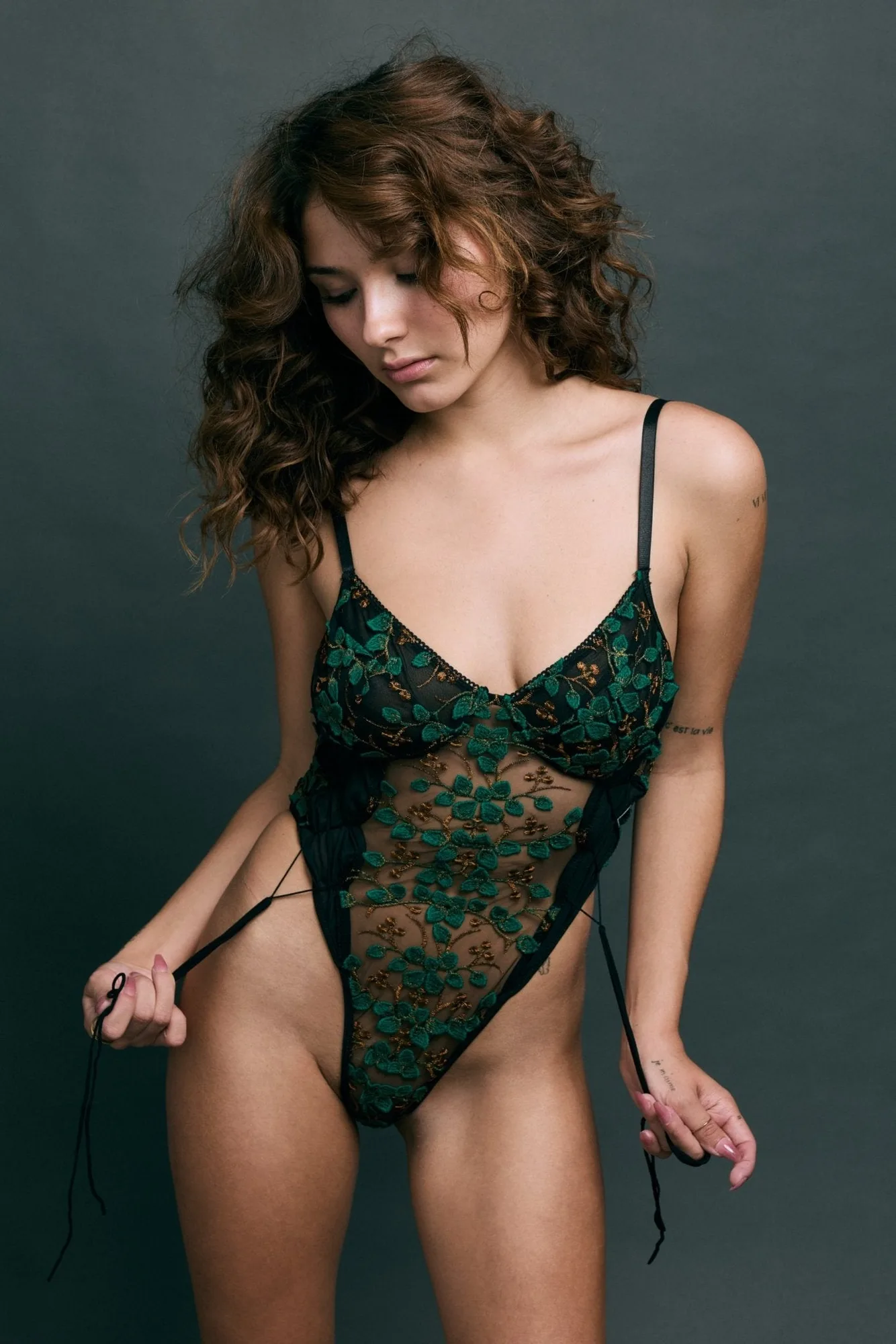
- Ivy Noir Bodysuit: A sleek black mesh bodysuit embroidered with trailing green florals, with adjustable side ties at the hips to customize the fit. Adjustable side ties are exactly the kind of design feature that extends a garment's usable range, so it fits more bodies and gets worn longer instead of being returned.
- Every Girl's Favorite Lingerie Set - Sky Blue, Burgundy, Green, & Black: A five-piece collection with a coordinated bra, thong, garters, and belt, available in four colors and multiple sizes. A multi-piece set with real color and size options is easier to keep in rotation for boudoir sessions, wedding nights, or milestones, which lowers the cost per wear compared with a single-use piece.
- "I Do" Bridal White Flower Lingerie Set: A three-piece set including a bra, thong, and belt, described as classy and romantic and suited to a wedding night or boudoir shoot. For a high-emotion purchase like bridal lingerie, it is worth confirming size availability and care instructions before buying, since the piece is likely to be kept rather than replaced.
Who this approach works for
Best for
- Shoppers who want a repeatable way to judge ethical claims instead of trusting labels
- Bridal, boudoir, and plus-size buyers who plan to wear a set more than once and want it to last
Not for
- Shoppers looking for a single certification that guarantees a fully ethical supply chain, which does not exist today
- Buyers who want the lowest possible price and are not willing to check materials, care, or factory disclosure
Ethical lingerie manufacturing is less about finding a perfect brand and more about asking better questions before you buy. Check disclosure, weigh materials against durability, and choose adjustable pieces that fit well enough to keep. That combination does more for workers and the planet than any single label.