Quick answer
Use a fine-tooth knit comb or a fabric shaver designed for delicates to remove pills, and gently pull snags back into place with a crochet hook or needle. Always wash mohair by hand in cool water with a gentle detergent to prevent future damage.
Why mohair pills and snags more than other knits
Mohair fibers are long, smooth, and loosely twisted, which gives the sweater its characteristic halo and softness. That same structure makes the surface fibers prone to tangling into pills and catching on jewelry or rough surfaces. The Cross Detail Mohair Sweater, for example, uses a blend of 8% wool, 56% acrylic, and 36% nylon — the wool adds warmth but also contributes to pilling when friction occurs.
When to stop and consider replacement
If a snag has pulled a loop that is longer than 1 cm or if the yarn is broken, home repair may not restore the original look. In those cases, a professional reweaver or a visible mending approach (like a decorative stitch) is a better option. Pilling alone is never a reason to replace — it is a cosmetic issue that can be managed.
Diagnose and fix pilling and snags
- Symptom: Small fuzzy balls (pills) appear on the surface, especially under arms, on sleeves, or where the sweater rubs against a bag or seat.
- Likely cause: Friction from normal wear — the loose mohair fibers tangle into pills. Washing in a machine or using a harsh detergent accelerates this.
- Corrective action: Lay the sweater flat. Use a fine-tooth knit comb or a fabric shaver on low setting to gently lift pills. For snags: use a crochet hook or blunt needle to pull the loose yarn loop to the inside of the sweater, then gently stretch the area to redistribute the tension. Always test the tool on an inconspicuous area first.
- Stop or choose another option: If the snag is longer than 1 cm or the yarn is broken, stop home repair. Take the sweater to a professional reweaver or use visible mending (e.g., a small embroidery stitch) to turn the snag into a design feature. Broken yarn cannot be invisibly fixed at home.
Product mentioned in this guide
-
Cross Detail Mohair Sweater: Fabric composition: 8% Wool, 56% Acrylic, 36% Nylon. Features a distressed design and raw edge hem. The wool content adds warmth but also increases pilling potential; the distressed design means some texture is intentional, so you can focus repairs on actual snags rather than the raw edges.
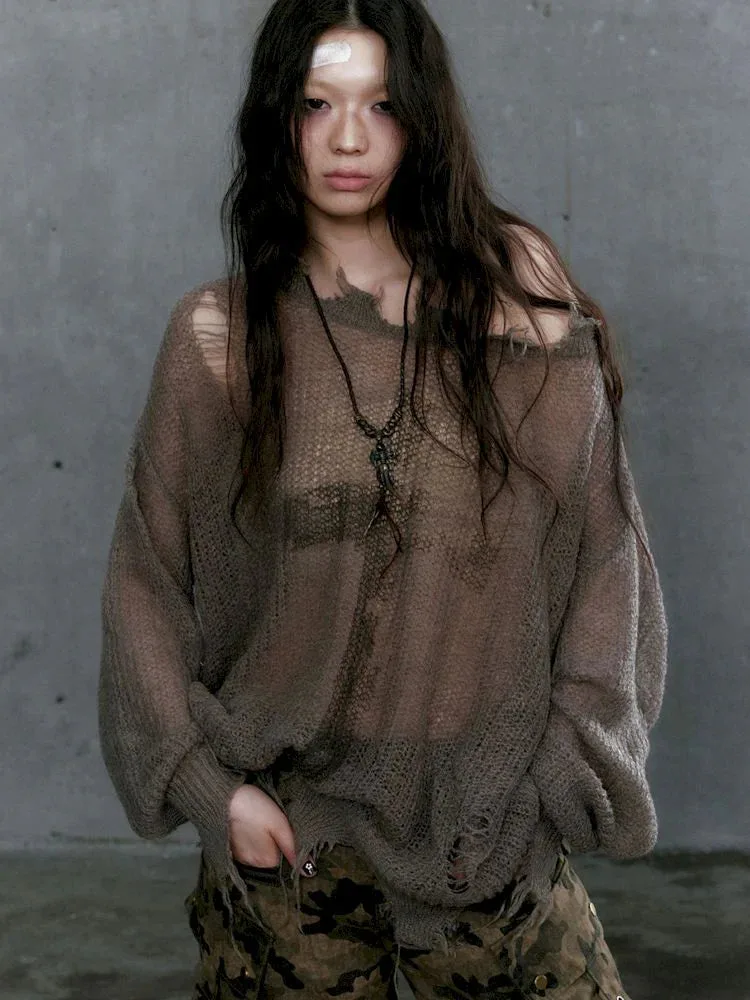
Cross Detail Mohair Sweater