Quick answer
Use DJECO Topanifarm nest and stack blocks for shape sorting by counting the printed objects, stacking big to small, and turning each block into a home for the six friendly animals.
Why nest and stack blocks work for shape sorting
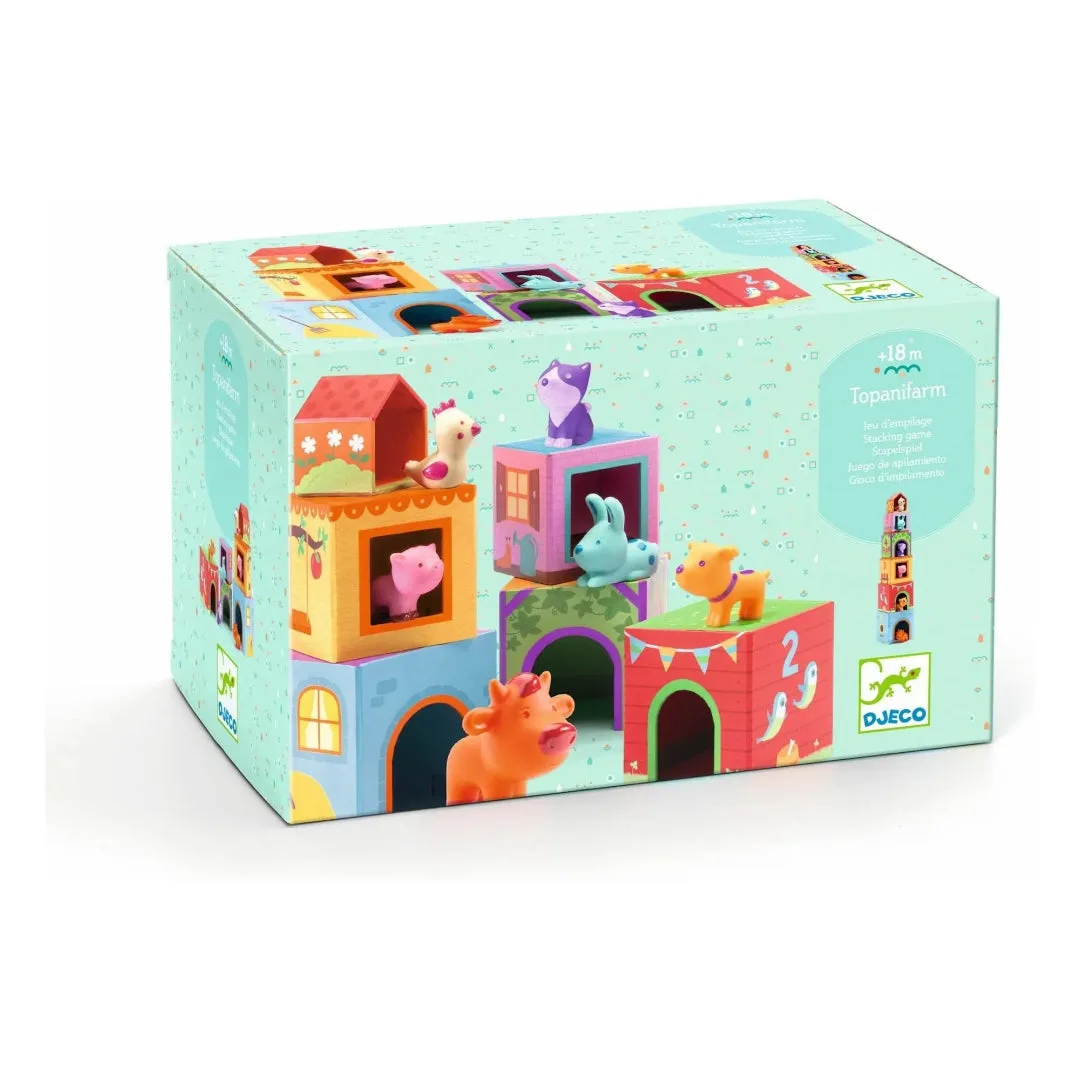
Nest and stack blocks are a classic early learning toy because they combine multiple skills in one simple activity. The DJECO Topanifarm set includes vibrant blocks that stack or nest big to small, and each block features a number and objects to count—like one sunflower for the cow and two birds for the dog. This design naturally invites toddlers to sort by size, count objects, and match animals to their homes.
Unlike single-purpose shape sorters, these blocks also support open-ended play. Once your child masters stacking, they can use the blocks as little houses, build towers, or line them up as a train. That flexibility keeps the toy engaging as your child grows.
Trade-offs and how to adapt
The blocks are made of sturdy cardboard, so they are lightweight and easy for small hands—but they are not as durable as wooden blocks. Avoid letting your toddler chew on them, and supervise play to prevent crushing. If your child is very rough with toys, you might reserve these blocks for guided activities rather than free-for-all play.
Also, the set focuses on counting and animal matching rather than traditional geometric shape sorting (like circles and squares). To extend the learning, you can point out the shapes on the printed scenery, such as the round sunflowers or the triangular trees.
5 playful shape sorting activities with DJECO Topanifarm
- Start with nesting big to small: Show your child how to nest the blocks from largest to smallest. Say the numbers aloud as you go. Common mistake: letting your child force a block into the wrong size opening—gently guide them to try another orientation or block. Check that your child can nest at least three blocks correctly before moving on.
- Count the objects on each block: Point to the printed objects (sunflowers, birds, apples, etc.) and count them together. For example, say 'One sunflower for the cow, two birds for the dog.' Common mistake: rushing through the count—let your child touch each object as you count. If your child can count up to three, extend by asking 'How many apples?' without pointing.
- Match animals to their homes: Name the six animals and ask your child to find the block that shows that animal. Then place the animal inside its 'home' block. Common mistake: assuming your child knows the animal names—introduce them first with a picture book or toy. Once your child matches all six, switch roles and let them give you the instructions.
- Build a tower and knock it down: Stack the blocks from largest at the bottom to smallest on top. Count each level as you build. Common mistake: stacking out of order—use visual cues like the size of the base to guide your child. Let your child knock the tower down safely; this helps with cause-and-effect learning.
- Create open-ended scenarios: Use the blocks as little houses for toy animals or as parts of a pretend farm. Ask questions like 'Where does the pig live?' or 'Can you build a fence?' Common mistake: limiting play to only stacking—encourage free exploration. Observe what your child invents; this shows you what skills they are practicing.
Product spotlight
-
DJECO- Topanifarm Nest and Stack Blocks: The vibrant blocks stack or nest big to small, and each acts as a little home for one of six friendly animals, with playful scenery plus numbers and objects to count. This design lets you combine shape sorting, counting, and imaginative play in one activity, making it a versatile early learning toy.
DJECO- Topanifarm Nest and Stack Blocks