Quick Answer
Fused quartz coverslips suit applications needing UV transparency and thermal stability, but they cost more and require gentler handling than standard glass. Choose thickness based on your objective's working distance and sample constraints.
Why choose fused quartz over glass?
Standard glass coverslips block UV light and can introduce fluorescence, which is a problem for UV microscopy and certain spectroscopy. Fused quartz transmits deep into the UV and has very low autofluorescence, making it the preferred choice for these techniques.
The trade-off is cost and fragility. Quartz is more expensive than glass and more brittle, so you need to handle it with care. For routine visible-light work, glass is often sufficient and more economical.
How thickness affects your microscopy
Coverslip thickness is not just a physical dimension; it directly influences the optical path length and spherical aberration. Most objectives are corrected for a specific coverslip thickness, often #1.5 (0.17 mm). Using a different thickness can degrade image quality, especially at high magnifications.
Quartz coverslips are available in #0 (0.10 mm), #1.5 (0.17 mm), and #2 (0.20 mm) thicknesses. For high-resolution work, match the thickness to your objective's correction. If your objective is not coverslip-corrected, a thinner coverslip like #0 can minimize aberrations.
Common Questions
How do I clean a fused quartz coverslip?
Use a lint-free wipe or optical tissue. Clean with a solvent like acetone or methanol, then gently wipe in one direction. Avoid abrasive materials and ultrasonic cleaners unless you are sure they are safe for quartz. Always handle coverslips by the edges to avoid fingerprints.
Which thickness should I choose?
Check your microscope objective's specification for the recommended coverslip thickness. If not specified, choose #0 (0.10 mm) to minimize optical aberrations. For general use where thickness is not critical, #1.5 (0.17 mm) is a common standard. If in doubt, consult your objective's manual or use a thinner coverslip.
Can I reuse fused quartz coverslips?
Yes, if they are not scratched or contaminated. Clean them thoroughly after each use and inspect under a microscope for damage. Discard if any scratches or residues remain. Reuse is possible but inspect carefully to avoid compromising your results.
Products mentioned
-
Fused Quartz Coverslip #No2: Fused Quartz Coverslip #No2 has a thickness of 0.20 mm and dimensions of 22 x 40 mm. This #2 thickness is a good choice for applications requiring a slightly sturdier coverslip, but be aware it may not match objectives corrected for #1.5 thickness.
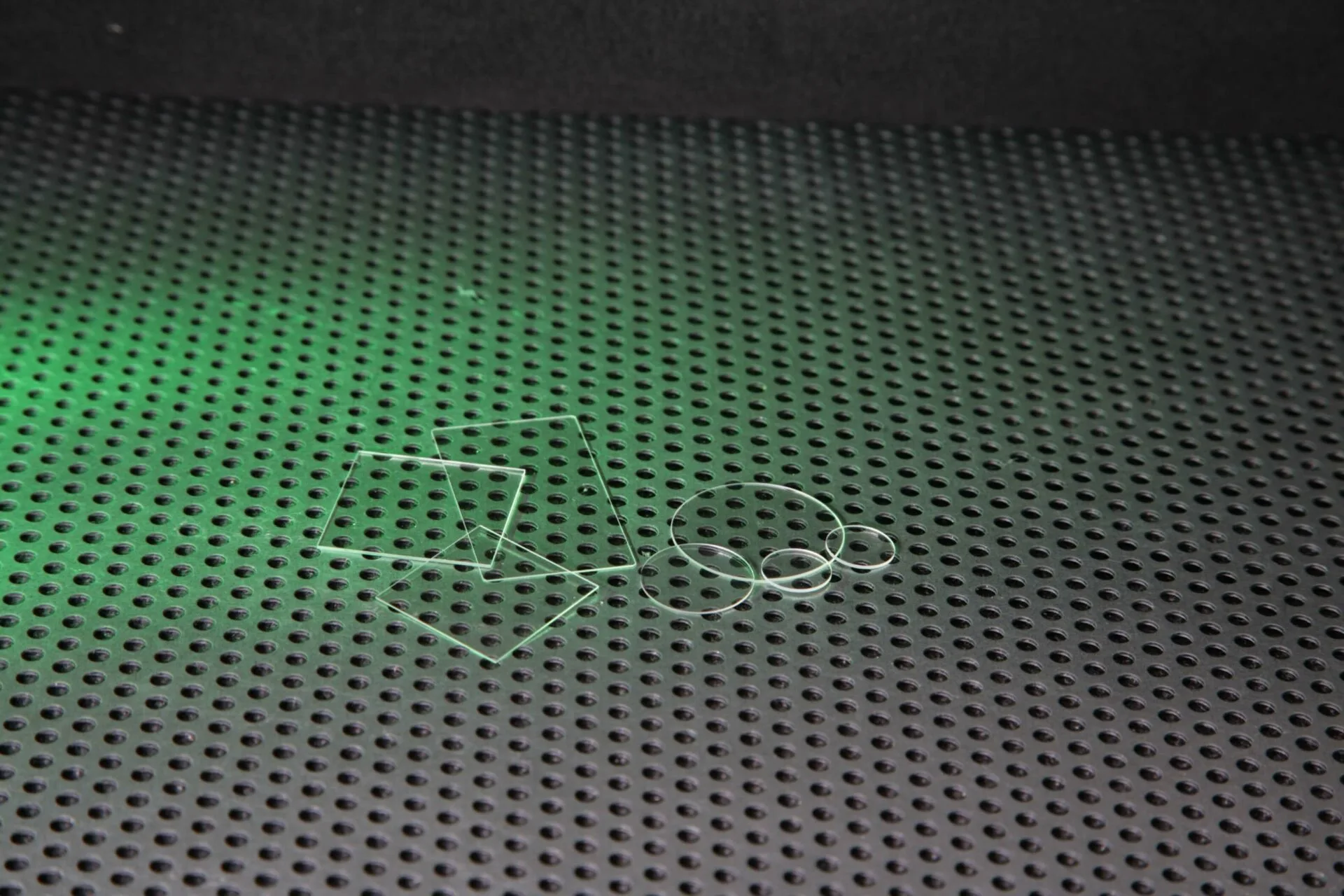
Fused Quartz Coverslip #No2
-
Fused Quartz Coverslip #No5: Fused Quartz Coverslip #No5 has a thickness of 0.50 mm and a diameter of 20 mm. The thicker #5 is more durable for handling, but it is not suitable for high-magnification microscopy due to its thickness; it is better for applications where optical correction is less critical.
Fused Quartz Coverslip #No5
-
Fused Quartz Coverslip #No0: Fused Quartz Coverslip #No0 has a thickness of 0.10 mm and dimensions of 25 x 25 mm. The #0 thickness is ideal for objectives not corrected for coverslip thickness, minimizing optical distortion at high magnifications.