Quick answer
Choose fused quartz coverslips when you need a thin, UV-transparent cover for high-clarity imaging or sealing a sample on a slide. Choose sapphire microscope slides when you need a durable, scratch-resistant 75 x 25 mm slide that can handle repeated cleaning and mechanical contact. They solve different problems, so the right pick depends on whether you are covering a sample or mounting it.
Format and thickness: coverslip vs slide
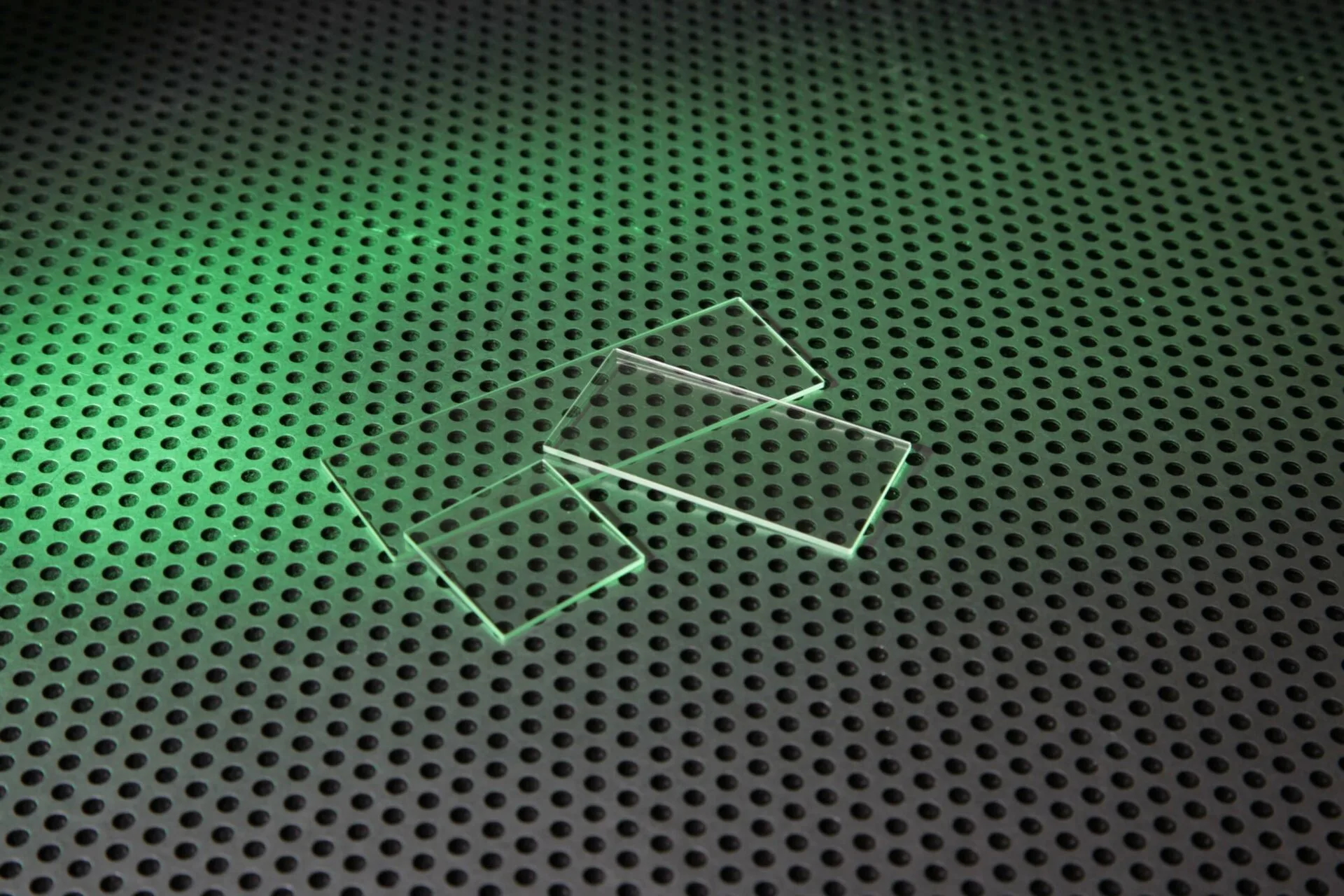
The most obvious difference is the form factor. Fused quartz coverslips are thin, small pieces designed to sit on top of a specimen. UQG Optics stocks them in No1 (0.15 mm), No2 (0.20 mm), and No5 (0.50 mm) thicknesses, with dimensions such as 25 x 25 mm or Ø 15 mm and Ø 25 mm. Sapphire microscope slides are full-size 75 x 25 mm pieces at 1 mm thickness, so they work as the base rather than the cover.
This matters for working distance and optical path. A 0.15 mm coverslip adds almost nothing to the optical path, while a 1 mm sapphire slide is a rigid platform that will not flex. If your objective has a short working distance or your method assumes a No1.5 coverslip, a thick slide is not a substitute. If you need a flat, stable surface that survives handling, a coverslip alone will not provide it.
UV and high-clarity performance
Fused quartz is chosen for UV microscopy and high-clarity coverslip work because it transmits deep into the UV without the fluorescence that some glasses show. That makes a quartz coverslip a practical choice for UV microscopy slides and for methods where background signal must stay low. Sapphire is also transparent and hard, but it is not the standard choice for UV coverslip applications; its strength and scratch resistance are the reasons to pick it.
If your protocol depends on the coverslip being the optical window, quartz gives you a thin, UV-friendly option. If your protocol depends on the slide surviving repeated cleaning and mechanical contact, sapphire gives you a surface that resists scratching better than standard glass. Do not assume one replaces the other: they sit at different points in the sample stack.
Handling, cleaning, and durability
Sapphire is extremely hard, so a sapphire microscope slide tolerates wiping and repeated cleaning that would scratch softer materials. That durability is useful when you reuse slides or when samples are manipulated directly on the surface. The trade-off is cost and rigidity: a 1 mm sapphire slide is more expensive and less forgiving of uneven mounting than a thin coverslip.
Fused quartz coverslips are thin and can chip at the edges if handled roughly, so they need careful storage and cleaning. They are not designed to be the load-bearing surface. In practice, many labs pair a quartz coverslip with a separate slide, keeping the coverslip as the optical interface and the slide as the mechanical support.
Trade-offs at a glance
- Thin quartz coverslip (No1, 0.15 mm): Minimal optical path and UV-friendly transmission, but fragile and not a load-bearing surface. Pick this when the coverslip is the optical window and the method assumes a thin cover.
- Thicker quartz coverslip (No5, 0.50 mm): More rigidity than No1 or No2, but it adds more optical path and may not suit short-working-distance objectives. Pick this when you need a sturdier quartz cover and your optics can tolerate the extra thickness.
- Sapphire microscope slide (1 mm, 75 x 25 mm): Hard, scratch-resistant, and reusable, but thicker, more expensive, and not a coverslip replacement. Pick this when the slide is the working surface and durability matters more than thinness.
Product facts
- Fused Quartz Coverslip #No1: Fused Quartz Coverslip #No1, thickness 0.15 mm, dimensions 25 x 25 mm, part numbers CFQ2557 / CFQ-2557 / CFQ 2557. The thinnest option here, so it adds minimal optical path and suits high-clarity imaging where a No1 coverslip is specified.
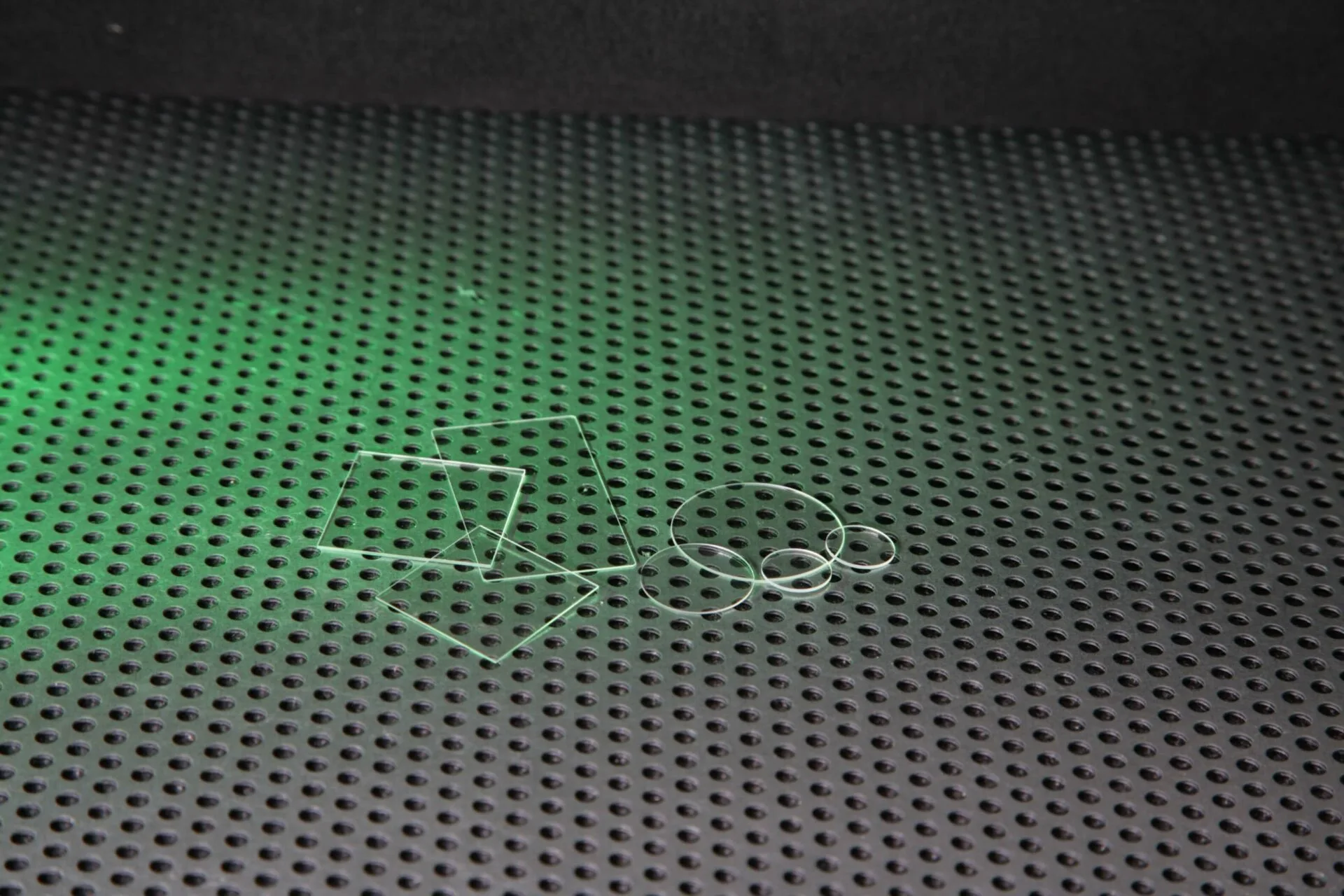
Fused Quartz Coverslip #No1
- Fused Quartz Coverslip #No2: https://uqgopticser.com/products/fused-quartz-cover-slip-no2-c57ba3596aa2f7a4817cd93c-1696556https://uqgopticser.com/products/fused-quartz-cover-slip-no2-4-b5a6ae7365ace2d4fb29ec5f-1696564https://uqgopticser.com/products/fused-quartz-cover-slip-no2-3-8dedc79854a396126b58a027-1696566Fused Quartz Coverslip #No2, thickness 0.20 mm, dimensions Ø 15 mm, part numbers CFQ1520 / CFQ-1520 / CFQ 1520. A round 15 mm coverslip works well for small wells or round mounting areas where a square coverslip would overhang.
- Fused Quartz Coverslip #No5: Fused Quartz Coverslip #No5, thickness 0.50 mm, dimensions Ø 25 mm, part numbers CFQ2555 / CFQ-2555 / CFQ 2555. The thickest quartz coverslip listed, giving more rigidity than No1 or No2 while staying far thinner than a 1 mm slide.
- Sapphire Microscope Slide: Sapphire Microscope Slide, thickness 1 mm, dimensions 75 x 25 mm, part numbers SMS7521 / SMS-7521 / SMS 7521. A full-size, hard slide that resists scratching and repeated cleaning, but it is not a thin coverslip and will not match short-working-distance coverslip methods.
Which should you choose?
Best for
- UV microscopy or high-clarity imaging where a thin, UV-transparent coverslip is required
- Sealing or covering a sample on a separate slide with minimal optical path
- Round mounting areas that suit Ø 15 mm or Ø 25 mm coverslips
Not for
- Acting as the base slide or load-bearing surface for repeated handling
- Protocols that need a full 75 x 25 mm rigid platform
- Applications where scratch resistance and reusability outweigh thinness