Quick answer
Choose fused quartz windows when you need deep UV transmission and thermal stability. Choose AR coated thin glass windows when you want to reduce visible-light reflections at a lower cost. The right choice depends on your wavelength range and budget.
Transmission and wavelength range
Fused quartz transmits well from the deep UV through the near-infrared, making it the go-to material for UV microscopy and spectroscopy. AR coated thin glass, typically borosilicate, is optimized for the visible spectrum and blocks most UV light. If your application uses UV wavelengths below 350 nm, fused quartz is the clear winner.
Reflection control and durability
AR coatings on thin glass reduce surface reflections to under 1% per surface in the visible band, which improves contrast and throughput in imaging systems. Fused quartz has a higher refractive index and reflects about 4% per surface without coating, but it is harder and more scratch-resistant than borosilicate glass. For high-vibration or outdoor setups, uncoated quartz may be more durable.
Trade-offs at a glance
- UV transmission vs visible reflection control: Fused quartz transmits UV down to 180 nm; AR coated borosilicate blocks UV but reflects less than 1% in the visible range. Use quartz for UV work; use AR coated glass for visible-light imaging.
- Durability vs optical enhancement: Uncoated fused quartz is harder and more scratch-resistant, but AR coatings are fragile and can degrade over time. Choose quartz for rugged environments; choose AR coating when maximum throughput matters.
- Cost and availability: AR coated borosilicate windows start at a lower price point and are widely stocked. Fused quartz coverslips cost more per piece, especially in larger sizes. AR coated glass fits tighter budgets; fused quartz justifies its cost for UV applications.
Product facts
- AR Visible Coating: AR Visible Coating – Borosilicate windows, plates & sheets, thickness 1.10 mm, dimensions 5 x 5 inches. This coated borosilicate window cuts visible reflections effectively and is available in a standard 5x5 inch size for easy integration into existing mounts.
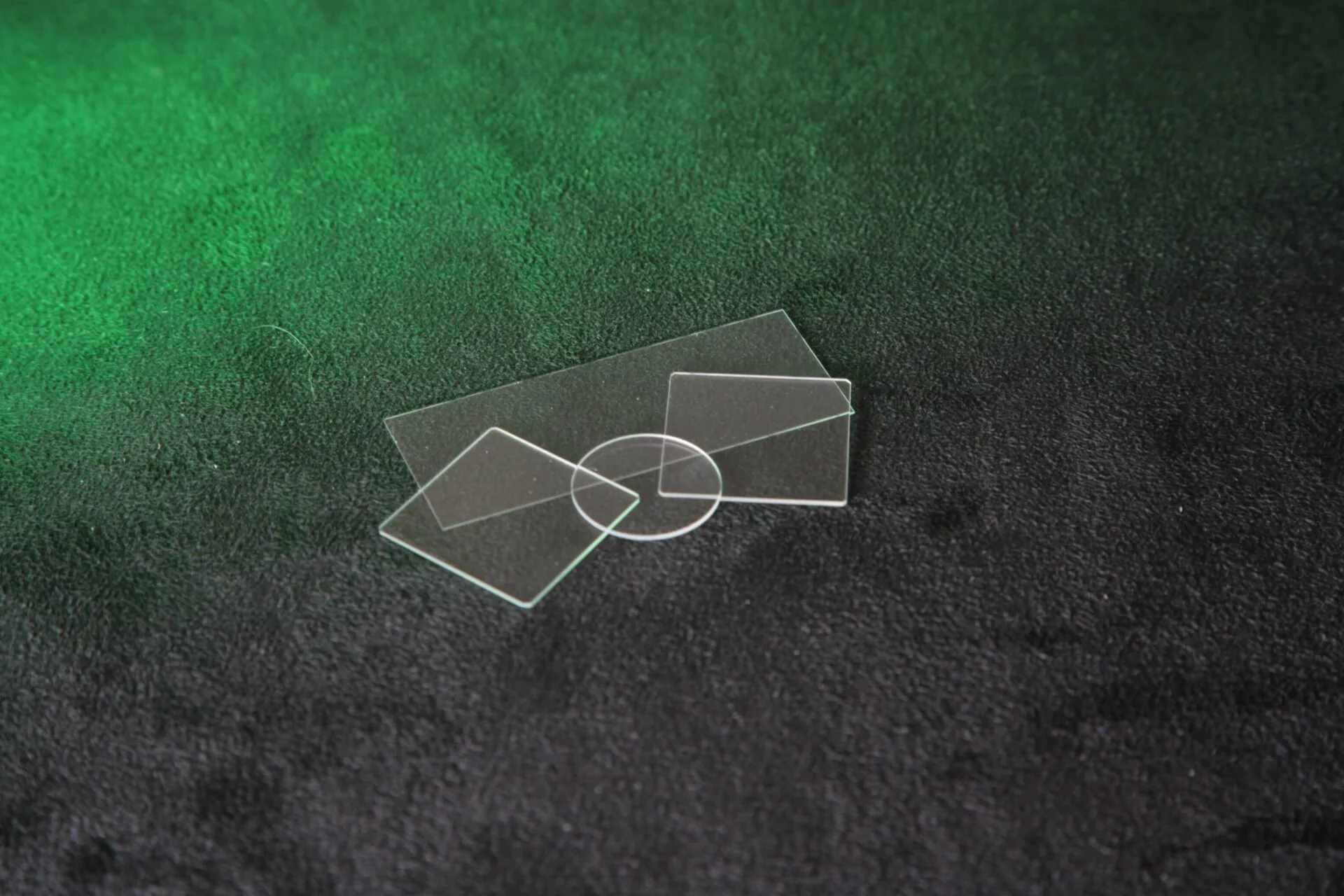
AR Visible Coating
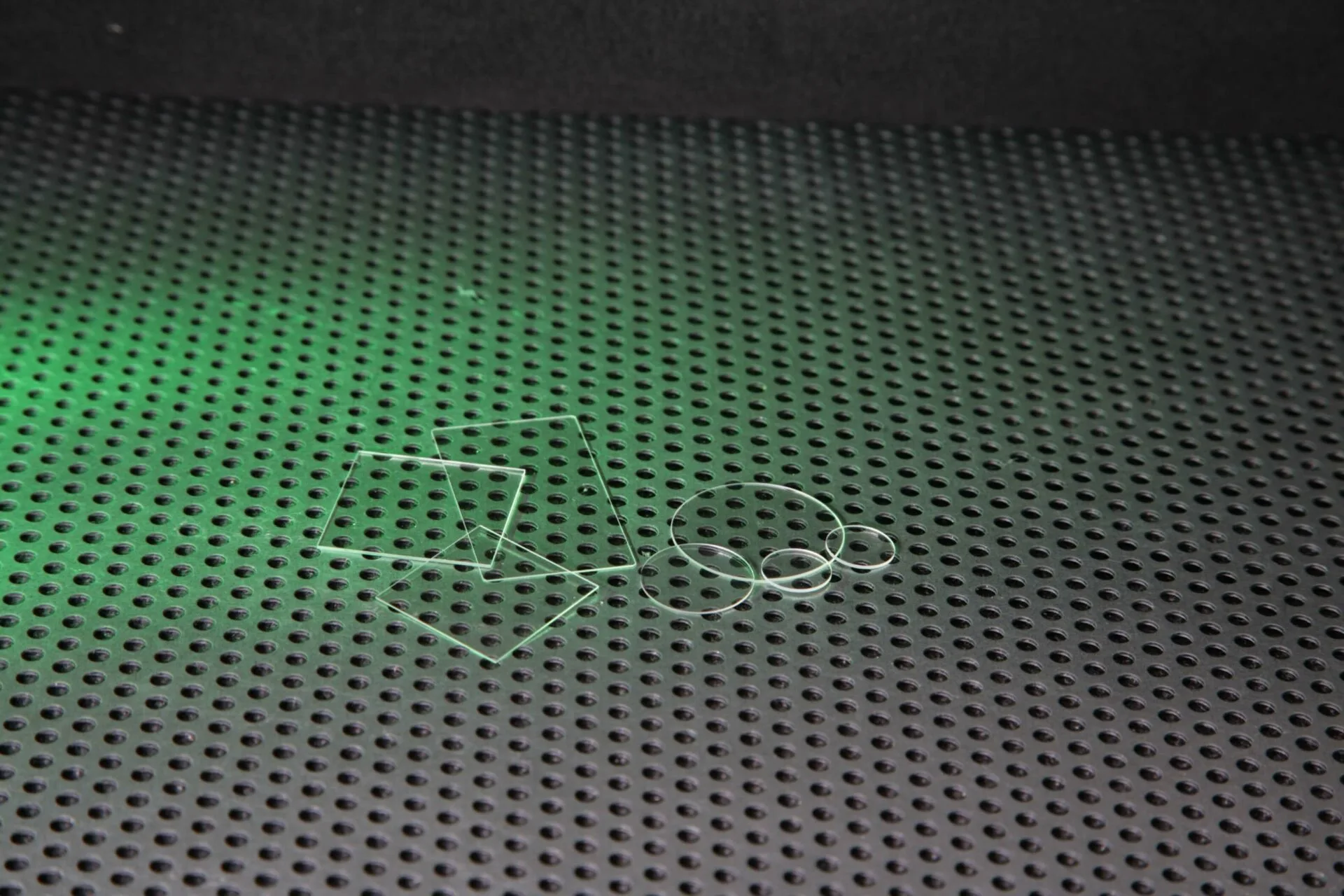
- Fused Quartz Coverslip #No5: https://uqgopticser.com/products/fused-quartz-cover-slip-no5-7-fbb34faa1181c186a2347e3c-1696552https://uqgopticser.com/products/fused-quartz-cover-slip-no5-2-aedc2c6fdb2b0374e2720230-1696553https://uqgopticser.com/products/fused-quartz-cover-slip-no5-5-772702f8cbbe05941d86e9d1-1696555Fused Quartz Coverslip #No5, thickness 0.50 mm, diameter 10 mm. The thin 0.50 mm fused quartz coverslip offers excellent UV transmission for microscopy while being thin enough to minimize spherical aberration.
Which one fits your setup?
Best for
- UV spectroscopy and fluorescence microscopy requiring deep UV transmission
- High-temperature or high-vibration environments where coating durability is a concern
Not for
- Visible-light systems where minimal reflection is critical and UV transmission is not needed