Quick answer
Choose Revell Contacta gel glue when you need extra working time to align large parts, and switch to a liquid cement for thin seams and capillary action on tight joints.
Why working time matters for large assemblies
When you are attaching a fuselage half or a wing section, the glue must stay workable long enough to adjust the fit. Gel glues like Revell Contacta do not dry instantly, so you can shift parts into perfect alignment before the bond sets. Liquid cements, by contrast, flow into seams and bond almost immediately, which is ideal for small details but unforgiving on large surfaces.
Application precision and control
Gel glue stays where you put it. The thick consistency means it will not run into unwanted areas or pool inside the model. Liquid cement, however, relies on capillary action to wick into tight joints, making it the better choice for seam lines and delicate parts where excess glue would ruin the finish. Each type demands a different technique, so the right choice depends on the specific step in your build.
Gel vs Liquid: Trade-offs at a glance
- Gel glue (e.g., Revell Contacta 13g gel): Apply a bead to one part, press together, and adjust within the open time. Best for large, visible joints where alignment is critical. Does not run into seams; requires cleaning excess before it dries.
- Liquid cement (e.g., thin capillary-action glue): Touch the brush to the seam; glue wicks into the gap by itself. Ideal for tight joints, panel lines, and small parts where precision matters. Bonds nearly instantly; no repositioning after application.
- When to combine both: Use gel for initial assembly of large sub-assemblies, then switch to liquid for final seam filling and detail work on the same model. Having both types on your bench covers every joint scenario.
Product facts
-
Revell "Contacta Glue" gel glue - 13g: Revell Contacta gel glue in a practical tube does not dry immediately, giving you time to position large model parts precisely. This extra working window is essential for aligning fuselage halves, wings, or other large components before the bond locks them in place.
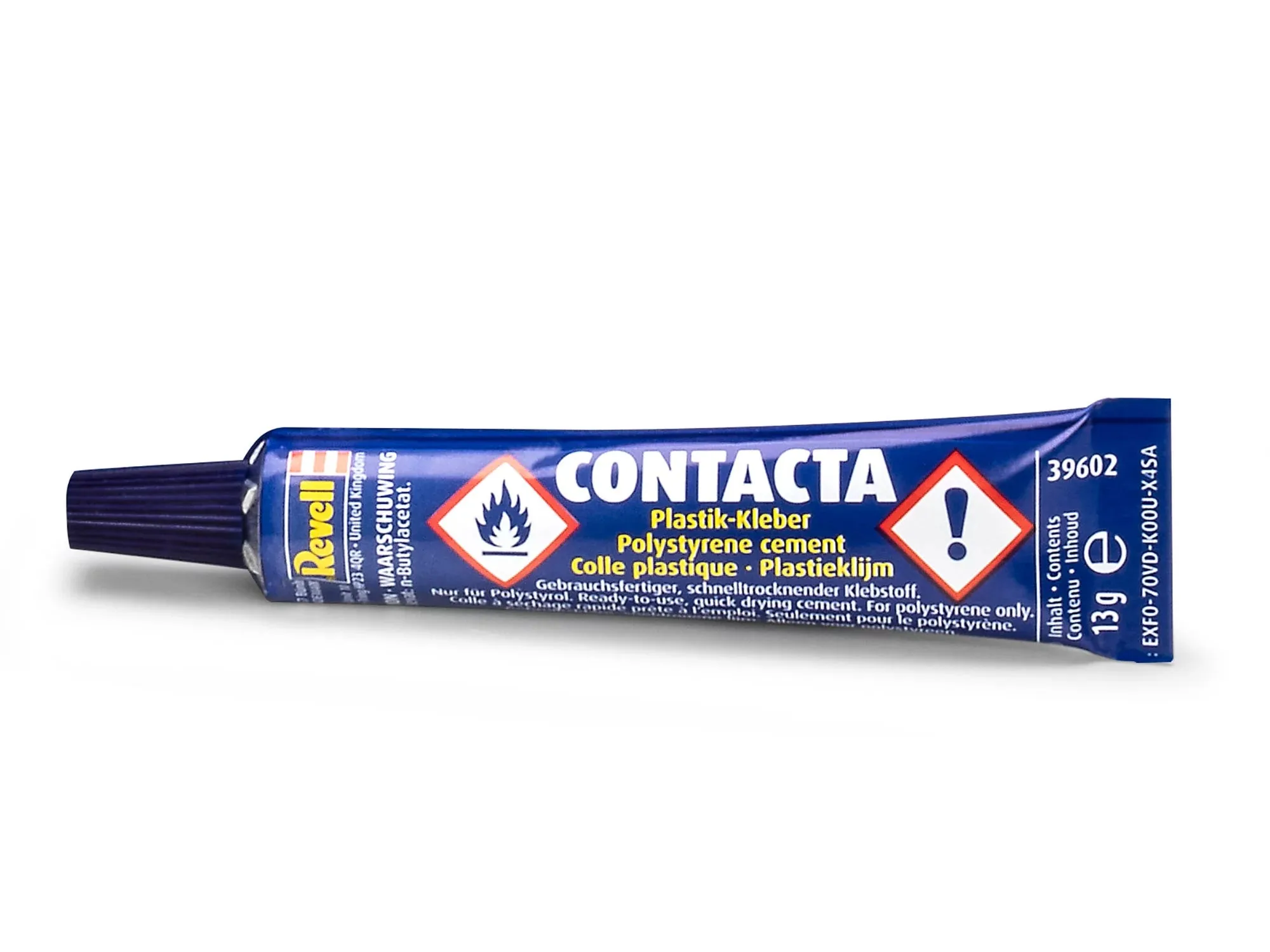
Revell "Contacta Glue" gel glue - 13g
Which glue fits your build?
Best for gel glue
- Modelers assembling large parts that need precise alignment before bonding
- Builders who prefer a thicker adhesive that stays put and does not run
Not ideal for
- Seam filling and capillary-action joints where liquid cement excels
- Very small or delicate parts where excess gel could obscure detail