Quick Answer
Giant floor puzzles are better for younger kids who need large, easy-to-handle pieces and love spreading out on the floor, while table puzzles suit older children who prefer a contained workspace and more intricate designs.
Space and Setup
Giant floor puzzles require a clear, flat area on the floor—often several feet across. This makes them ideal for playrooms or living rooms with open carpet, but they can be tricky in small spaces or on tables. Table puzzles, by contrast, fit neatly on any desk or tabletop and are easier to contain.
Piece Size and Handling
Floor puzzle pieces are typically larger and thicker, making them easier for toddlers and preschoolers to grasp and manipulate. Table puzzle pieces are smaller and more detailed, which can frustrate younger children but challenge older ones who enjoy fine motor work.
Giant Floor Puzzle vs. Table Puzzle: Tradeoffs at a Glance
- Play Space: Floor puzzles need open floor area; table puzzles work on any desk or table.
- Piece Size: Floor puzzles use large, chunky pieces (great for small hands); table puzzles have smaller, more intricate pieces.
- Difficulty & Age: Floor puzzles often have fewer, larger pieces (ages 2–5); table puzzles range from 24 to 100+ pieces (ages 4+). Check the piece count: floor puzzles usually top out around 48 pieces, while table puzzles can go much higher.
- Portability & Storage: Floor puzzles can be bulky to store and transport; table puzzles fit in boxes or bags easily.
- Social Play: Floor puzzles encourage group play on the floor; table puzzles are better for solo or two-player focus.
Featured Puzzle
-
Beautiful Curly Me Curly + Confidence Clubhouse Jigsaw Puzzle: This 100-piece jigsaw puzzle features a vibrant clubhouse scene with girls painting, coding, doing science experiments, playing violin, and building a robot. The 100-piece count and detailed artwork make it a solid table puzzle choice for kids who enjoy focused, thematic challenges—though the piece size is smaller than typical floor puzzle pieces.
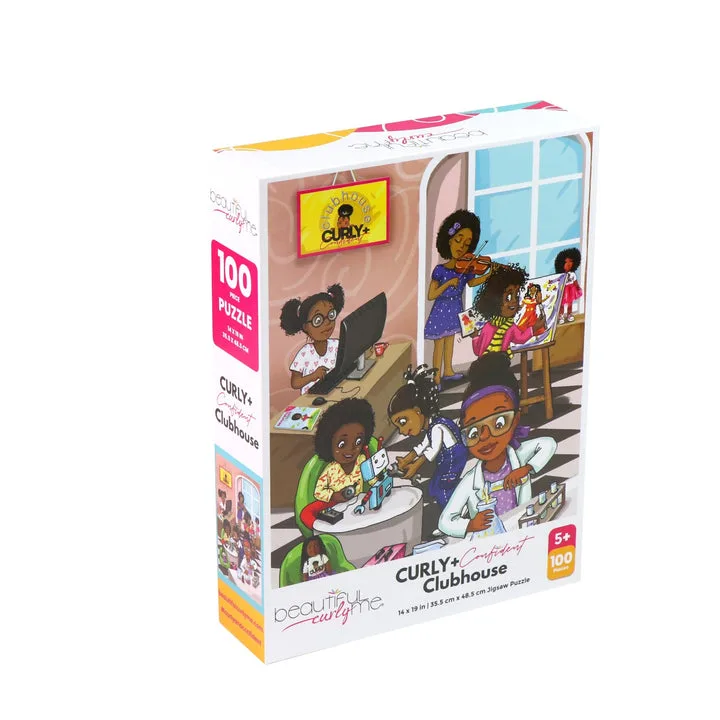
Beautiful Curly Me Curly + Confidence Clubhouse Jigsaw Puzzle
Which Should You Choose?
Best for
- Toddlers and preschoolers (ages 2–4) who need large, easy-to-grip pieces
- Families with open floor space and kids who like to spread out
- Group play or playdates where multiple children work together
Not ideal for
- Older children (ages 6+) who want detailed, challenging puzzles
- Small spaces or families who need to store puzzles compactly
- Kids who prefer working at a desk or table