Quick answer
Use gilding flakes for a smooth, metallic foil look; loose glitter for sparkle that catches light from every angle; and glitter paste for raised, dimensional shimmer. If you want one finish for card making, gilding flakes give the most polished metallic result, while glitter paste is the easiest to control on small areas.
Shimmer finishes look similar in the pot but behave very differently on paper. Gilding flakes, loose glitter and glitter paste each change how a card feels, how it catches light and how much time you spend cleaning up.
This comparison covers what each finish actually does, where it struggles, and which one suits the card or project in front of you. The right choice usually comes down to texture and control rather than sparkle alone.
Gilding flakes: smooth metallic coverage
Gilding flakes are thin, metallic pieces that are applied to an adhesive surface and then pressed down. They give a continuous, reflective finish that looks closer to foil than to sparkle. Because the flakes are lightweight, they sit flat against the surface and keep fine die-cut detail readable.
The trade-off is that gilding flakes need a tacky adhesive and a little patience. They also tend to be a one-shot finish: once they are pressed down, repositioning is difficult. That makes them best for focal elements where you want a clean metallic block of colour rather than scattered sparkle.
- Apply to a tacky surface and press firmly before brushing away excess flakes.
- Keep the flakes contained in a tray so stray pieces do not transfer to other projects.
Loose glitter: maximum sparkle, minimum control
Loose glitter gives the most light-catching sparkle of the three. Each particle reflects at a different angle, so the finish shifts as the card moves. That makes it a strong choice for celebration cards, tags and accents where the shimmer is the point.
The trade-off is control. Loose glitter needs an adhesive base, and it can shed if the adhesive is not fully covered. It also adds texture, which can obscure very fine stamped lines. If you want a crisp image with sparkle, glitter is better used around the design than over it.
- Work over a folded sheet of paper so you can return excess glitter to its container.
- Seal glittered areas if the project will be handled often.
Glitter paste: raised shimmer you can place precisely
Glitter paste is a dimensional medium that holds its shape as it dries. You can apply it through a stencil or spread it with a spatula, which makes it the most controllable of the three finishes. It sits on top of the surface rather than soaking in, so it works well over ink and cardstock.
The trade-off is drying time and bulk. A thick application can take a while to dry, and the raised texture may not suit projects that need to lie flat for mailing. Used thinly, though, it adds a subtle shimmer without changing the structure of the card.
- Spread paste thinly for a flatter finish that is easier to mail.
- Clean stencils and tools promptly before the paste sets.
How to choose between them
Start with the effect you want. A smooth metallic panel points to gilding flakes. All-over sparkle points to loose glitter. A raised, stencilled pattern points to glitter paste. Each finish can also be combined, but it is usually easier to pick one as the main effect and use the others sparingly.
Consider the surface too. Dark card and paper make metallic finishes stand out, which is why gilding flakes and metallic markers pair well on dark backgrounds. Lighter card shows glitter paste texture more clearly, while loose glitter reads best where light can move across it.
- Test each finish on a scrap of the same cardstock before committing to a final card.
- Keep one finish as the focal point so the card does not look busy.
Trade-offs at a glance
- Gilding flakes: Give a smooth, foil-like metallic finish with fine detail, but need a tacky adhesive and are hard to reposition once pressed. Choose when you want a polished metallic panel rather than scattered sparkle.
- Loose glitter: Delivers the strongest, most light-catching sparkle, but sheds if the adhesive is not fully covered and can obscure fine stamped lines. Choose for celebration cards and accents where sparkle is the main effect.
- Glitter paste: Offers precise, raised shimmer through stencils and spatulas, but takes time to dry and may not lie flat for mailing. Choose when you want controlled, dimensional shimmer on a specific area.
Products that support these finishes
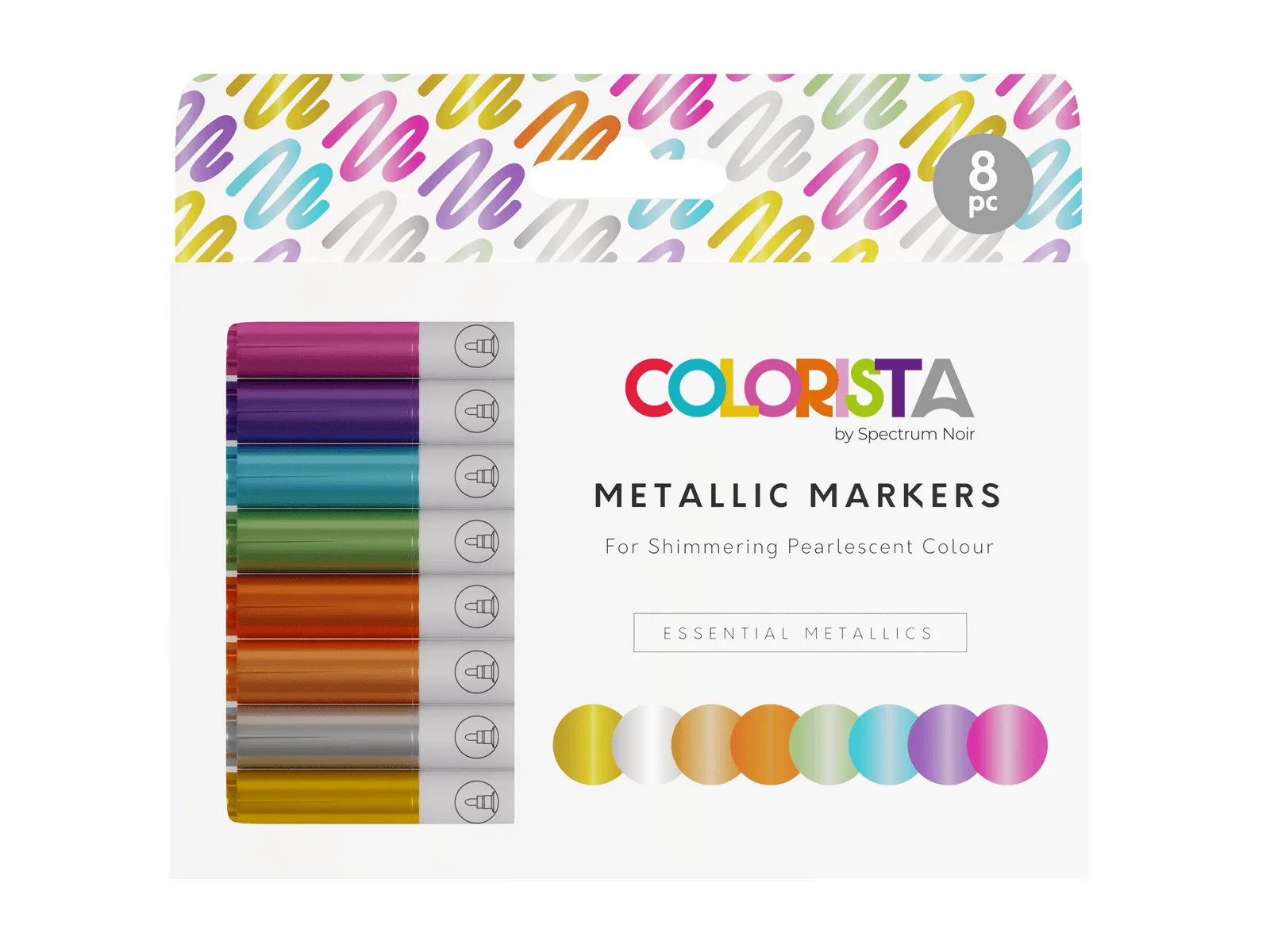
- Colorista - Metallic Marker - Essential Metallics 8pc: Each marker offers lustrous, metallic colour with opaque coverage on a variety of surfaces, and a 2mm bullet tip offers control and precision for neat lines and detailed work. Useful for adding metallic detail around gilded or glittered areas without reaching for a separate medium.
- Crafter's Companion Double Sided Finger Lift Tape: A double-sided tacky adhesive tape that leaves a clear, sticky line, 5mm wide and 25m long, with easy-lift backing. A practical base for gilding flakes and loose glitter because it holds the finish in place without wet glue.
- Arden Creative Studio Premium Cardstock Coffee Bean Brown 12" x 12" - 20 Pack: A deep chocolate-brown cardstock with a smooth finish on one side and a linen-textured finish on the other. Dark card makes metallic and glitter finishes stand out, and the smooth side is better for detailed die-cutting.
Which shimmer finish fits your project?
Best for
- Card makers who want a smooth metallic focal point and are happy to work with adhesive and a tray
- Crafters who want maximum sparkle for tags, celebration cards and party stationery
- Stencilled or mixed-media projects that need raised, precisely placed shimmer
Not for
- Projects that must stay perfectly flat for mailing, where raised glitter paste can add bulk
- Very fine stamped detail where loose glitter would cover the lines
- Quick makes where you cannot wait for paste to dry or press flakes evenly
Match the finish to the effect you want, not the label on the pot. Gilding flakes for a smooth metallic look, loose glitter for all-over sparkle, and glitter paste for raised, controlled shimmer. Test each on a scrap of your cardstock first, and the right choice becomes obvious.