Quick Answer
Focus on solid wood construction, a realistic checkout experience, and enough accessories to spark open-ended play. The Tiny Land Kid's Grocery Store Playset hits all three at a reasonable price.
Why Material Matters for a Long-Lasting Playset
A grocery store playset gets handled daily—sometimes roughly. Solid wood stands up to bumps and drops better than particleboard or plastic. Wood also feels nicer to little hands and doesn't tip over as easily when kids lean on the counter.
Check the finish too. Non-toxic, water-based paints and smooth edges are essential for safety. If the set includes a wooden play food set, make sure the pieces are painted with child-safe coatings that won't chip off quickly.
Size and Storage: Does It Fit Your Space?
Playsets range from compact countertop units to full-store setups with shelves and a checkout stand. Measure your play area before buying. A large set might overwhelm a small room or block traffic flow.
Also think about storage. Some sets fold or have built-in bins for play food and accessories. If space is tight, look for a playset that can be partially disassembled or that includes a storage bag.
Accessories That Encourage Realistic Role Play
The best pretend play shops include a working cash register with buttons that click, play money, and a scanner. A play credit card machine adds modern realism that kids love.
Look for a set that comes with a variety of play food—fruits, vegetables, canned goods, and boxed items. The more variety, the longer the play stays interesting. A wooden play food set is especially durable and looks more realistic than plastic alternatives.
Decision Rules for Choosing a Grocery Store Playset
- Rule 1: Prioritize solid wood over plastic or particleboard: Wood lasts longer, feels better, and is safer when coated with non-toxic paint. Avoid sets with sharp edges or flimsy parts.
- Rule 2: Match the size to your available play space: Measure the area where the set will live. A full-store setup needs at least 3x3 feet of floor space. Compact countertop sets work for smaller rooms. If you plan to move the set between rooms, choose a lightweight but sturdy model.
- Rule 3: Check the accessory count and variety: Look for at least 20 pieces of play food, a cash register with sounds, play money, and a scanner. More pieces mean richer role-play scenarios.
- Rule 4: Confirm the set includes a realistic checkout experience: A working scanner, a credit card terminal, and a cash drawer make the play feel authentic. Kids love ringing up items and handling payments.
- Rule 5: Verify safety certifications and age recommendations: The set should meet ASTM or EN71 safety standards. Age recommendations usually start at 3 years due to small parts. Always check the label. For children under 3, look for a set without small accessories or with a higher age rating.
Product Spotlight
-
Tiny Land® Kid's Grocery Store Playset: Step into the world of pretend play where little shopkeepers run their own store, set prices, and ring up sales—all while learning essential life skills. Our Kid’s Grocery Store Playset brings realistic shopping fun into your child’s playroom with an interactive design and endless storytelling opportunities. This set combines a checkout counter, play food, and accessories in one package, so you don't need to buy extras separately to create a complete pretend shop experience.
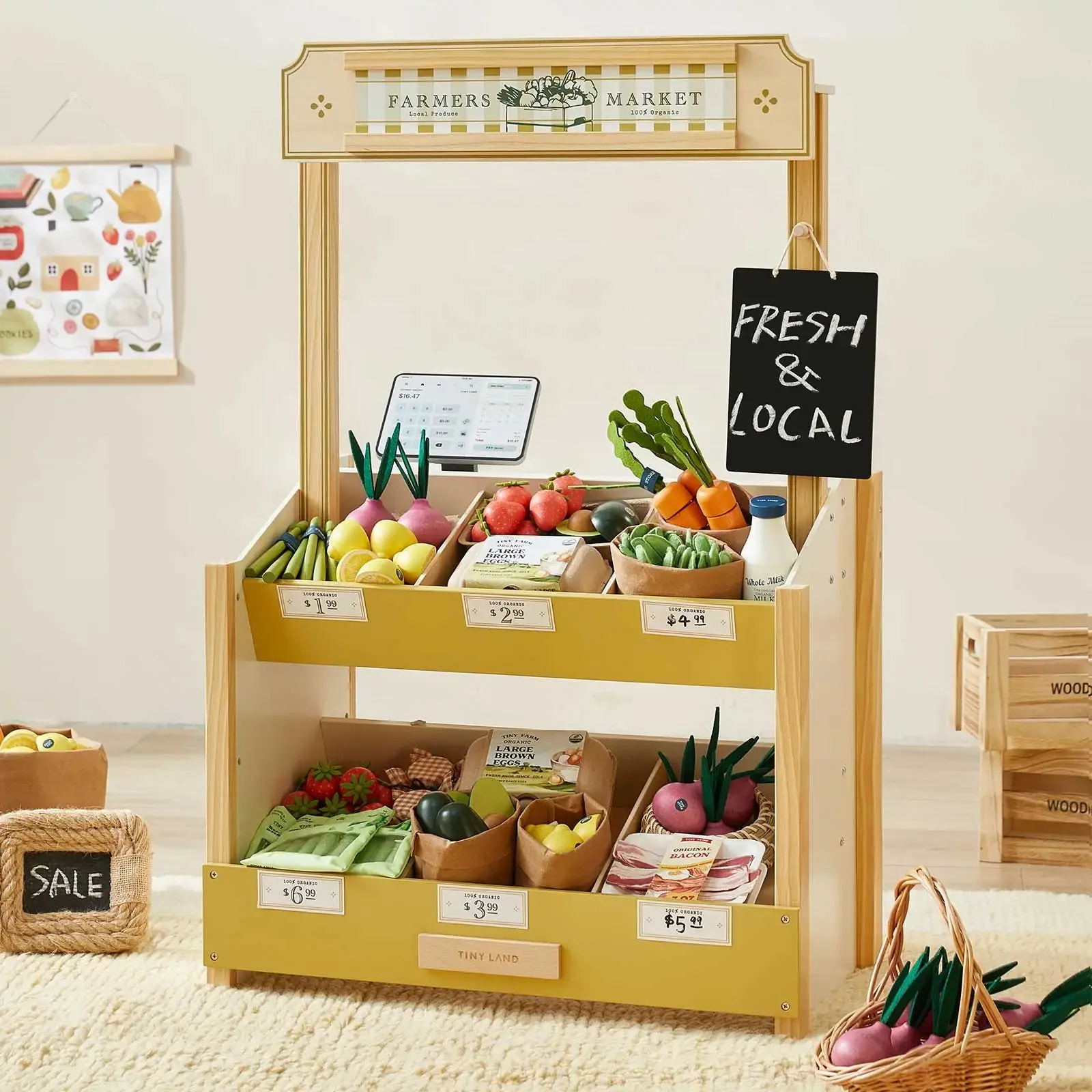
Tiny Land® Kid's Grocery Store Playset
Who This Playset Is For
Best For
- Parents who want a durable wooden playset that can handle daily play
- Kids ages 3 to 7 who enjoy role-playing shopping and running a store
Not For
- Families with very limited floor space (consider a compact countertop set instead)
- Children under 3 years old (small parts may be a choking hazard)