Quick answer
For 4K @ 60Hz over HDMI 2.0, keep cable length under 15 feet to maintain full 18Gbps bandwidth. Longer runs may need active cables or signal boosters.
Why length matters for 4K HDMI
HDMI 2.0 cables are rated for 18Gbps bandwidth to handle 4K at 60Hz with HDR. Passive copper cables lose signal integrity over longer distances. Beyond 15 feet, you risk flicker, black screens, or resolution drops. For runs over 25 feet, consider an active optical HDMI cable or a signal extender.
The cable's build quality also affects performance. Braided jackets and gold-plated connectors protect against interference and corrosion, which helps maintain signal strength over the rated length.
Frequently asked questions
What is the maximum length for a passive HDMI 2.0 cable at 4K 60Hz?
For reliable 18Gbps performance, stay under 15 feet. Some high-quality cables may work up to 25 feet, but signal degradation becomes more likely beyond that.
Can I use a longer cable if I don't need 4K?
Yes. At 1080p or lower resolutions, passive HDMI cables can often run 30-50 feet without issues because bandwidth demands are lower.
Do braided or gold-plated cables improve signal over distance?
Braided jackets add durability but don't extend range. Gold plating prevents corrosion at the connector, which helps maintain a consistent connection, but it doesn't increase the cable's maximum length.
What should I look for in a short 4K HDMI cable?
For short runs (1-3 feet), focus on 18Gbps rating, solid connector build, and flexible jacket. A 1 ft. cable like the RitzGear option works well for connecting a streaming stick or laptop to a nearby monitor. For short connections, a quality 18Gbps cable with braided nylon and gold plating ensures reliable 4K performance without excess cable clutter.
Product spotlight
-
RitzGear 4K HDMI Cables | 10-Pack of 1 Ft. High-Speed 18Gbps HDMI 2.0 Connectors | Durable Braided Nylon, Gold Plating, 4K @ 60Hz Ultra HD, 3D, 2160p, 1080p & Ethernet Support for TV, Laptop & Gaming: RitzGear 4K HDMI Cables are 1 ft. long, support 18Gbps bandwidth, and feature braided nylon jackets and gold-plated connectors. For short connections between nearby devices, these cables provide full 4K @ 60Hz performance without signal loss, and the durable build reduces wear from frequent plugging and unplugging.
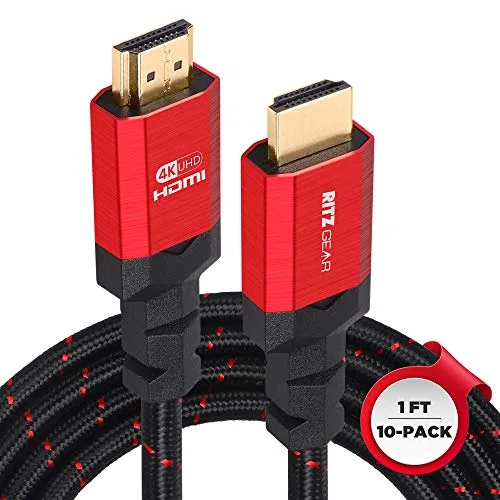
RitzGear 4K HDMI Cables | 10-Pack of 1 Ft. High-Speed 18Gbps HDMI 2.0 Connectors | Durable Braided Nylon, Gold Plating, 4K @ 60Hz Ultra HD, 3D, 2160p, 1080p & Ethernet Support for TV, Laptop & Gaming