Quick answer
For a typical two-car driveway, start with two motion lights: one near the garage or entry door and one at the street-side gate or curb. Add a third unit if the driveway runs longer than about 40 feet or has a dark middle zone between those two points. Choose the TECKNET 416 LED model for standard-width drives and the TECKNET 495 LED model when you need maximum spread across a wider approach or a corner.
Measure the driveway before you count lights
Walk the driveway at night and mark three points: where a car leaves the road, where a person would step out of a vehicle, and where the house entry sits. Those are the zones that need light first. A single motion light at the garage wall often leaves the street end dark, because motion sensors trigger on movement across their field rather than down a long narrow lane.
For coverage planning, treat each wall-mounted solar motion light as handling roughly 15 to 20 feet of driveway width when mounted 6 to 8 feet high and angled slightly downward. That is a planning estimate, not a lab rating, so use it to decide how many units to buy, then adjust the angle after the first night.
- Under 20 feet long: one light near the entry usually covers the walking path.
- 20 to 40 feet long: two lights, split between the house end and the street end.
- 40 to 60 feet long: three lights, with the middle unit covering the dark gap.
- Wider than two cars: add one unit per extra 15 to 20 feet of width.
Why lumens matter less than beam spread
A 4200lm solar light coverage claim tells you the total output, but it does not tell you how far the light reaches across a driveway. Two lights with the same lumen figure can behave very differently if one uses a narrow one-sided beam and the other spreads light across three sides. For a driveway, spread matters more than a single bright hotspot, because you want to see the whole approach, not just the spot directly under the fixture.
That is why a three-sided design can replace a higher-lumen single-sided unit in some driveways. If your main problem is a wide gate or a corner where a car turns in, prioritize a fixture with wider coverage rather than simply chasing the largest lumen number.
Placement rules that prevent false triggers and dead zones
Mount motion lights 6 to 8 feet above the ground and angle the sensor slightly downward. Higher mounting increases detection range but can also pick up passing cars, tree branches, or pets, which drains the battery with unnecessary triggers. Keep the sensor away from heat sources such as dryer vents and from reflective surfaces that can bounce motion back into the lens.
Aim the beam across the driveway rather than straight down it. Cross-lighting reveals the shape of a person or vehicle better than a straight-on beam, and it reduces the harsh glare you get when a light points directly at a driver or a camera.
For solar models, confirm the panel gets direct sun for most of the day. A fixture mounted in permanent shade may still trigger correctly but will not recover enough charge to run through the night at full brightness.
Match the light to the gate, not just the driveway
The street-side gate or curb is usually the hardest spot to light because it is far from the house and often shaded by fences or hedges. If your gate area is wide or has a corner, one unit with broad three-sided coverage will do more than two narrow units pointed at the same spot. If the gate is narrow and the main concern is the walk from car to door, a single well-placed unit near the entry is enough.
Check whether the fixture you are considering includes a size option. Size can change the panel area and the mounting footprint, so measure the wall or post space before ordering rather than assuming every variant fits the same bracket location.
Driveway lighting decision rules
- Driveway under 20 feet: One light near the house entry is usually enough, because the walking path is short and the street end is close to the door. Buy one unit and spend the savings on a better mounting height.
- Driveway 20 to 40 feet: Two lights work best: one at the house end and one at the street or gate end, each angled across the drive rather than down it. Two units cover the two zones people actually use.
- Driveway over 40 feet or with a dark middle: Add a third unit in the middle gap. A single long-throw light rarely covers the full length without leaving a dim section. Three units beat one oversized unit for even coverage.
- Wide gate or corner approach: Choose a fixture with wider three-sided or 300-degree coverage instead of adding more narrow units at the same point. Spread solves corners better than extra brightness.
- Permanently shaded mounting spot: Solar motion lights need direct sun to recharge. If the only mounting point is shaded all day, plan for a different location or accept reduced night runtime. Confirm sun exposure before you commit to the position.
Two TECKNET solar motion lights compared
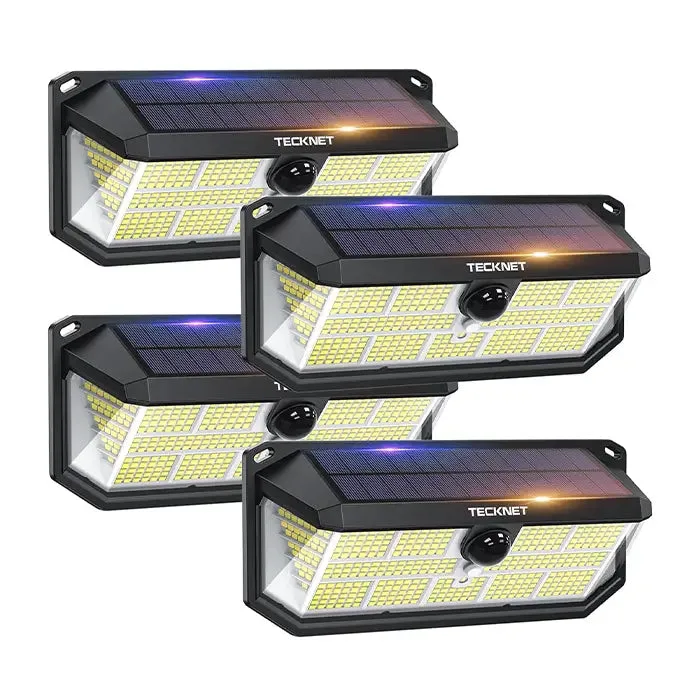
- TECKNET 416 LED Solar Lights Outdoor Motion Sensor Waterproof 4200lm: 416 LED beads with a reflective light structure and three-sided lighting, rated 4200lm and IP waterproof for outdoor use. The three-sided spread suits a standard two-car driveway where you want the whole approach visible, not just a bright patch under the fixture.
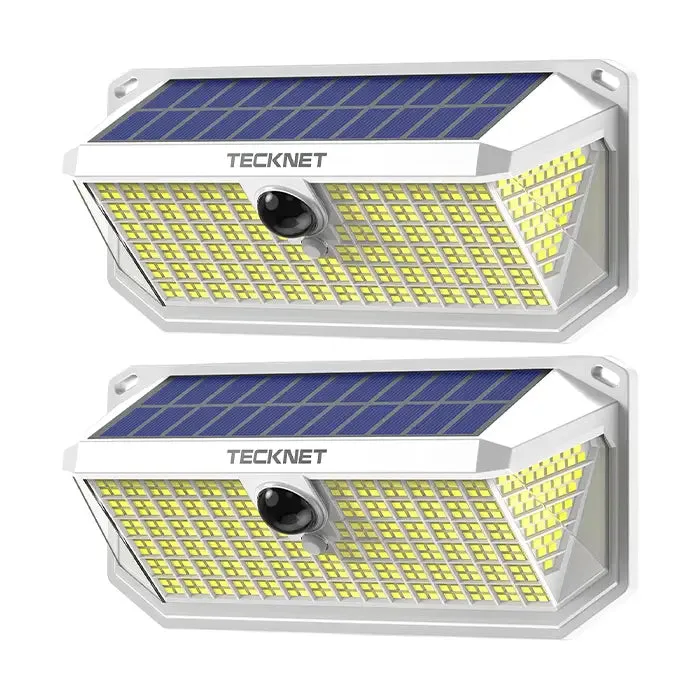
- TECKNET Solar Lights Outdoor 495 LED Motion Sensor Waterproof Wall Lights: 495 LEDs with 300-degree coverage and a high-efficiency solar panel listed at a 30% conversion rate, giving an estimated 10 to 14 hours of night lighting after a full day of charge. The wider 300-degree spread and longer runtime help on wider gates, corner approaches, or driveways where the fixture cannot be aimed straight down the lane.
Who should buy which setup
Best for
- Homeowners lighting a standard two-car driveway with a house-end and street-end zone
- Buyers who want a three-sided spread that reveals the whole approach rather than one bright hotspot
- Wider gates or corner entries that need 300-degree coverage and longer night runtime
Not for
- Driveways where the only mounting point is in permanent shade all day
- Buyers who need wired, always-on illumination rather than motion-triggered light