Quick answer
Assemble a 1000 piece puzzle efficiently by sorting pieces by edge and color first, building the frame, then working in small sections from the inside out.
Why sorting matters more than you think
Jumping straight into connecting pieces without sorting is the number one time-waster. A 1000 piece puzzle has roughly 40–50 edge pieces and hundreds of interior pieces with similar shades. Sorting by color and pattern lets you focus on one small area at a time, reducing visual clutter and decision fatigue.
Some puzzlers prefer to dump all pieces face-up on a large table. That works for 500 pieces, but with 1000 pieces you risk losing small pieces under stacks. Instead, use shallow trays or the box lid to keep groups separate.
Lighting and surface setup
Good lighting is essential. A dim room makes it hard to distinguish subtle color variations, especially in winter scenes where whites and grays blend. Use a daylight LED lamp if possible. A flat, non-glare surface like a puzzle mat or felt board also prevents pieces from sliding around.
Step-by-step assembly process
- Sort pieces by edge and color: Separate all edge pieces (flat edges) into one pile. Then group the remaining pieces by dominant color or pattern (e.g., sky, snow, trees, buildings). Use small containers or the puzzle box lid for each group. Common mistake: mixing similar shades together. If two colors look nearly identical under your light, keep them separate until you have more context.
- Build the frame first: Assemble the edge pieces to form the complete border. This gives you a defined workspace and a reference for where each section belongs. Check the box image frequently to confirm corner and edge alignment. Checkpoint: if a piece seems to fit but the pattern doesn't continue naturally, it's likely in the wrong spot. Try rotating it or swapping with another edge piece.
- Work in small sections from the frame inward: Pick one color group (e.g., the red barn) and connect pieces within that group. Attach completed sections to the frame as soon as they touch it. Repeat for each color zone, leaving the most uniform areas (like solid sky or snow) for last. Common mistake: trying to fill the entire center at once. Focus on one small cluster at a time to avoid feeling overwhelmed.
- Use the box image as your map: Keep the box lid or a photo of the completed image nearby. Refer to it whenever you are unsure where a piece goes. For detailed scenes, zoom in on small details like windows or fences to match piece shapes. Checkpoint: if a piece has a unique shape but no obvious color match, place it in a 'maybe' pile and revisit after other sections are done.
- Save uniform areas for last: After all distinct sections are assembled, tackle the remaining solid-color or repetitive areas (e.g., sky, snow, grass). Sort these pieces by shape (knob vs. hole orientation) and try each one systematically. Common mistake: rushing through uniform areas by force-fitting pieces. Take your time and test each piece in multiple orientations before moving on.
Puzzle that works well with this method
-
A Village in Winter 1000 Piece Jigsaw Puzzle: This 1000-piece puzzle features a snowy village scene with distinct color zones: white rooftops, red cardinals, and warm building tones. The clear color separation makes sorting by shade straightforward, so you can apply the section-by-section strategy without guessing.
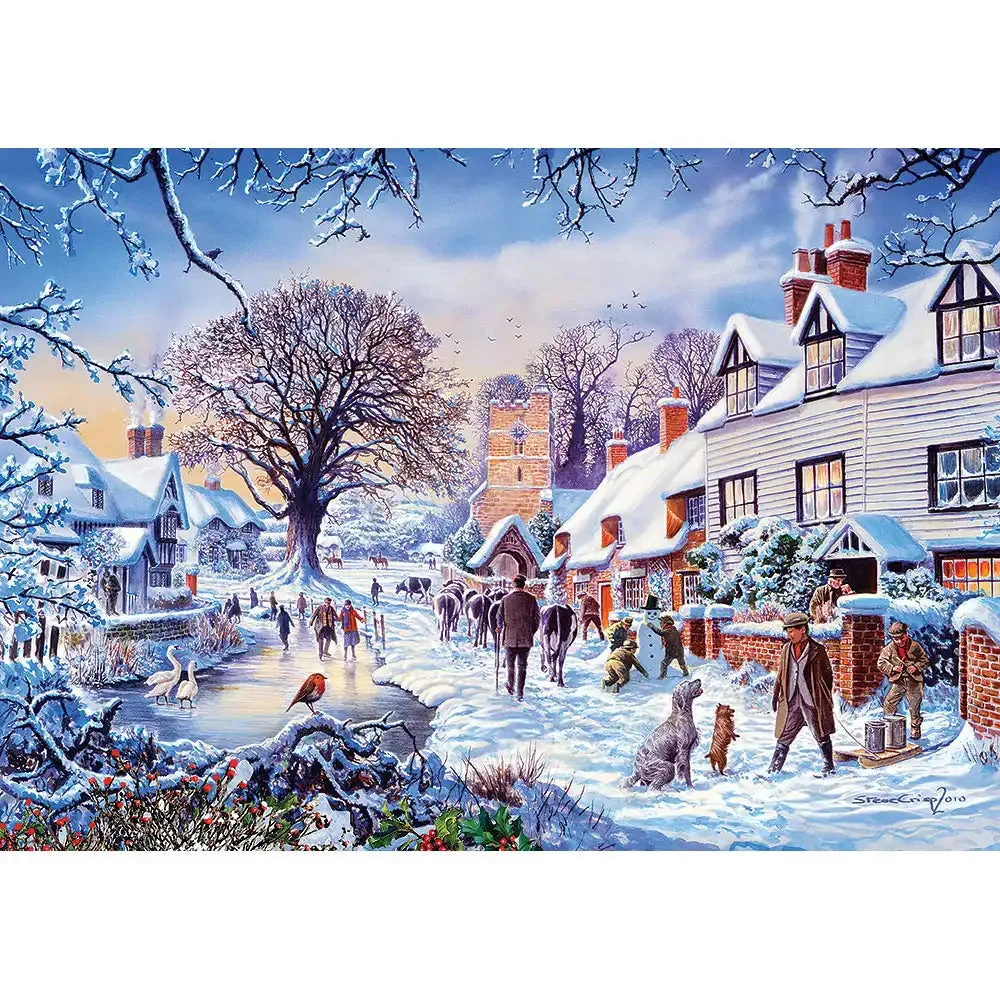
A Village in Winter 1000 Piece Jigsaw Puzzle