Quick answer
Pick one corner of your living room, clear the floor, and place a low, open shelf against the wall with two or three toys on it. Add a small mat or rug in front, keep the space free of clutter, and rotate the toys every week or two. This gives your child a defined Montessori play corner without turning the whole room into a playroom.
Montessori
You do not need a separate playroom to give your child a Montessori play space at home. A single corner of the living room, set up with a low shelf and a clear floor area, can work just as well. The key is making that corner predictable, uncluttered, and easy for your child to use independently.
This guide walks through the setup step by step, from choosing the spot to rotating toys. It also covers common mistakes, like overfilling the shelf or placing it where your child cannot reach, and shows how a few specific toys fit naturally into a small Montessori corner.
Why a living room corner works for Montessori
Montessori spaces are built around accessibility and order, not square footage. A living room corner can meet both needs if your child can reach the shelf, see what is on it, and put things back without help. Being near the family also means your child can play while you cook, read, or talk, which supports the Montessori idea that children learn best alongside everyday life rather than in isolation.
The tradeoff is that living rooms are shared spaces. You will need to accept some visible toy storage and set a boundary around the corner. That is usually easier than it sounds, because a defined corner reads as intentional rather than messy.
- Choose a corner your child already gravitates toward, not the one that looks best from the sofa.
- Keep the corner away from the TV if possible, so it becomes a low-stimulation zone.
Choose the spot and clear the floor
Walk through your living room and look for a corner with a wall for the shelf, enough floor space for your child to sit and spread out materials, and a clear path so they can get there without climbing over furniture. A corner near a window is fine, but avoid direct sun if you are placing wooden toys there, since prolonged heat and light can dry out or fade finishes.
Once you pick the spot, remove everything that does not belong to your child's play: bags, charging cables, decorative items on the floor, and any furniture that crowds the area. The goal is a clean floor your child can claim. If the corner is carpeted, that is enough. If it is hard flooring, plan to add a small mat in the next step.
- Checkpoint: you should be able to sit on the floor in the corner with your child and still have room to reach the shelf.
- Common mistake: choosing a corner that is technically empty but sits in a walkway, so toys get stepped on.
Add a low, open shelf
The shelf is the backbone of a montessori shelf in living room setup. It should be low enough that your child can see and reach the top surface while standing or sitting, and open enough that toys are visible rather than hidden in bins. A two-tier shelf or a low cubby unit works well. If you already own a low bookshelf, you can use it as long as the bottom shelf is reachable.
Place the shelf against the wall at the edge of the corner, leaving floor space in front of it. Put only two or three toys on it at a time, spaced apart. This is the part most families get wrong: a crowded shelf looks generous but makes it hard for a young child to choose or clean up. Empty space on the shelf is a feature, not a waste.
- Checkpoint: your child can take a toy off the shelf and put it back without your help.
- Common mistake: using deep bins or a toy chest, which hides choices and encourages dumping.
Set up the floor area with a mat
A small mat, rug, or even a folded blanket defines where play happens and protects the floor. It also gives your child a visual cue for where to sit and where materials belong. Keep the mat simple and washable. In a living room, a neutral mat blends in better than a bright character rug, and it is easier to clean.
Place the mat directly in front of the shelf, with a little space between the mat and the shelf so your child can stand and choose a toy. If your living room has a coffee table nearby, move it back or to the side so the mat area stays open. The mat should be large enough for one child to sit and work, not so large that it takes over the room.
- Checkpoint: the mat stays flat and does not slide when your child stands up.
- Common mistake: making the play area so big that toys migrate across the whole living room.
Choose a small rotation of toys that fit the corner
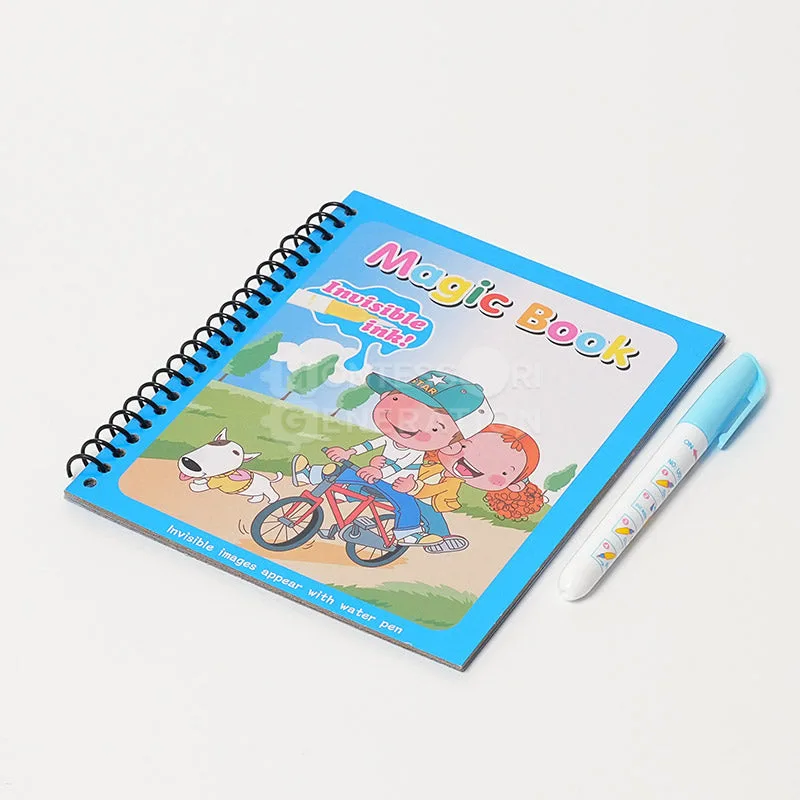
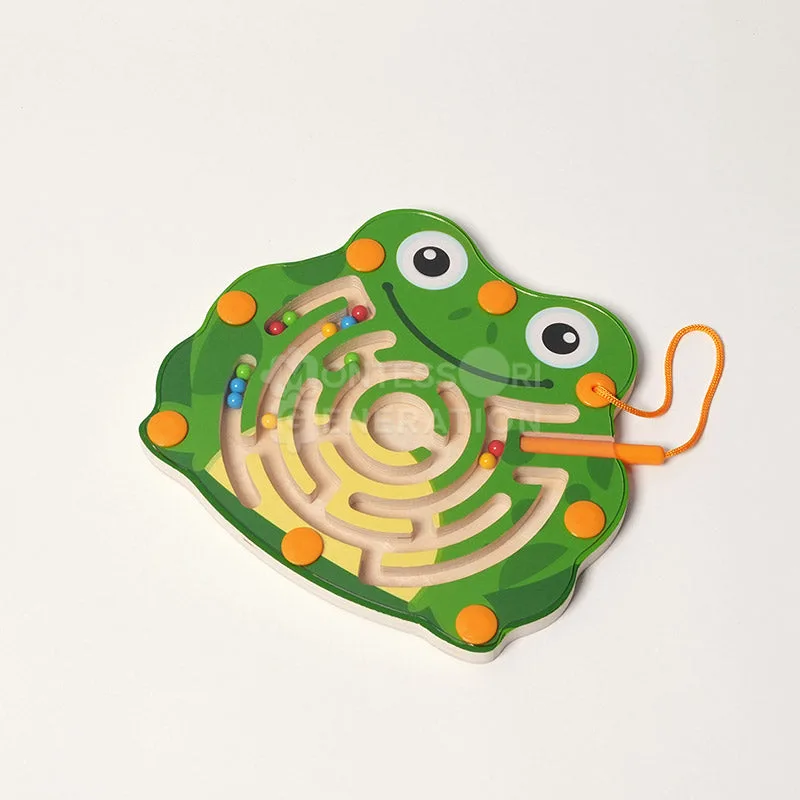
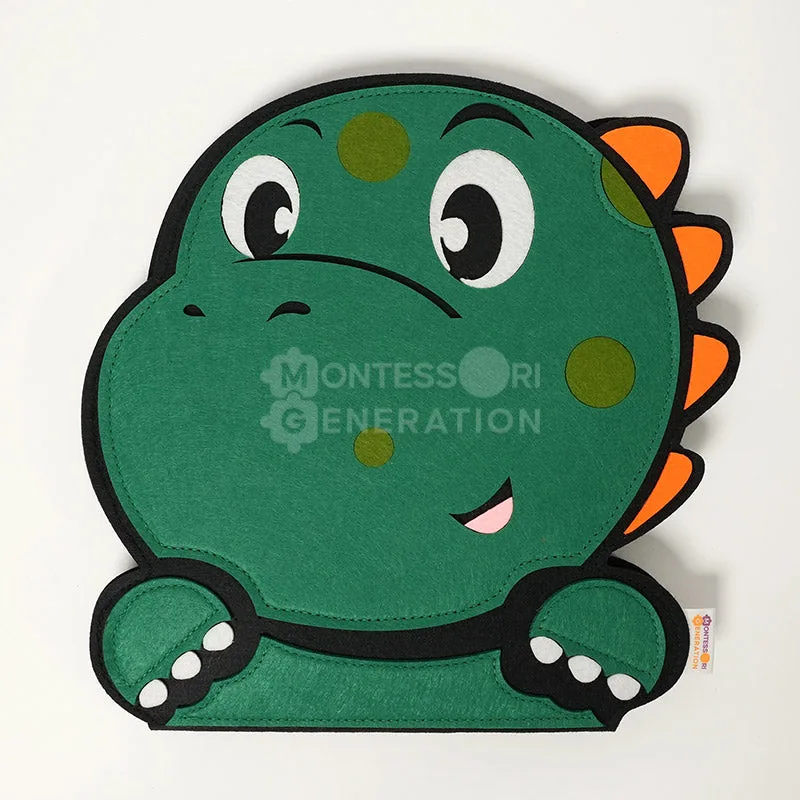
A Montessori corner works best with a few open-ended toys that have a clear purpose and a defined place. For a small corner, look for toys that are flat or compact, can be used sitting down, and do not need many loose parts. Busy boards, mazes, and reusable activity books fit this description well because they store flat and can be used on a lap or on the mat.
For example, the Montessori Dino Busy Board is a soft felt board measuring 23.2 by 11.6 inches, so it can lean against the wall or lie flat on the mat without taking over the corner. The Montessori Magnetic Maze is smaller at 6.9 by 8.1 inches and works well as a shelf item for ages 2 and up. The Montessori Magic Reusable Book, for ages 3 and up, comes with a water pen and stores flat, which makes it a good quiet-time choice in a shared room.
- Pick toys with a clear beginning and end, so your child knows when the activity is finished.
- Avoid toys with many small pieces in a living room corner, where pieces get lost.
Rotate toys and keep the corner tidy
Once the corner is set up, plan a simple rotation. Every week or two, swap one or two toys on the shelf for ones you have stored away. This keeps the corner interesting without adding clutter, and it matches the Montessori idea that fewer, well-chosen toys support deeper play. Store the rest out of sight, ideally in a closet or bin your child cannot reach.
Tidy the corner at the end of the day, ideally with your child. Put toys back on the shelf and smooth the mat. If a toy is broken or missing pieces, remove it rather than leaving it out. A corner that resets each evening is easier to maintain and more inviting the next morning.
- Checkpoint: the shelf holds no more than three toys at a time.
- Common mistake: rotating too often, which prevents your child from returning to a favorite activity.
Your 6-step Montessori corner setup
- Pick the corner: Choose a living room corner with a wall for the shelf, floor space for sitting, and a clear path. Check that you and your child can both sit there comfortably. Checkpoint: the corner is not in a walkway.
- Clear the floor: Remove bags, cables, decor, and extra furniture from the corner so your child has a clean floor to claim. Common mistake: leaving a chair or side table that crowds the play area.
- Place the low shelf: Set a low, open shelf against the wall. Put two or three toys on it with space between them. Avoid deep bins and toy chests. Checkpoint: your child can reach and return toys without help.
- Add a mat: Lay a small, washable mat in front of the shelf to define the play area and protect the floor. Keep it simple so it blends with the room. Common mistake: a mat so large the toys spread across the living room.
- Choose fitting toys: Stock the corner with compact, open-ended toys that store flat or sit on a shelf, such as a busy board, a magnetic maze, or a reusable activity book. Checkpoint: no more than three toys on the shelf at once.
- Rotate and reset: Swap one or two toys every week or two, and tidy the corner each evening with your child. Store extra toys out of reach. Common mistake: rotating too often or leaving broken toys on the shelf.
Toys that fit a small Montessori corner
- Montessori Dino Busy Board: Soft felt busy board, age 2+, size 23.2 x 11.6 inches (59 x 29.5 cm), weight 7.8 oz (220 g), spot clean only. It is large enough to teach dressing skills but light enough to lean against a wall or lay flat on a mat, so it suits a corner without a dedicated playroom.
- Montessori Magnetic Maze: Wooden magnetic maze, age 2+, size 6.9 x 8.1 inches (17.5 x 20.5 cm), weight 7.8 oz (220 g), non-toxic paint, clean with a damp cloth and mild soap. Its compact size makes it a natural shelf item in a living room, and the enclosed design means no loose pieces to lose under furniture.
- Montessori Magic Reusable Book: Reusable coloring book with water pen, age 3+, size 7.0 x 5.9 x 0.1 inches (17.9 x 15.1 x 0.3 cm), weight 2.6 oz (75 g), spot clean only. It stores flat and can be used again after the page dries, which makes it a low-mess option for a shared living space.
A Montessori play corner in your living room does not need much space or many toys. Pick one corner, keep the shelf low and light, add a mat, and rotate a few well-chosen items. Done consistently, that small area becomes a place your child returns to on their own.