Quick answer
For video, start with a variable ND filter for exposure control, a CPL for glare reduction, and a UV filter for lens protection. A magnetic filter kit like the Urth Essentials Filter Kit Pro makes swapping fast and safe on set.
Why ND filters matter more for video than stills
In video, shutter speed is locked to frame rate (usually 1/48 or 1/50 at 24fps) to maintain natural motion blur. Without an ND filter, you often can't keep the aperture open wide enough without overexposing, especially in bright daylight. A variable ND gives you stepless adjustment, while fixed ND filters like ND8 or ND64 offer predictable stops for specific conditions.
A polarizing filter (CPL) is also valuable for video because it cuts reflections from water, glass, and foliage, deepening skies and boosting contrast without shifting color. The trade-off is that a CPL reduces light by about 1–2 stops, so you may need to pair it with an ND in very bright scenes.
Magnetic vs. screw-on: speed vs. security
Magnetic filter systems let you attach or swap filters in seconds without threading, which is a huge advantage when you're chasing changing light or moving between shots. The Urth Essentials Filter Kit Pro uses a magnetic adapter ring that stays on your lens, so filters snap on and off quickly. The trade-off is that magnetic systems can be slightly thicker, and the adapter ring adds one extra piece to keep track of.
Screw-on filters are simpler and often cheaper, but they require careful threading and can be slow to change. For run-and-gun video work, magnetic is usually worth the extra cost.
Decision rules for your starter video filter kit
- Choose a variable ND first: A variable ND (like ND2-ND32 or ND2-ND400) lets you dial in exactly the right exposure without changing filters. This is the most versatile option for video because lighting changes quickly on location.
- Add a fixed ND for specific stops: If you shoot in consistent conditions (e.g., interviews in a studio or outdoor golden hour), a fixed ND like ND8 or ND64 gives cleaner results without the potential cross-polarization artifacts of variable NDs at extreme settings. Fixed NDs are sharper and cheaper per stop, but less flexible.
- Include a CPL for outdoor scenes: A circular polarizer cuts glare from water, windows, and foliage, and deepens blue skies. It's essential for outdoor video to reduce reflections and increase color saturation without post-processing.
- Don't forget a UV or clear protection filter: A UV filter protects your front lens element from dust, scratches, and moisture. It's cheap insurance, especially when swapping lenses in dusty or humid conditions. For video, it won't affect exposure.
- Consider magnetic for speed: Magnetic systems let you swap filters in seconds without threading. If you shoot run-and-gun or documentary style, a magnetic kit like the Urth Essentials Filter Kit Pro saves time and reduces the risk of dropping filters. Magnetic adapters add slight thickness; ensure your lens hood still fits.
Product facts
-
Essentials Filter Kit Pro: The Essentials Filter Kit Pro includes a UV, CPL, ND8, and ND1000 Pro filter, built with AERO-C10 ionically tempered UV glass and German SCHOTT B270 optical glass, plus CoraNano Max 34-layer dual-side coating. This gives you a complete starter set for video: UV for protection, CPL for contrast, ND8 for slight light reduction, and ND1000 for long exposures or bright scenes, all in one magnetic kit.
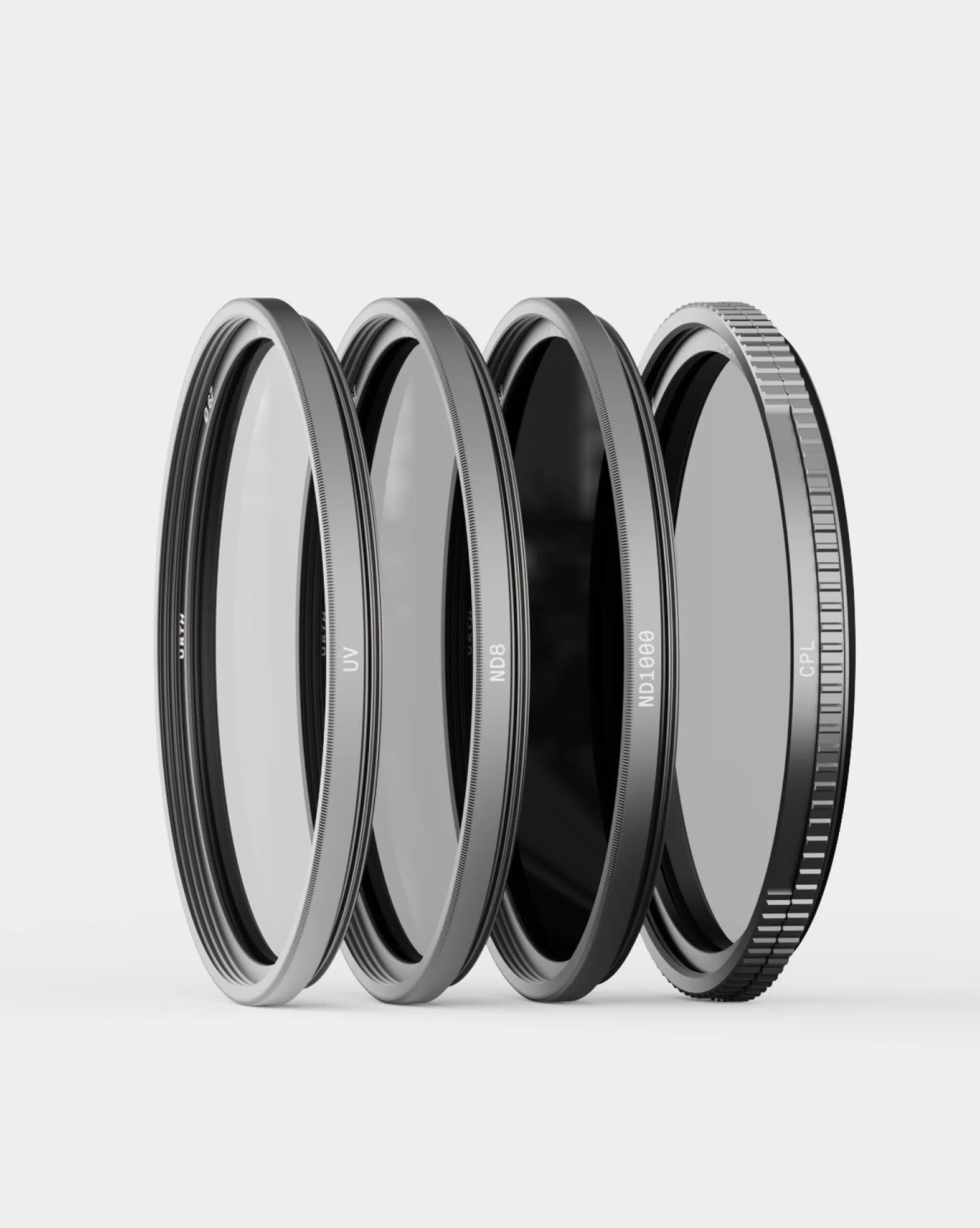
Essentials Filter Kit Pro
Who should buy what
Best for
- Videographers who shoot outdoors and need flexible exposure control
- Run-and-gun or event shooters who change filters frequently
- Beginners who want a complete, easy-to-use kit with magnetic speed
Not for
- Studio videographers who shoot under controlled lighting and rarely change filters
- Budget-conscious buyers who need a single fixed ND and nothing else