Quick answer
Choose a strap pouch that securely holds your camera or accessories, mounts firmly on your pack's shoulder strap, and allows one-handed access without unclipping the bag.
Size and weight limits matter more than you think
Strap pouches are small by design — they sit on a shoulder strap and can't support heavy camera bodies or large lenses. Most are built for compact cameras, action cams, or accessories like batteries and cards. Check the pouch dimensions and weight capacity against your gear before buying.
A pouch that's too large can throw off your balance or swing when you move. A too-small pouch won't close properly, leaving your gear exposed. Measure your camera or accessory and compare it to the pouch's internal dimensions.
Mounting system compatibility
Not all strap pouches attach the same way. Some use hook-and-loop straps, others use clips or magnetic systems. The most reliable designs attach securely to the shoulder strap and also anchor to the sternum strap to prevent sliding.
If your backpack lacks a sternum strap or has a non-removable one, some pouches won't fit. Check the attachment method and whether it works with your pack's strap width. Thick padded straps may need wider loops.
Access speed and security trade-off
A strap pouch's main advantage is quick access, but fast access can mean less security. Pouches with zippers or flaps keep items safe but require two hands. Magnetic or snap closures allow one-handed retrieval but may not be as secure in rough terrain.
Think about your typical use: if you're hiking or biking, security matters more. If you're street shooting or commuting, speed might be the priority. Some pouches offer a combination — a secure main compartment with a quick-access outer pocket.
Decision rules for choosing a strap pouch
- Rule 1: Match the pouch to your camera size: Measure your camera or accessory length, width, and depth. Compare to the pouch's internal dimensions. Leave a little room for padding or a case.
- Rule 2: Verify the attachment system: Check if the pouch uses straps, clips, or magnets. Ensure it fits your backpack's shoulder strap width (usually 2-3 inches) and that it can anchor to a sternum strap if needed.
- Rule 3: Decide on access vs. security: If you need one-handed quick draw, choose a magnetic or snap closure. If you're in rough terrain or crowded areas, pick a zippered or flap design. Some pouches offer both. Consider a pouch with a secure main compartment and a smaller quick-access pocket for the best of both worlds.
- Rule 4: Check the material and weather resistance: Look for water-resistant fabrics like ripstop nylon or coated polyester. Sealed zippers add extra protection. If you shoot in rain or dust, this matters more than brand.
Product highlights
-
Matador Speed Stash Backpack Strap Pouch v2: The Matador Speed Stash Backpack Strap Pouch v2 mounts directly to a backpack shoulder strap and works with virtually any pack that has a sternum strap. This means you can use it with most hiking or travel backpacks without worrying about compatibility, as long as your pack has a sternum strap.
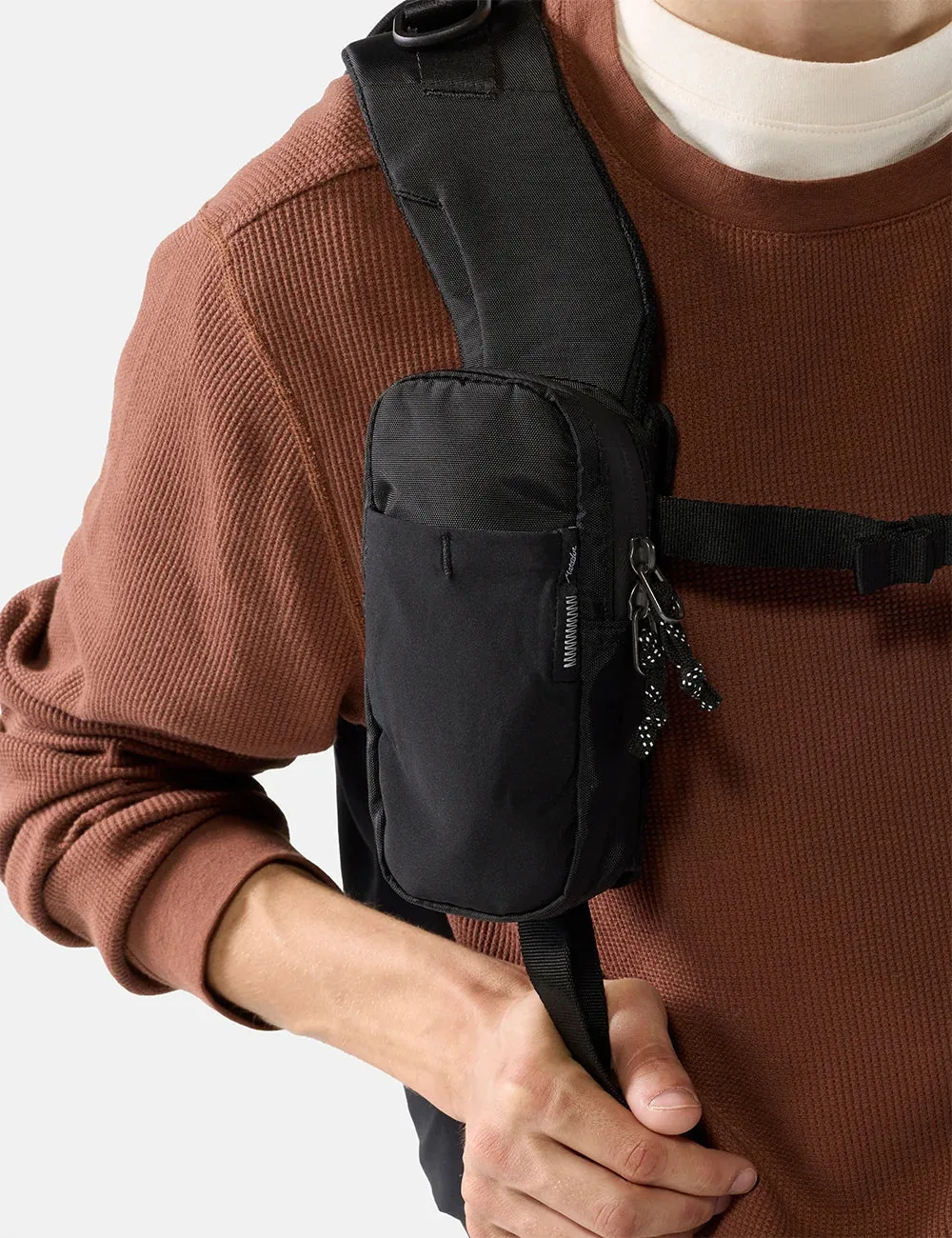
Matador Speed Stash Backpack Strap Pouch v2
Who should buy a strap pouch
Best for
- Street photographers who need fast access to a compact camera or action cam
- Hikers and travelers who want to keep a small camera or accessories on their backpack strap without digging through their main bag
Not ideal for
- Photographers carrying a full-frame DSLR with a large lens — the weight and bulk are too much for a strap pouch
- Users who need to carry multiple lenses or a large camera body — a chest pack or belt system would be more practical