Quick answer
Choose a macro focusing rail that matches your lens weight and desired precision: a single-axis rail like the ProMaster MR1 works well for most close-up work, while a dovetail sliding rail gives you smoother, more stable adjustments for critical focus stacking.
Single-axis vs dovetail: what changes?
A single-axis macro focusing rail moves the camera forward and backward along one plane. It is simpler, lighter, and usually more affordable. The ProMaster MR1 Macro Focusing Rail with Quick Release is a good example of this type. It works well for most close-up subjects like flowers or small products where you only need fine forward-backward adjustments.
A dovetail sliding rail uses a dovetail channel that provides a wider contact surface and less play. This design gives you smoother, more stable movement, which is especially helpful when you are stacking multiple shots for extreme depth of field. The ProMaster Professional Dovetail Macro Sliding Rail uses this approach.
Quick release vs fixed plate: which matters more?
A quick-release system lets you detach the camera from the rail without unscrewing the tripod plate. This is convenient if you switch between handheld and tripod shooting often. The ProMaster MR1 includes a quick-release clamp, so you can move quickly between setups.
A fixed plate design is simpler and has fewer moving parts, which can mean slightly more rigidity. If you rarely remove the camera from the rail, a fixed plate is fine and may save a little weight.
Weight capacity and stability
Macro rails have a weight limit. Heavier camera bodies and longer macro lenses need a rail that can support them without sagging. Both the ProMaster MR1 and the ProMaster Dovetail Sliding Rail are rated for typical DSLR and mirrorless setups, but check your specific gear weight before buying.
If you use a heavy telephoto macro lens or a camera with a battery grip, consider a dovetail rail for its wider base and better stability. For a lightweight mirrorless body with a compact macro lens, a single-axis rail is perfectly adequate.
How to pick the right macro focusing rail
- Check your lens weight: Look up the weight of your camera and macro lens. Choose a rail that supports at least that much weight, ideally with a 20% margin for safety.
- Decide on single-axis or dovetail: If you do basic close-ups and rarely stack images, a single-axis rail like the ProMaster MR1 is enough. If you do focus stacking or need precise, repeatable adjustments, go with a dovetail rail. For focus stacking, a dovetail rail is almost always worth the extra cost.
- Consider quick release: If you frequently switch between handheld and tripod shooting, get a rail with a quick-release clamp. If the rail stays on the tripod most of the time, a fixed plate is fine.
Macro focusing rails we recommend
-
ProMaster MR1 Macro Focusing Rail with Quick Release: Price Guarantee Rent Now You can buy with confidence knowing the price is competitive, and if you only need it for a weekend project, renting is an option.
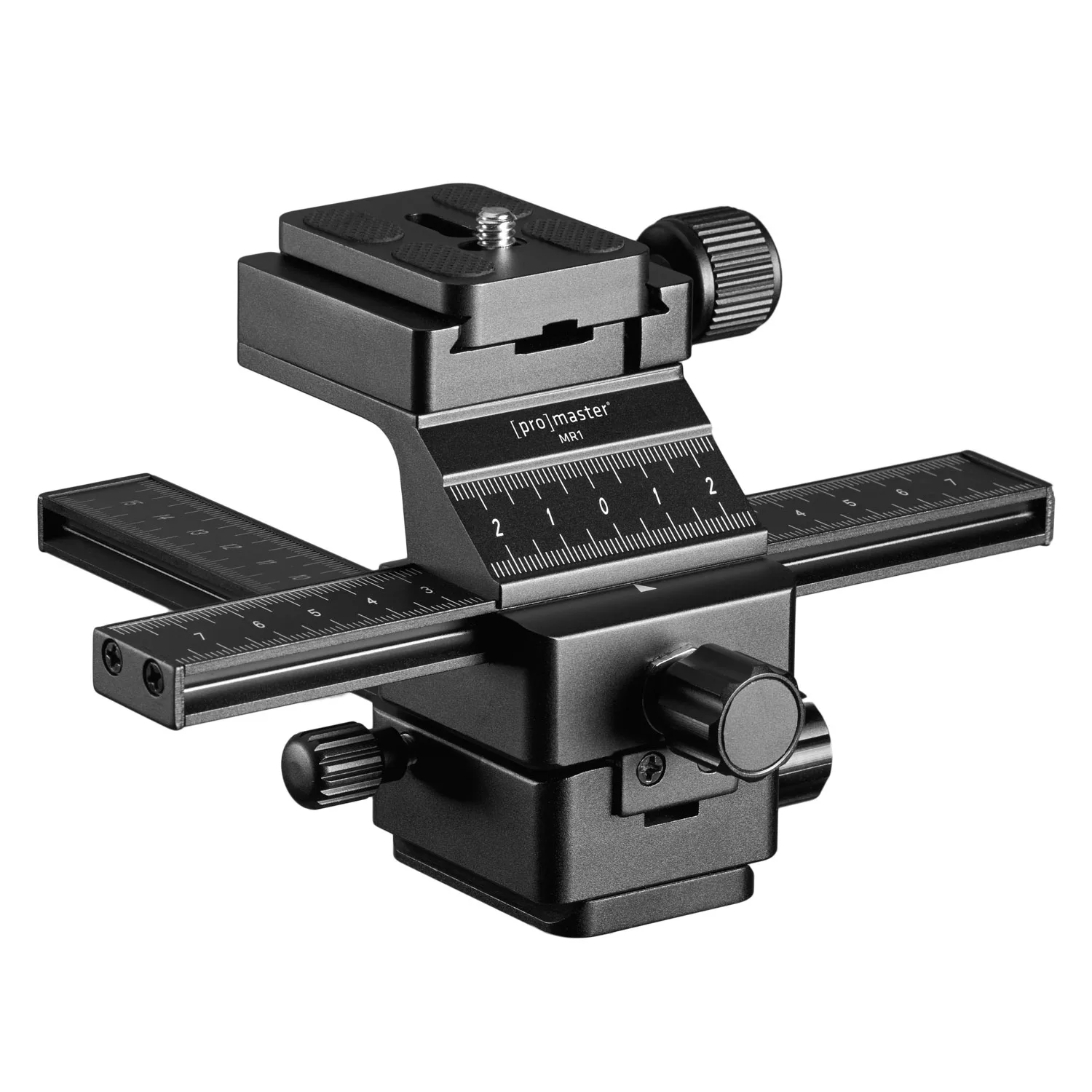
ProMaster MR1 Macro Focusing Rail with Quick Release
-
ProMaster Professional Dovetail Macro Sliding Rail: Price Guarantee Rent Now The same flexible purchasing and rental options apply, so you can test the dovetail design before committing to a purchase.
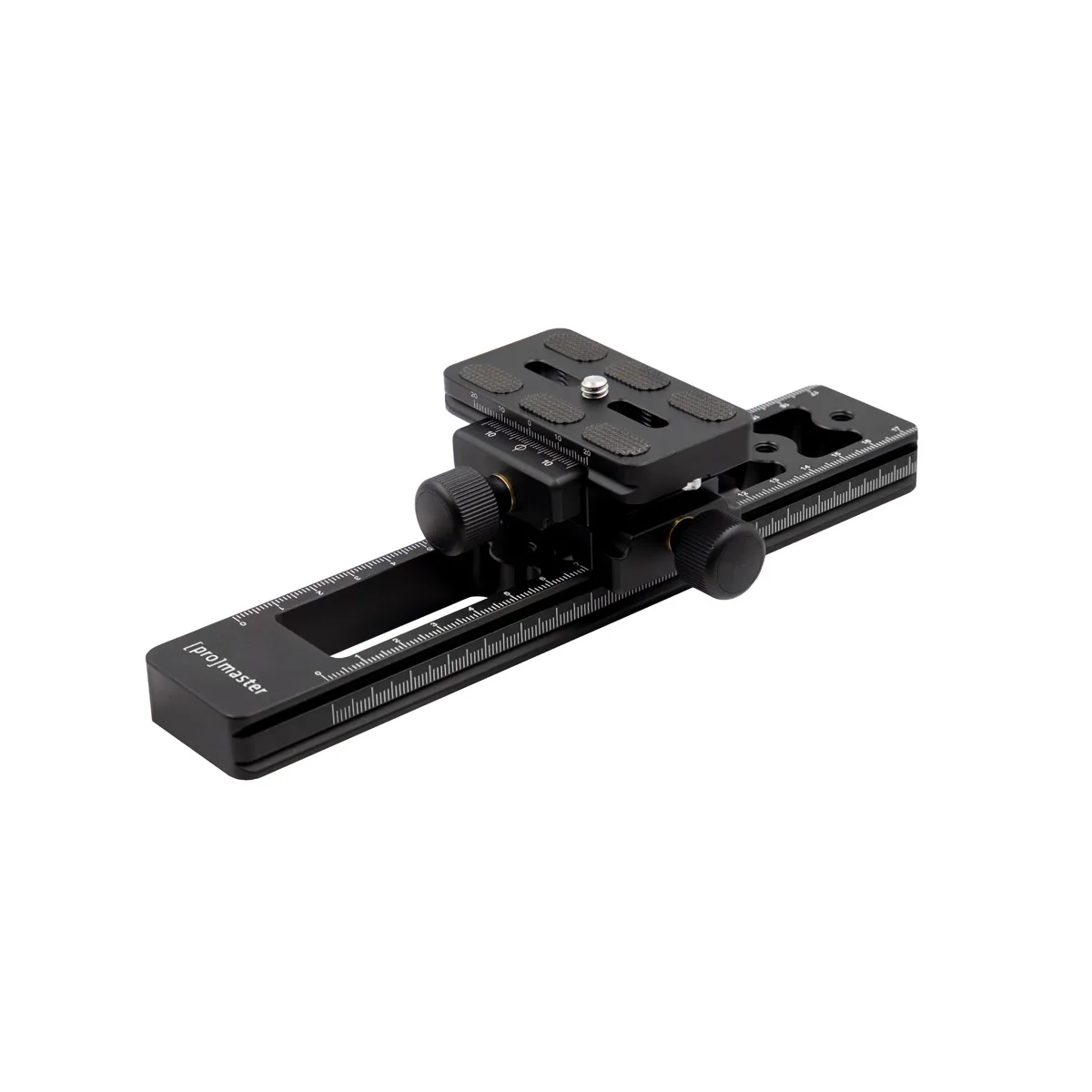
ProMaster Professional Dovetail Macro Sliding Rail
Who should buy which?
Best for
- Photographers who want a simple, affordable rail for general close-up work
- Anyone who needs quick-release convenience for switching between handheld and tripod shooting
Not for
- Serious focus stackers who need the smoothest, most stable movement possible