Quick answer
Choose a quilt pattern by matching its required shapes and tools to what you have already sewn, not by how the finished quilt looks. If a pattern uses only squares, rectangles, or precut-friendly units and offers multiple sizes or optional ruler instructions, it will usually suit a confident beginner. If it relies on curved piecing, Y-seams, or templates you do not own, treat it as a stretch project and expect a slower build.
A quilt pattern can look simple on the cover and still ask for skills you have not practiced yet. The fastest way to avoid a stalled project is to read the pattern like a set of instructions before you buy, then compare those instructions to the quilts you have already finished.
This guide gives you concrete decision rules for choosing a quilt pattern at your skill level. You will learn which pattern features signal an easy build, which ones signal a stretch, and how to use the pattern listings at GE Designs to make a confident choice.
Read the pattern before you buy it
Start with the shape list. Patterns built from squares, rectangles, and strip sets are the most forgiving because every seam is straight and every unit can be chain pieced. Patterns that mention curves, Y-seams, or set-in seams ask for a different skill set, so save those for after you have practiced those units on a small project.
Next, look at the cutting instructions and the tools they name. A pattern that includes instructions for regular rulers as well as specialty rulers gives you a fallback if you do not own the specialty tool yet. A pattern that assumes one specific ruler without an alternative is a commitment, so check your ruler drawer before you commit.
- Count the number of distinct fabric cuts. Fewer cuts means fewer chances to mislabel pieces.
- Look for a size range. Multiple size options let you start with a crib or table runner before committing to a bed quilt.
- Check whether the pattern is precut-friendly. Patterns written for 5" squares or 10" squares reduce cutting decisions.
Match pattern features to your skill level
Confident beginners do best with patterns that repeat one or two units many times. Repetition builds muscle memory, and any mistake shows up early enough to fix. If a pattern uses a single block in a straight grid, you can usually finish it with basic rotary cutting and a quarter-inch seam.
Intermediate quilters can take on patterns with alternating blocks, strip piecing, or a layout that creates movement. These patterns are not harder to sew, but they are harder to keep organized. Labeling your pieces and working in batches keeps the assembly accurate.
- Beginner: one block, straight grid, squares or rectangles only.
- Confident beginner: two alternating units, strip piecing, precut-friendly.
- Intermediate: dynamic layouts, multiple size options, optional specialty rulers.
Use the pattern listing as a skill filter
A good pattern listing tells you the finished size, the fabric requirements, and the tools the designer used. That is enough to judge whether the project fits your skill level. If a listing omits the required ruler or the number of blocks, treat that as a decision limitation and look for a pattern with clearer instructions.
At GE Designs, patterns are written by Gudrun Erla and often include Stripology ruler instructions alongside regular ruler instructions. That dual approach is useful because it lets you choose the cutting method that matches your tools and your comfort level.
- Check the finished size. A 16 1/2" x 48" table runner is a low-commitment first project.
- Check the fabric format. 5" squares, 10" squares, and 2 1/2" strips each change the cutting workload.
- Check the designer's tool notes. Optional ruler instructions mean you are not locked into one method.
Start with a small project to test a new skill
When you want to try a new technique, scale it down. A table runner uses the same piecing skills as a bed quilt but finishes in a fraction of the time. If the runner goes well, you already know the block works for you, and you can size up with confidence.
Small projects also let you test a fabric combination before you cut into a full quilt's worth of yardage. If the colors do not sing at runner scale, you have lost very little and learned a lot.
- Use a table runner to test a block before committing to a bed quilt.
- Keep the first version in one fabric family so you can focus on technique, not color balance.
- If the pattern includes multiple sizes, start at the smallest and work up.
Decision rules for matching a pattern to your skill level
- If you have finished fewer than three quilts: Choose a pattern that uses only squares, rectangles, or strip sets and repeats one block many times. Prefer a pattern with a small finished size, such as a table runner, so you can complete the full process—cutting, piecing, quilting, binding—without a long commitment. Start with Lil' Winny or Lil' Billie, then size up.
- If you own a Stripology ruler: You can take on patterns designed around it, such as Rita or Alberta, because the cutting is faster and more accurate. Check whether the pattern also includes regular ruler instructions so you can still use the pattern if you change tools later. Specialty rulers expand your pattern options but are not required for every pattern.
- If you are unsure about a pattern's difficulty: Read the fabric requirements and the tool list before buying. If the listing does not name the required ruler or the number of blocks, treat that as a decision limitation and look for a pattern with clearer instructions. Clear instructions are more valuable than a pretty cover.
- If you want to try a new technique: Test it on a small project first. A table runner uses the same piecing skills as a bed quilt but finishes quickly. If the technique works for you, size up with a pattern that offers multiple size options. Small projects are the cheapest way to learn.
Patterns and tools that match this approach
- Lil' Winny- Table Runner Pattern 246: The Lil' Winny pattern is a quick-to-make, visually striking table runner that turns 5" squares into a lively, modern design full of movement. Measuring 16 1/2" x 48", this project is perfect for showcasing your favorite fabric collections—whether you're working with 5" squares, Fat 12s (6" x 21"), or a Lil' Bundle. It is a low-commitment first project that uses precut-friendly 5" squares, so you can practice accurate piecing without cutting a full bed quilt's worth of fabric.
- Lil' Billie - Table Runner Pattern 243: Lil' Billie is a playful new addition to our Lil' Pattern Collection. Like all patterns in this series, it's designed to make the most of 5" squares, making it Lil bundle friendly and great for scraps. At first glance, Lil' Billie looks intricate, but it's actually much faster and easier than it seems—especially when paired with the Stripology Rulers. Of course, you don't need special tools; the pattern includes instructions for using regular rulers as well. The pattern gives you a fallback if you do not own Stripology rulers, so it fits a confident beginner who wants an intricate look without buying new tools.
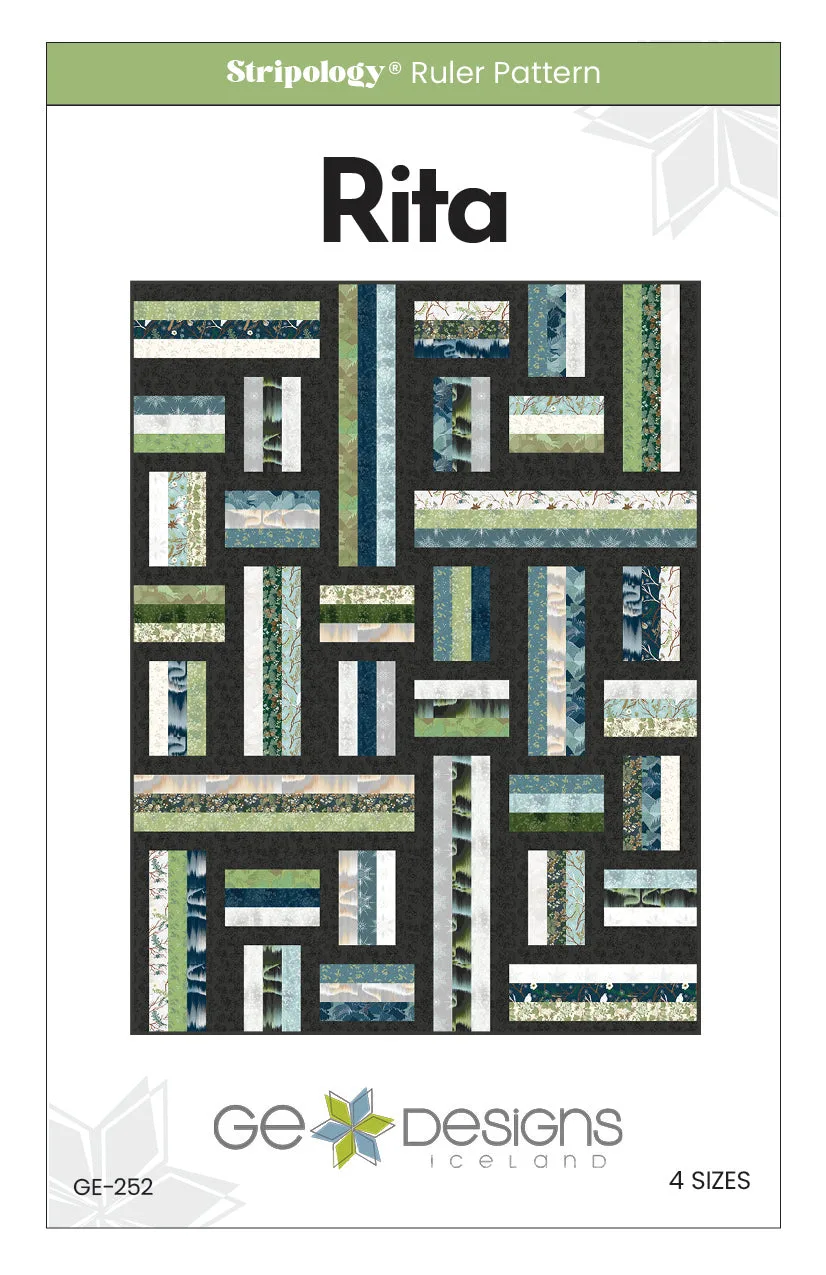
- Rita Quilt Pattern GE-252: Create a bold, modern quilt with the Rita pattern by Gudrun Erla. This striking design features clean lines and playful strip piecing, arranged in a dynamic layout that gives the illusion of movement and depth. Designed with Stripology® rulers in mind, Rita makes cutting fast and accurate while keeping the construction simple and enjoyable. Using 2 1/2" strips or stash-friendly fabric cuts, this pattern is perfect for... Strip piecing from 2 1/2" strips is a natural next step after table runners, and the dynamic layout rewards an intermediate quilter who can keep organized.
- Alberta 10" Square Pattern 172: This quilt uses assorted 10" squares along with background fabric and fast, innovative piecing and cutting with the Stripology or Stripology Squared rulers by GE Designs. Instructions for using regular rulers are included. The pattern comes with 6 different size options: crib, lap, twin, full, queen, king. The six size options let you start at crib or lap and size up later, and the included regular-ruler instructions mean you are not blocked if you do not own a Stripology ruler.
Who these patterns fit
Best for
- Confident beginners who have sewn a few straight-seam projects and want a finished quilt or runner
- Quilters who prefer precut-friendly patterns using 5" or 10" squares
- Anyone who wants optional ruler instructions so they can use the tools they already own
Not for
- Quilters looking for curved piecing, appliqué, or advanced techniques
- Sewists who want a single large bed quilt as their very first project
- Anyone who prefers patterns without any ruler-based cutting instructions
Choose a pattern by matching its shapes, tools, and finished size to what you have already sewn. Start small, read the listing carefully, and let your tools—not the cover photo—decide what you buy next.