Quick answer
To choose a Schott longpass filter, first determine your required cutoff wavelength—this is the point where the filter transitions from blocking to transmitting light. Then match the filter dimensions to your optical path. For near-infrared applications, the https://uqgopticser.com/products/schott-rg9-3-e8ce866cb39042257f24f7c0-1696613Schott RG9 (cutoff around 720 nm) is a compact, cost-effective choice. For UV-blocking or visible-light work, the Schott N-WG295 (cutoff around 295 nm) offers a larger 50x50 mm aperture.
Understanding Cutoff Wavelength
The most critical specification for any longpass filter is its cutoff wavelength. This is the wavelength at which transmission rises sharply from near zero to its maximum. Schott filters are named by their cutoff: for example, RG9 begins transmitting around 720 nm (near-infrared), while N-WG295 starts around 295 nm (deep UV). Choosing the wrong cutoff means your detector sees either too much unwanted light or not enough signal.
If your application involves blocking visible light while passing infrared—common in night-vision or fluorescence imaging—a filter like RG9 is appropriate. If you need to block UV and pass visible light, N-WG295 is a better fit. Always verify the cutoff against your light source and detector sensitivity.
Size and Mounting Considerations
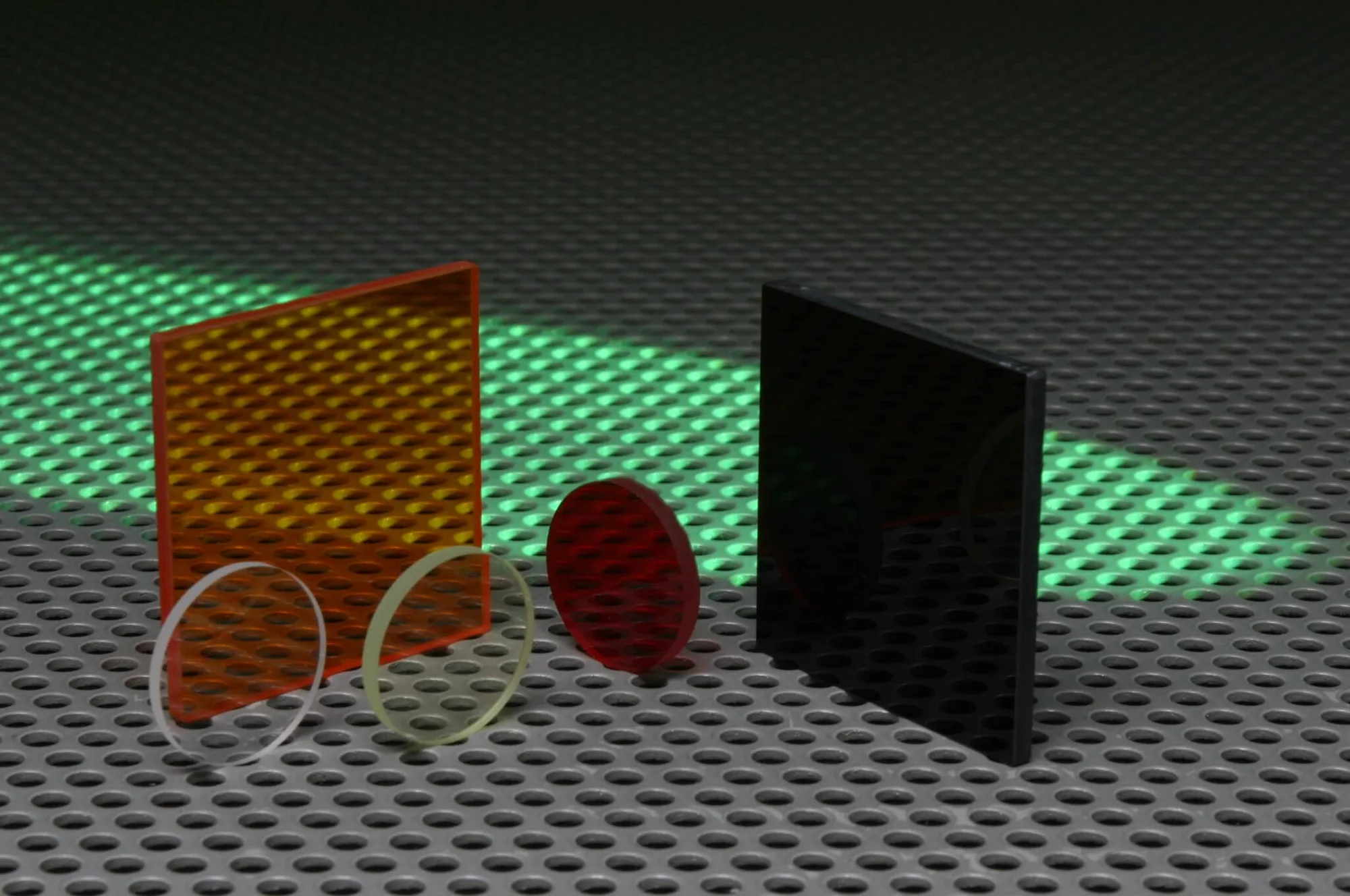
Schott longpass filters come in standard diameters and squares. The RG9 is available as a Ø12.5 mm disc, ideal for small-diameter lenses or fiber-coupled systems. The N-WG295 comes as a 50x50 mm square, suitable for larger beam paths or filter holders. If your setup uses a standard 1-inch (25.4 mm) mount, you may need an adapter or a custom size—check the dimensions before ordering.
Thickness also matters: both filters listed here are 2-3 mm thick, which is typical for standard mounts. Thicker filters can cause beam displacement in converging light, so for precision imaging, confirm the thickness tolerance with the supplier.
Trade-Offs Between Compact and Large Formats
Small filters like the Ø12.5 mm RG9 are less expensive and easier to handle in confined spaces, but they limit your beam diameter. Larger filters like the 50x50 mm N-WG295 offer more flexibility for collimated beams or multi-channel systems, but they cost more and require larger mounts. There is no universal best—choose based on your optical layout.
If you anticipate upgrading your system later, consider buying the larger format now to avoid re-purchasing. For one-off experiments, the smaller size is often sufficient and more budget-friendly.
Decision Rules for Choosing a Schott Longpass Filter
- Match cutoff to your light source: Identify the wavelengths you want to block and those you want to pass. The filter's cutoff must lie between them. For IR work, choose RG9 (720 nm cutoff). For UV-blocking visible pass, choose N-WG295 (295 nm cutoff). Checkpoint: Does your detector respond to the passed wavelengths?
- Choose size for your optical path: Measure the clear aperture of your lens or holder. A Ø12.5 mm filter fits small systems; a 50x50 mm filter fits larger ones. If your beam is collimated, size is less critical; if focused, the filter must be placed in the collimated section to avoid aberrations. Verdict: Use the larger format if you need to accommodate future changes.
- Consider thickness and mounting: Both filters are 2-3 mm thick, compatible with most standard mounts. For precision imaging, verify that the thickness does not shift the focal plane. If using a custom holder, confirm the filter's outer dimensions and thickness tolerance. Next step: Order a mount or adapter that matches the filter's diameter or square size.
Schott Longpass Filter Options at UQG Optics
- Schott RG9: Schott RG9 longpass filter, Ø12.5 mm, 3 mm thick. Part numbers FRG92512, FRG-92512, FRG 92512. This compact size fits small optical assemblies and is ideal for near-infrared applications where space is limited. The low price makes it a good starting point for prototyping.
- Schott N-WG295: Schott N-WG295 longpass filter, 50x50 mm, 2 mm thick. Part numbers FWG29550, FWG-29550, FWG 29550. The larger square format suits wider beams and standard filter holders. Its deep-UV cutoff is essential for blocking UV while transmitting visible light in microscopy or spectroscopy.
Which Filter Fits Your Setup?
Best for
- Near-infrared imaging or fluorescence: Schott RG9 (Ø12.5 mm) – compact and affordable
- UV-blocking visible-light applications: Schott N-WG295 (50x50 mm) – large aperture for microscopy or spectroscopy
Not for
- Applications requiring a sharp cutoff above 800 nm: consider other Schott RG series filters
- High-power laser systems: standard longpass filters may not handle extreme fluence without damage