Quick answer
For the strongest visual development in the first months, choose a mobile with high-contrast black and white patterns or bold primary colors, and ensure it can be positioned at the right distance (12–14 inches) from your baby's eyes.
Why visual development matters for newborns
Newborns see the world in blurry, low-contrast images at first. Their vision develops rapidly in the first few months, and a well-chosen baby mobile can help stimulate their ability to focus, track movement, and distinguish shapes.
High-contrast patterns (like black and white or bold reds and yellows) are easier for a newborn's immature visual system to process. Mobiles with simple, distinct shapes encourage your baby to practice focusing and following, which builds the neural pathways for sight.
Key trade-offs in mobile design
Black and white mobiles are excellent for 0–3 months, but babies quickly outgrow them. Colorful mobiles with rotating figures can hold interest longer but may be too complex for a newborn to see clearly.
Mobiles with music and lights add sensory input but can overstimulate a very young baby. If you choose one, look for a volume control or a quiet mode.
A mobile that attaches to a bouncer or play gym offers portability and can be used during supervised play, but it may not be as stable as a crib-mounted mobile. Always follow safety guidelines for mounting height and secure attachment.
Your baby mobile decision rules
- Age-appropriate contrast: For newborns under 3 months, choose a mobile with black and white or high-contrast patterns. After 3 months, switch to a mobile with bright primary colors or more complex shapes.
- Positioning distance: Hang the mobile 12–14 inches (30–35 cm) from your baby's face—this is the optimal distance for their developing vision. Too close or too far reduces visual stimulation. Measure the distance from the lowest hanging piece to your baby's eyes.
- Movement and interaction: Look for a mobile that rotates or has moving parts. Slow, gentle rotation helps your baby practice visual tracking. Some mobiles allow your baby to bat or spin pieces, adding tactile exploration. Ensure all parts are securely attached and free of small, detachable pieces.
- Safety and mounting: Always mount the mobile securely according to the manufacturer's instructions. Remove the mobile once your baby can push up on their hands or reach for the mobile (around 5–6 months) to avoid entanglement. Set a calendar reminder to remove the mobile when your baby starts sitting up.
Product spotlight
-
Toy For Bouncer: The Toy For Bouncer by BABYBJÖRN features brightly colored rotating figures that spark a baby's curiosity and may elicit their first smile. The rotating action encourages visual tracking, while the bright colors help your baby distinguish shapes—supporting visual development during supervised play in a bouncer.
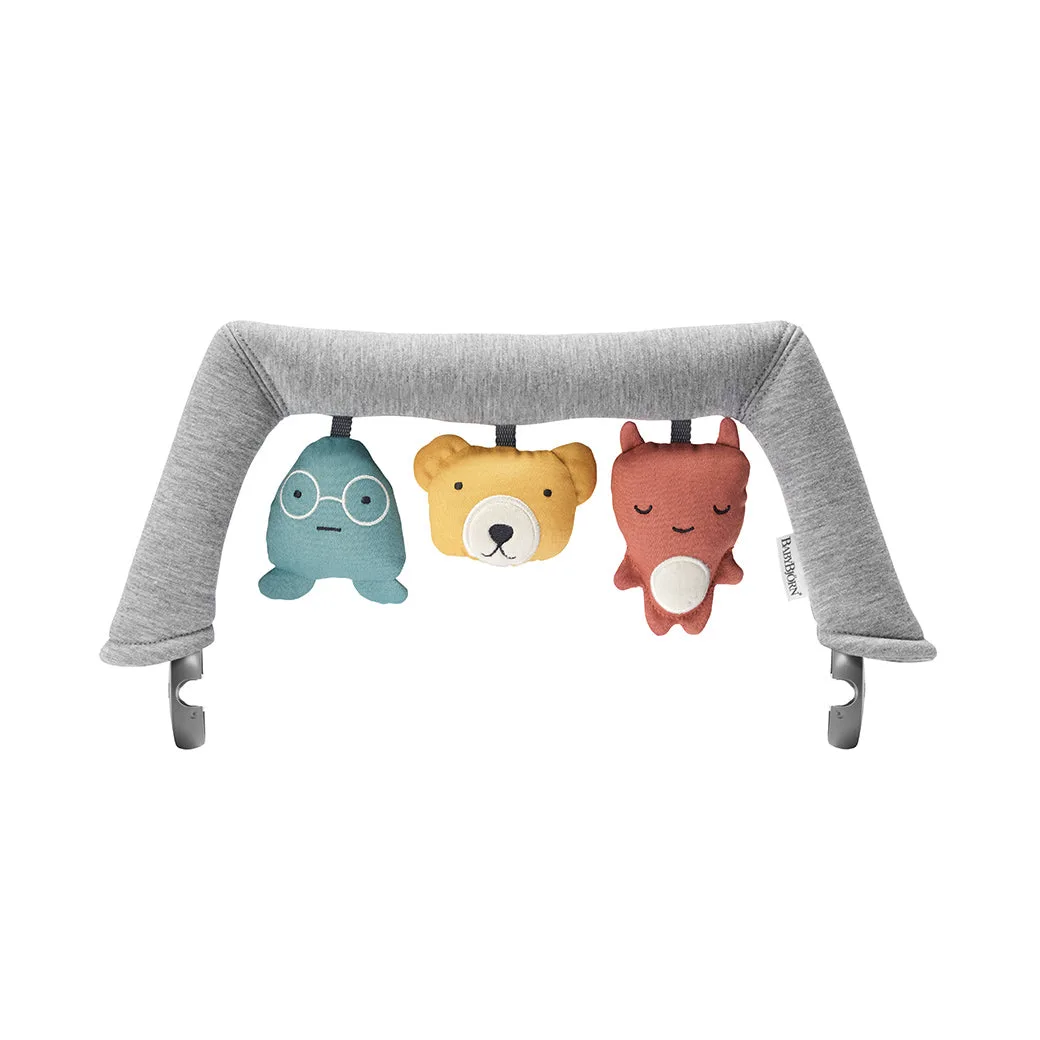
Toy For Bouncer
Which mobile is right for your baby?
Best for
- Newborns (0–3 months): a black and white or high-contrast mobile for focused visual stimulation
- Babies 3–6 months: a colorful mobile with rotating figures or interactive elements to encourage tracking and curiosity
Not for
- Babies who can sit up or push up on hands (risk of entanglement—remove the mobile)
- Parents seeking a mobile primarily for sleep aid (consider a white noise machine or a mobile with a separate volume control)