Quick Answer
For most toddlers, a versatile balance beam set with adjustable height and multiple configurations is the best choice. Look for solid wood construction, a low height for safety, and pieces that can be rearranged to grow with your child's skills.
Size and Space Considerations
Before buying a balance beam, measure the area where you plan to use it. Toddlers need room to step on and off safely, so add at least a couple of feet of clearance on each side. If space is tight, look for a set that can be stored compactly or used in smaller configurations.
The height of the beam is critical. For toddlers, a lower beam is safer and less intimidating. Look for a set that sits close to the ground, ideally under 4 inches, to minimize the impact of falls.
Safety Features to Prioritize
Safety is the top priority when choosing a balance beam for toddlers. Check that the wood is smoothly sanded with no splinters, and that all edges are rounded. Non-slip surfaces or added grip pads can help prevent slips during use.
Also consider stability. A beam that wobbles too much can be frustrating and unsafe. Look for a design with wide, stable supports or a low profile that stays put during active play.
Versatility and Long-Term Value
Toddlers quickly outgrow simple toys, so a balance beam that offers multiple activities is a smarter investment. Sets that include planks, nogs, and connecting supports let you create different pathways and obstacle courses, keeping the challenge fresh.
A modular set can also be used for other activities like stepping stones or a low bench. This versatility extends the life of the product and provides more value for your money.
Decision Rules for Choosing a Balance Beam
- Measure your space first: Decide where the beam will be used and measure the floor area. Choose a set that fits comfortably with at least 2 feet of clearance on each side. If space is limited, consider a set that can be partially assembled or stored vertically.
- Prioritize low height and stability: For toddlers, pick a beam that is low to the ground (under 4 inches) with a stable base. This reduces the risk of injury and boosts confidence. Check customer reviews for stability feedback before purchasing.
- Look for modularity and grip: Choose a set with multiple pieces and configurations, and ensure the walking surface has a non-slip texture or can be enhanced with grip pads. Modular sets often last longer because they can be rearranged to create new challenges.
Product Spotlight
-
Balance Beam Set: The Balance Beam Set includes planks and nogs with connecting supports, allowing you to create interesting pathways and obstacle courses. This modular design lets you adjust the difficulty and layout as your toddler's balance improves, keeping them engaged for longer.
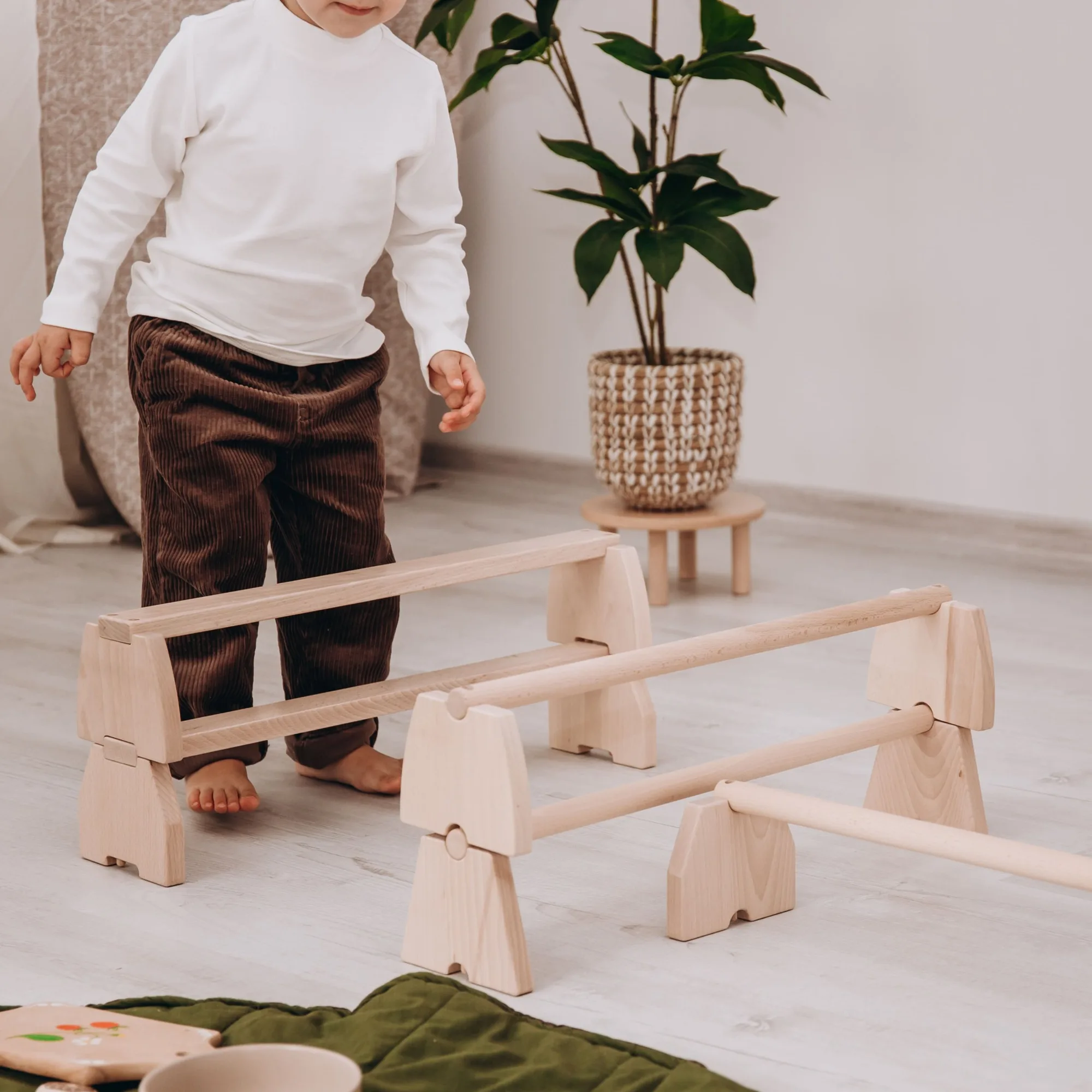
Balance Beam Set
Who Should Choose This Type of Balance Beam
Best for
- Parents with toddlers who are just starting to practice balance and coordination
- Families with limited space who want a versatile, low-profile indoor activity
Not for
- Older children who need a higher, more challenging balance beam for advanced training