Quick answer
For most adults, choose a 500-piece puzzle if you want a satisfying 2–4 hour session that fits on a standard card table. Choose a 750-piece puzzle if you want a longer, more challenging build—especially a 750 piece shaped puzzle—and have a dedicated space like a 3-foot-wide table. If you are new to puzzles, start with 500. If you regularly finish 500s and want more of a challenge, move up to 750.
The jump from 500 to 750 pieces sounds small, but it changes your puzzle time, table footprint, and how often you get stuck. A 500-piece puzzle is a comfortable evening project for most adults. A 750-piece puzzle adds roughly 50% more pieces, which often means 4–6 hours of total build time and a larger finished size.
This guide gives you concrete decision rules so you can pick the right count without guessing. We will look at time, space, difficulty, and how shaped puzzles change the math. You will also see real examples from our catalog, including a 500-piece family puzzle and a 300-piece option that can help you bridge the gap.
Time and difficulty: what actually changes from 500 to 750 pieces
Piece count is the biggest factor in how long a puzzle takes, but it is not the only one. A 500-piece puzzle with large areas of sky or water can feel harder than a 750-piece puzzle with clear color blocks. As a rule, a 500-piece puzzle takes most adults 2–4 hours. A 750-piece puzzle usually takes 4–6 hours. That assumes average image complexity and a dedicated workspace.
Difficulty also depends on piece size and shape. Standard 500 and 750-piece puzzles use similar piece sizes, so the 750 simply has more pieces and a larger finished area. If you want a medium puzzle difficulty that still feels achievable in one or two sittings, 500 is the safer bet. If you want a weekend project that stays out on the table, 750 gives you more build time for your money.
- Track your last 500-piece build time. If it took under 3 hours, a 750 is a reasonable next step.
- If you puzzle in short 30-minute sessions, a 500-piece puzzle will feel more rewarding because you see progress faster.
Table space and storage: measure before you buy
A 500-piece puzzle typically finishes around 20 x 20 inches, though exact dimensions vary by brand and shape. A 750-piece puzzle is often larger, but the finished size depends on the manufacturer. Shaped puzzles can be wider or taller than rectangular ones with the same piece count. Always check the finished dimensions on the box, not just the piece count.
You also need room for loose pieces. A good rule is to have at least 6 inches of border around the finished puzzle for sorting trays or piles. If you use a puzzle mat or board, make sure it fits your table with room to spare. For a 750-piece puzzle, a 3-foot-wide table is a comfortable minimum for most rectangular designs.
- Measure your table and subtract 12 inches from each dimension to estimate your maximum finished puzzle size.
- If you puzzle on a shared table, a 500-piece puzzle is easier to move or store between sessions.
Shaped puzzles: why a 750 piece shaped puzzle plays differently
A 750 piece shaped puzzle is not just a bigger rectangle. The border follows a silhouette—an animal, a house, a scene—so edge pieces are irregular and the corners may not be obvious. That adds difficulty because you cannot rely on a straight frame to anchor your build. Many shaped puzzles also have a smaller finished area than a rectangular 750 because the shape cuts away corners.
If you are choosing your first shaped puzzle, 750 pieces can be a steep jump. A 500-piece shaped puzzle or a 300-piece shaped scene puzzle gives you the fun silhouette without the extra piece count. If you have already done several 500-piece puzzles and want a new challenge, a 750 shaped puzzle is a great next step.
- Sort edge pieces first, but expect them to be curved or angled—do not force them into a straight line.
- Check the finished dimensions: a shaped 750 may be smaller than you expect, which can make pieces feel more crowded.
How to choose your piece count: a simple decision path
Start with your available time and space. If you have 2–4 hours and a standard card table, choose 500. If you have 4–6 hours and a larger dedicated table, choose 750. Next, consider your experience. If you have never finished a 500-piece puzzle, start there. If you regularly finish 500s without frustration, 750 is a natural progression.
Finally, think about the image. High-contrast, distinct sections make a 750 feel easier. Large gradients or repeating patterns make any count harder. When in doubt, choose the lower count for a more relaxing build, or the higher count for a longer challenge.
- New to puzzles: 300–500 pieces.
- Comfortable with 500: try 750.
- Want a display piece: consider a 500-piece wood puzzle with a stand.
Decision rules for 500 vs 750 piece puzzles
- Time rule: If you want to finish in one or two sittings, choose 500. If you want a multi-day weekend project, choose 750. 500 = 2–4 hours; 750 = 4–6 hours for most adults.
- Space rule: Measure your table. A 500-piece puzzle usually fits a card table. A 750-piece puzzle often needs a 3-foot-wide table plus room for loose pieces. If you cannot leave the puzzle out, stay with 500.
- Experience rule: If you have not completed a 500-piece puzzle yet, do not start with 750. Build one 500 first to learn your pace and sorting habits. New puzzlers: 300–500. Returning puzzlers: 750.
- Shape rule: A 750 piece shaped puzzle adds difficulty because the border is irregular. If you want a shaped puzzle, try a 300 or 500 shaped scene first. Shaped 750 is for puzzlers who already enjoy a challenge.
- Image rule: Busy, high-contrast images make 750 manageable. Large sky, water, or repeating patterns make any count harder. When in doubt, choose the lower count for a relaxing build.
Real puzzles that show the difference
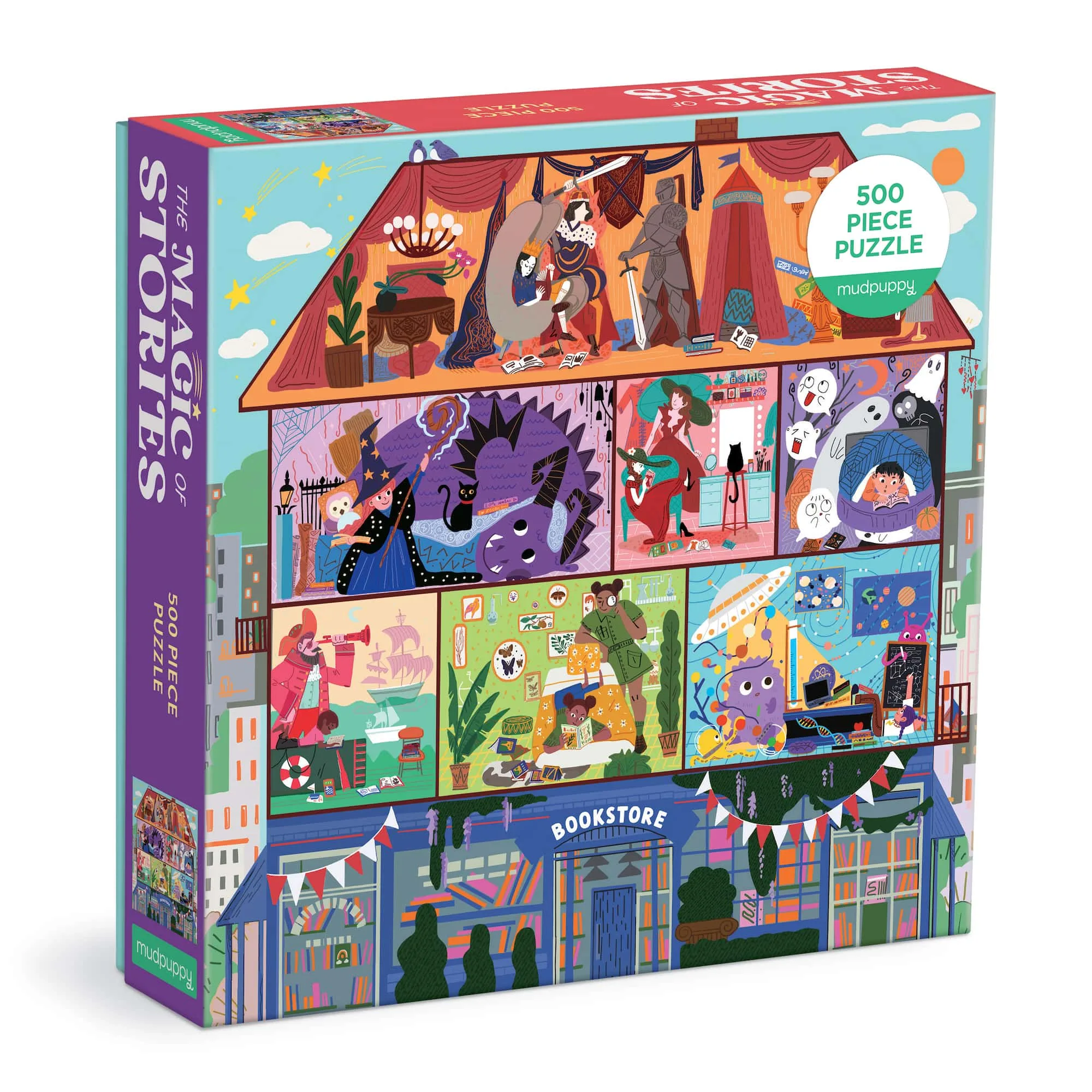
- Magic of Stories 500 Piece Family Puzzle: 500-piece puzzle, finished size 20 x 20 inches (51 x 51 cm), ages 8–99, packaged in a matte-finish sturdy box. This is a classic 500-piece size that fits a standard card table and stores easily. The 20 x 20-inch square shape gives you a manageable build area, and the sturdy box is good for gifting or reuse.
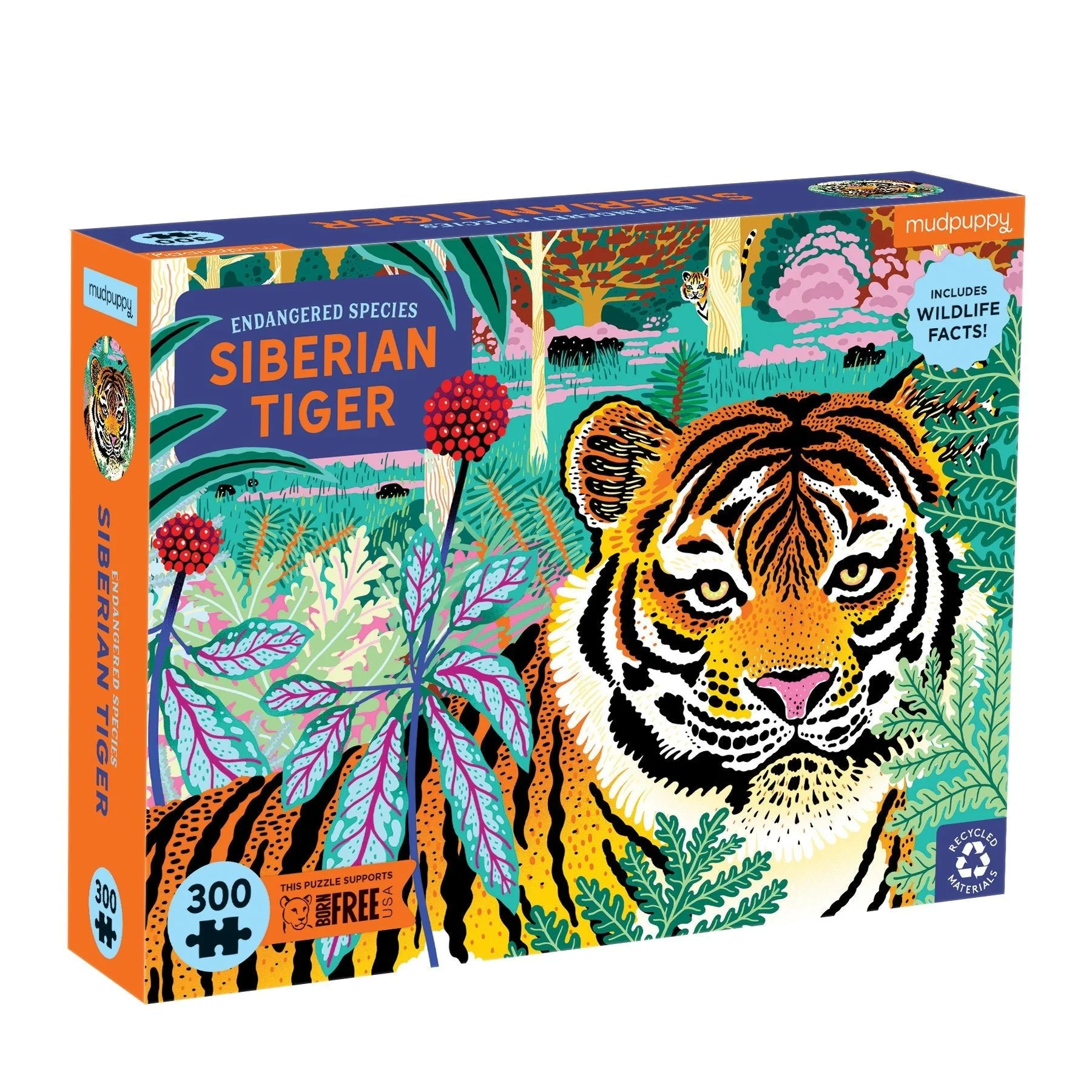
- Siberian Tiger Endangered Species 300 Piece Puzzle: 300-piece puzzle, finished size 24 x 18 inches (61 x 46 cm), includes wildlife facts, and 1% of the retail value is donated to Born Free USA. A 300-piece puzzle is a smart bridge if you are not ready for 750. It has a larger finished size than some 500s but fewer pieces, so it builds faster and feels less intimidating while still offering a satisfying image.
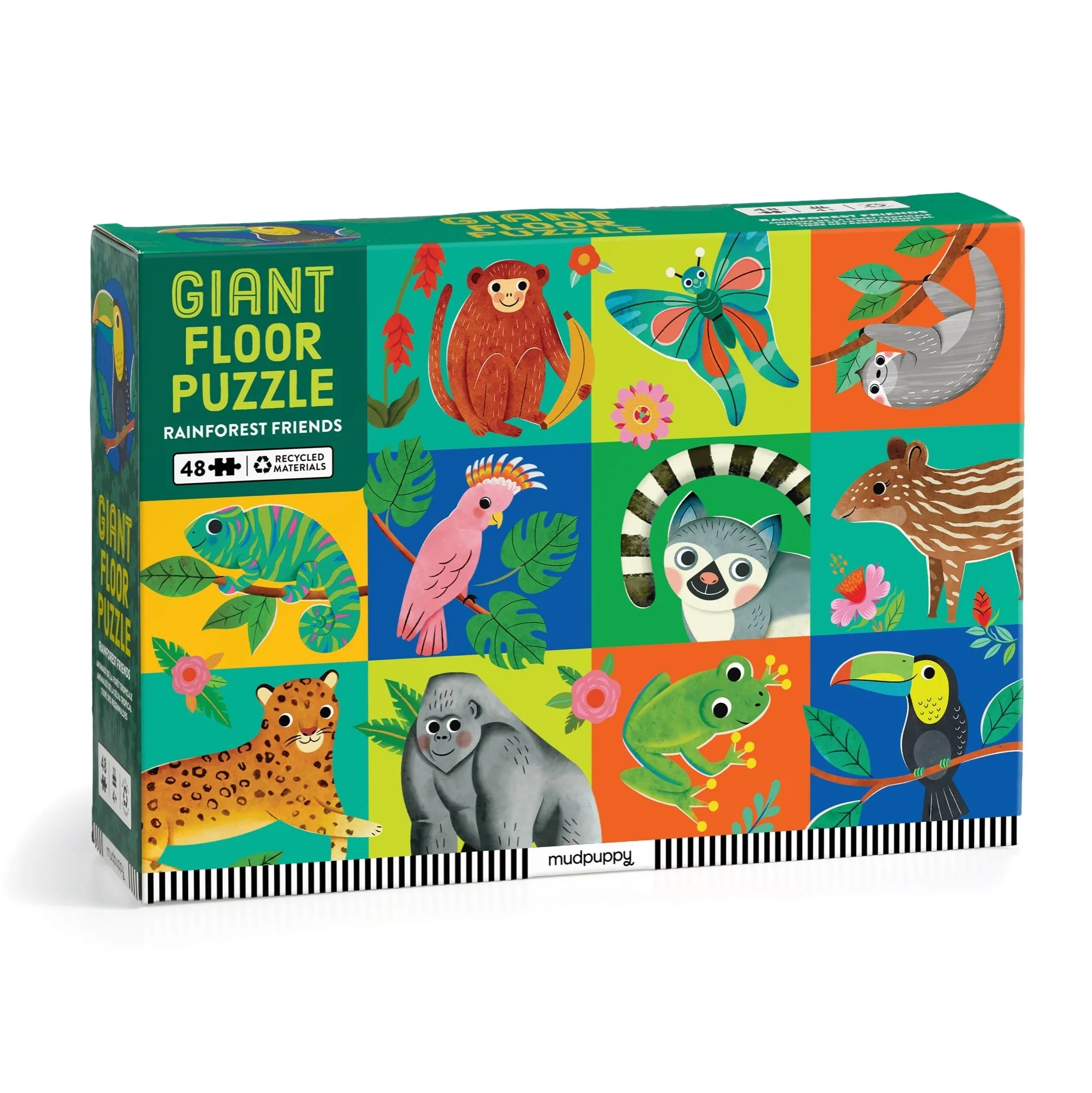
- Rainforest Friends 48 Piece Giant Floor Puzzle: 48-piece giant floor puzzle with oversized pieces, designed for independent or group play and to develop spatial awareness. This shows that piece count alone does not determine difficulty. Giant floor puzzles are for younger children or group play, not adults. If you are shopping for a mixed-age household, keep floor puzzles separate from your 500 vs 750 decision.
Who should choose which
Best for
- Adults who want a satisfying evening puzzle that fits a standard table (500 pieces)
- Puzzlers who have completed several 500s and want a longer, more challenging build (750 pieces)
- Families with older children (ages 8+) who want a shared project (500-piece family puzzle)
- Anyone who wants a shaped puzzle challenge after mastering rectangular 500s (750 piece shaped puzzle)
Not for
- Young children or families with toddlers—choose a 48-piece giant floor puzzle or 2-piece match-up puzzles instead
- People with very limited table space or no way to leave a puzzle out—choose 300–500 pieces
- First-time puzzlers who have never finished a 500-piece puzzle—start with 300–500
- Anyone who dislikes long projects—a 750 may feel tedious; stay with 500
Choosing between 500 and 750 pieces comes down to time, space, and experience. Use the decision rules above, measure your table, and pick the count that matches your real-life puzzle habits. If you are still unsure, start with a 500-piece puzzle like the Magic of Stories 500 Piece Family Puzzle, then move up to 750 when you are ready for a longer build.