Quick Answer
For most laser focusing setups, choose a plano-convex lens with a focal length about 1.5 to 2 times your beam diameter, and pick N-BK7 for visible to near-IR, fused silica for UV or high-power IR.
Substrate Choice: N-BK7 vs Fused Silica
The substrate determines how your lens handles wavelength and power. N-BK7 optical glass is a standard choice for visible and near-infrared lasers because it offers good transmission and low cost. Fused silica is better for ultraviolet wavelengths or high-power applications because it handles higher temperatures and has lower thermal expansion.
If you are working with a common laser wavelength like 532 nm or 1064 nm at moderate power, N-BK7 gives you excellent value. For UV lasers below 350 nm or for high-power continuous-wave lasers, fused silica is the safer material to avoid thermal damage and maintain beam quality.
Focal Length and Diameter: What Matters
The focal length controls the spot size and working distance. A shorter focal length gives a smaller spot but requires the lens to be closer to the target, which can be a problem if you need space for other optics. A longer focal length gives a larger spot and more working room.
The diameter must be large enough to capture the full beam without clipping. Measure your beam diameter at the lens position and add a safety margin of at least 20%. For a Gaussian beam, use the 1/e^2 diameter as your reference.
Trade-Off: Cost vs Performance
N-BK7 lenses are significantly cheaper, but they are not suitable for UV or very high power. Fused silica costs more but offers better performance in demanding conditions. If your application is simple prototyping or low-power visible lasers, N-BK7 is often the right balance.
Also consider that plano-convex lenses are designed for infinite conjugate use, meaning the light entering should be parallel. If your laser beam is diverging, you may need additional collimation optics or a different lens type.
Decision Rules for Plano-Convex Lens Selection
- Determine your laser wavelength: If your wavelength is below 350 nm or above 2 µm, choose fused silica. For visible or near-IR (400-1100 nm) at moderate power, N-BK7 is sufficient.
- Estimate required focal length: For focusing a collimated beam to a small spot, use f ≈ 1.5 to 2 times the beam diameter as a starting point. Adjust based on spot size and working distance needs. Calculate spot size with the formula: spot diameter ≈ (4λf)/(πD), where λ is wavelength and D is beam diameter.
- Select diameter with margin: Measure the beam diameter at the lens and choose a lens diameter at least 20% larger to avoid clipping and diffraction effects.
- Check power handling: For high-power lasers (above ~10 W CW) or pulsed lasers with high peak power, prefer fused silica to reduce thermal lensing and damage risk. If unsure about power limits, contact the manufacturer for a quote and specification check.
Relevant Product Options
-
Plano-Convex Lenses - I2-IR Fused Silica: Plano-convex lenses in I2-IR fused silica are designed for infinite conjugate use and are ideal for all-purpose focusing elements. This fused silica option suits UV and high-power IR laser focusing where thermal stability is critical.
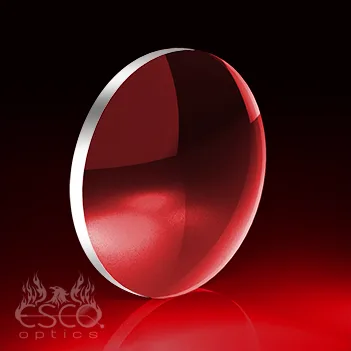
Plano-Convex Lenses - I2-IR Fused Silica
-
Plano-Convex Lenses, N-BK7 Optical Glass*: These N-BK7 plano-convex lenses are positive focal length elements with one spherical and one flat surface, ideal for all-purpose focusing. N-BK7 provides a cost-effective choice for visible and near-IR laser focusing in non-critical applications.
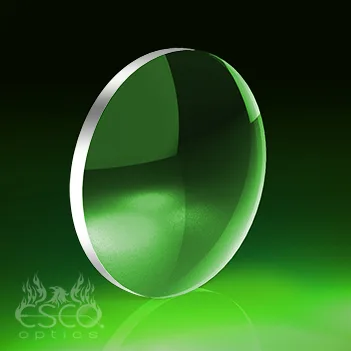
Plano-Convex Lenses, N-BK7 Optical Glass*
Which Lens Fits Your Application?
Best for
- Visible and near-IR laser focusing at moderate power where cost matters
- UV or high-power IR applications requiring thermal stability
Not for
- Applications needing tight focusing with very short working distance—consider a different lens shape
- Highly divergent beams without additional collimation