Quick Answer
Choose a pull along train that matches your toddler's age and motor skills, uses safe, durable materials, and offers more than one way to play—like stacking and pulling—so it grows with your child.
Why Age and Motor Skills Matter
Pull along toys are designed to support toddlers as they learn to walk and pull. For younger toddlers (around 10-12 months), look for trains with chunky pieces that are easy to grasp and don't require fine motor precision. For older toddlers (18 months and up), trains with detachable carriages and stacking elements encourage creativity and problem-solving.
A train that is too advanced can frustrate a young child, while one that is too simple may not hold an older toddler's interest. Consider the recommended age range on the product—it's a helpful starting point, but also observe your child's coordination and patience.
Materials and Safety: What to Look For
Wooden toys are a popular choice for their durability and natural feel. Check that the wood is smooth, splinter-free, and coated with non-toxic, child-safe paint. Avoid small parts that could become choking hazards, especially for children under 3. Look for sturdy construction that can withstand rough play and tugging.
The train's cord should be short enough to prevent tangling but long enough for comfortable pulling. Some trains have a fixed cord, while others allow you to adjust or remove it. Ensure the wheels are securely attached and roll smoothly.
Play Value: More Than Just Pulling
The best pull along trains offer extra play features that extend their usefulness. Stacking pieces, detachable carriages, and the ability to create different configurations keep toddlers engaged beyond just pulling. These features also support fine motor skills, hand-eye coordination, and imaginative play.
Consider how the train can be used in different ways. For example, a train with colored pieces can help teach colors and sequencing. A train that can be taken apart and reassembled offers endless possibilities for creative play.
Decision Rules for Choosing a Pull Along Train
- Age Check: Confirm the train's recommended age range. For babies under 12 months, prioritize simple, chunky pieces. For toddlers over 18 months, look for more complex features like stacking or detachable parts. Check the label for age guidance and compare it with your child's current skills.
- Material and Safety: Choose trains made from smooth, non-toxic wood with secure wheels and a short, safe cord. Avoid trains with small detachable parts that could be choking hazards for children under 3. Inspect the train for sharp edges, loose parts, and paint that may chip.
- Play Value Assessment: Look for trains that offer multiple ways to play, such as stacking, sorting, or imaginative scenarios. A train that can be used in different ways will hold your child's interest longer and support more developmental skills. Think about how the train can be used beyond pulling—does it encourage creativity and problem-solving?
Product Spotlight
-
Pull along activity train "After The Rain" collection: This 2-in-1 early learning toy can be stacked or pulled along, with 1 locomotive and 2 detachable carriages. It is made from Schima wood, beech wood, and plastics, and is recommended for ages 10 months and up. The detachable carriages and stacking pieces offer versatile play that grows with your child, while the mixed materials provide durability and a comfortable grip for small hands.
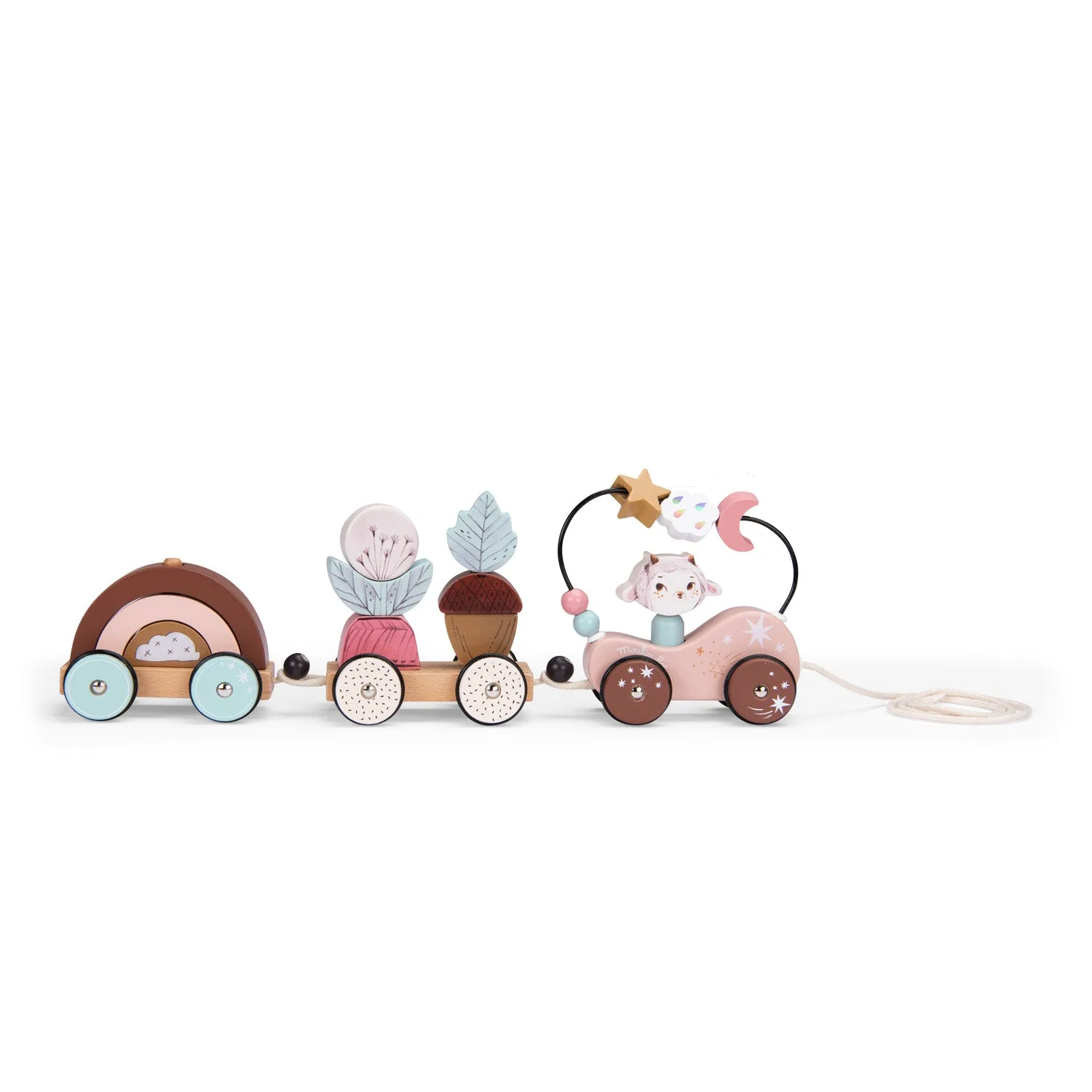
Pull along activity train "After The Rain" collection
Is a Pull Along Train Right for Your Toddler?
Best for
- Toddlers who are learning to walk and need a motivating pull toy
- Children who enjoy open-ended, imaginative play with stacking and building
Not for
- Children under 10 months who are not yet pulling to stand
- Toddlers who prefer push toys or ride-ons over pull-along activities