Quick Answer
To choose the right nose cone, match its shape and material to your rocket's diameter and flight goals. For general sport flying, a standard parabolic or ogive nose cone works well. For high-speed or high-altitude flights, consider a longer, sleeker shape to reduce drag. Always ensure the nose cone fits your airframe tube and shoulder length.
Choosing the right nose cone is a critical decision that affects your rocket's aerodynamics, stability, and overall performance. Whether you're building for fun or aiming for a certification flight, the nose cone's shape and material influence drag, weight, and how well the rocket tracks. This guide will help you evaluate options and make an informed choice.
We'll cover common nose cone types, material trade-offs, and how to ensure a proper fit for your rocket kit. We'll also highlight some LOC Precision kits that come with well-matched nose cones, and explain how to adapt or replace them when needed.
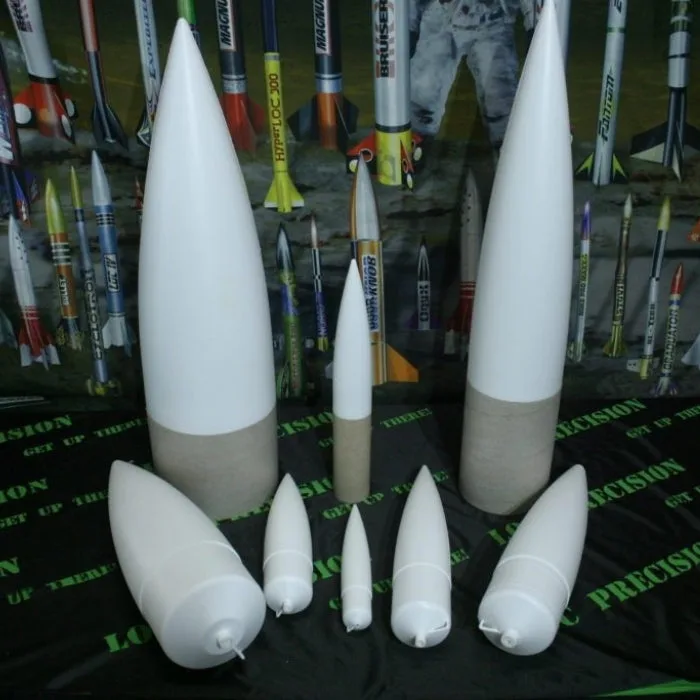
nose cones
Understanding Nose Cone Shapes
Nose cones come in several shapes, each with distinct aerodynamic properties. The most common are ogive, parabolic, conical, and elliptical. Ogive nose cones, characterized by a curved profile that tapers to a point, offer a good balance of low drag and volume, making them a popular choice for sport and high-power rockets. Parabolic shapes are similar but slightly blunter, providing more internal volume for payloads or electronics while still performing well.
Conical nose cones are straight-sided and simple to manufacture, but they create more drag at high speeds. Elliptical nose cones are often used on scale models for aesthetic reasons. For most hobbyists, an ogive or parabolic nose cone is the best all-around choice. If you're flying at high speeds or aiming for altitude, a longer, sleeker nose cone reduces drag but may add weight and cost.
- Ogive: Best all-around for sport flying.
- Parabolic: Good volume for payloads.
- Conical: Simple but draggy; fine for low-speed models.
Material Matters: Plastic, Fiberglass, and More
Nose cones are typically made from plastic (often injection-molded), fiberglass, or balsa wood. Plastic nose cones are lightweight and inexpensive, making them ideal for entry-level and mid-power rockets. They are durable enough for most flights but can crack on hard impacts. Fiberglass nose cones are stronger and more heat-resistant, suitable for high-power rockets that experience greater stress and speed. They are heavier and more expensive but offer better longevity.
Balsa wood nose cones are light and easy to shape, but they are fragile and require finishing. For high-performance rockets, fiberglass is often the preferred material. When purchasing a kit, the nose cone is usually matched to the airframe. If you're replacing a nose cone, consider the weight and strength needed for your motor and flight profile.
- Plastic: Light, cheap, good for sport flying.
- Fiberglass: Strong, heat-resistant, for high-power.
- Balsa: Light but fragile, requires finishing.
Fit and Compatibility
A nose cone must fit your airframe tube perfectly. The shoulder—the part that inserts into the tube—should slide in snugly but not too tightly, allowing for a friction fit or easy ejection. Measure the inside diameter of your tube and the shoulder diameter of the nose cone. Most kits specify the tube diameter, such as 3.1 inches or 4 inches. Ensure the nose cone's shoulder length is adequate for a secure fit, especially if you plan to add a payload bay.
Some nose cones come with a molded-in shoulder, while others require you to glue a separate shoulder piece. If you're adapting a nose cone from a different kit, check the fit carefully. For example, a 38mm motor mount rocket may use a 3.1-inch airframe, so a nose cone designed for that tube will fit. Always test the fit before committing to a build.
- Measure your tube's inside diameter.
- Check shoulder diameter and length.
- Test fit before gluing.
Decision Rules for Choosing a Nose Cone
- Match the diameter: Measure your airframe tube's inside diameter. Nose cones come in standard sizes like 3.1 inches or 4 inches. Choose one that fits snugly without forcing. Check the spec of your kit or tube before ordering.
- Consider your flight goals: For altitude or speed, select a sleeker, longer nose cone (ogive/parabolic) to reduce drag. For scale looks, match the original shape. If you're aiming for high performance, prioritize shape over aesthetics.
- Choose material based on power: For low-power motors, plastic is fine. For high-power flights, use fiberglass to withstand heat and stress. Match material to motor class and expected speed.
- Check shoulder fit: Ensure the shoulder length is adequate for a secure fit and that it slides in smoothly for ejection. Test fit before building.
Product Facts: Nose Cones in LOC Kits
- Magnum 3.1": The 3" Magnum has been revamped with a single 29mm motor mount and includes a payload section, making it perfect for level one certification flights. The payload section likely uses a nose cone that can be removed for carrying altimeters or other electronics. When choosing a replacement, ensure it matches the 3.1-inch tube diameter and has a shoulder compatible with the payload bay.
- V2 4": The 4" LOC V2 Rocket Kit is part of the ADVANCED SERIES, featuring factory pre-slotted airframe and through-the-wall fin construction. It comes standard with a 38mm motor mount and flies great on F50 and G motors using an optional MMA-2 adapter. This scale model likely has a specific nose cone shape to replicate the V2's iconic profile. When replacing it, you'll need a nose cone that matches the 4-inch diameter and possibly a boat tail design for scale accuracy.
Fit Guidance
Best For
- Sport flyers using mid-power motors who want a reliable, lightweight nose cone.
- High-power enthusiasts seeking fiberglass nose cones for durability and heat resistance.
Not For
- Scale modelers who require exact historical shapes—consider custom or kit-specific nose cones.
- Budget builds where plastic nose cones are sufficient and cost is a concern.
Choosing the right nose cone comes down to matching your airframe size, flight goals, and material needs. By understanding shapes and materials, you can make a selection that improves stability and performance. Always verify fit before you glue, and don't hesitate to ask your rocket supplier for advice if you're unsure.