Quick answer
To choose the right precision wedge window, first confirm that your system needs to eliminate back reflections—if not, a standard flat window will save you money. Then match the wedge angle, flatness, and substrate to your wavelength and beam quality requirements, and verify the diameter and thickness options fit your mount.
Why wedge angle matters
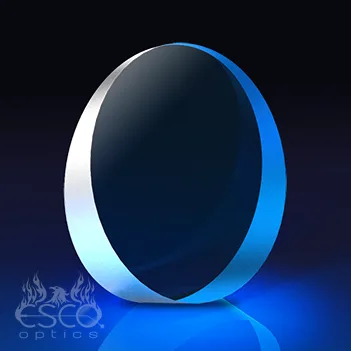
A precision wedge window has a deliberate angle between its two surfaces, typically 30 arcminutes. This angle deflects back reflections away from the optical path, preventing them from interfering with the beam or creating ghost images. If your setup is sensitive to back reflections—for example, in laser systems or interferometry—a wedge is the right choice.
The wedge angle also affects beam deviation. Even though the window is angled, the beam passes through and exits slightly displaced. For most applications this displacement is negligible, but if you are aligning a high-precision system, account for the beam shift in your layout.
Reading flatness specifications
Flatness is expressed in waves, such as λ/4 or λ/10, and indicates how closely the surface matches a perfect plane. A lower value (like λ/10) means a flatter surface, which minimizes wavefront distortion. For interferometry or laser applications that require high beam quality, choose λ/10. For less demanding setups, λ/4 is often sufficient and more cost-effective.
When you see a specification like 'λ/4 at 632.8 nm', the flatness is measured at that wavelength. If your operating wavelength is different, the actual wavefront error will scale accordingly. Always confirm the test wavelength with the manufacturer if your system uses a different laser wavelength.
Substrate: UV fused silica vs. N-BK7
The substrate material determines the window's transmission range, thermal stability, and durability. UV grade fused silica offers excellent transmission from the UV through the near-infrared, and it is more resistant to thermal shock and radiation damage. N-BK7 is a borosilicate crown glass with good transmission in the visible and near-infrared, but it does not transmit UV light well.
For UV applications, choose UV grade fused silica. For visible or near-infrared work, N-BK7 is often a more economical choice. If you are unsure which substrate your application requires, check the wavelength of your source and the transmission data for each material.
Decision rules for choosing a precision wedge window
- Do you need a wedge at all?: If back reflections cause interference or damage, a wedge is necessary. Otherwise, a flat window is simpler and cheaper. Only choose a wedge when back reflections are a real problem.
- What flatness do you require?: For interferometry or high-power lasers, choose λ/10. For general laser windows or less sensitive systems, λ/4 is adequate. Match flatness to your wavefront error budget.
- What substrate fits your wavelength?: Use UV grade fused silica for UV or broad-spectrum transmission. Use N-BK7 for visible and near-infrared if cost is a concern. Check your operating wavelength before choosing a material.
- What size and thickness do you need?: Verify the diameter and thickness options match your mount and pressure requirements. Thicker windows handle higher pressure differences. Confirm dimensions with your mechanical design.
Precision wedge windows at a glance
- Precision Wedge Windows, S1-UV Grade Fused Silica: Precision laser quality round wedge windows are ideal for applications where direct back reflections would be a problem. These elements have a deliberate wedge of 30 minutes. Optical flat wedges range from λ/4 to λ/10 flatness. This gives you a clear choice: if you need to suppress back reflections and maintain high wavefront quality, select a λ/10 flatness for demanding laser or interferometer systems, or λ/4 for more general use.
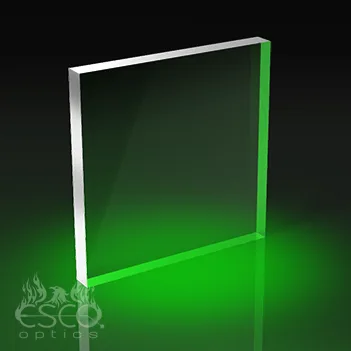
- Commercial Quality Windows, Square, N-BK7 Optical Glass*: Commercial quality square windows are available in N-BK7 with surface accuracy up to 2λ per inch and 60-40 scratch-dig. They are used for sight glasses, instrument windows, and beamsplitter substrates. If your application does not require the tight flatness of a precision wedge, a commercial square window offers a cost-effective alternative for simple protection or beam splitting.
Who should choose a precision wedge window?
Best for
- Laser systems where back reflections can damage the source or cause instability
- Interferometry and metrology setups that need high wavefront quality (λ/10 flatness)
Not for
- Simple sight glass or protection windows where back reflections are not an issue—consider commercial quality flat windows instead