Quick answer
Choose a tennis ball that matches your dog's mouth size, chewing strength, and play environment. Standard balls work for gentle fetchers, but dogs that chew or play on rough surfaces need more durable options.
Why standard tennis balls aren't always safe
Standard human tennis balls are made with a felt cover that can wear down quickly on concrete or asphalt. Once the felt is gone, the rubber core can act like sandpaper on your dog's enamel. They also contain pressurized air and a rubber core that can crack or split if chewed hard, creating sharp edges.
For dogs that love to chew or play fetch on rough surfaces, look for balls labeled as dog-specific. These are typically made with non-abrasive materials and are designed to withstand more wear without breaking apart.
Size matters for safe play
A ball that is too small can become a choking hazard or get lodged in your dog's throat. A ball that is too large may be uncomfortable to carry or difficult to pick up. Measure your dog's mouth width or observe how they carry existing toys to gauge the right diameter.
Standard tennis balls are about 2.5 inches in diameter, which works for most medium to large breeds. Small breeds or puppies often need a smaller ball, while giant breeds may prefer a slightly larger one for easier retrieval.
How to choose: decision rules
- Check the material: Look for non-abrasive, non-toxic materials. Avoid balls with loose felt that can peel off. Dog-specific balls often use a smooth rubber or a felt that is bonded more tightly to the core.
- Match size to mouth: The ball should be large enough that your dog cannot fully close their mouth around it, but small enough to pick up comfortably. A good rule: the ball diameter should be slightly wider than your dog's muzzle opening. If your dog regularly tries to swallow toys, size up.
- Consider the playing surface: For grass or sand, standard balls work fine. For concrete, asphalt, or gravel, choose a ball with a thicker, more durable cover that won't wear down quickly. This reduces the risk of dental wear and ingestion of felt fibers.
- Assess chewing behavior: If your dog is a gentle fetcher who drops the ball, standard tennis balls are fine. If your dog likes to chew or shred toys, choose a ball designed for heavy chewers—often made of solid rubber with no felt cover. For aggressive chewers, avoid any ball with a seam or hollow core.
- Check for bounce and visibility: A good fetch ball should have a consistent bounce so your dog can track it. Bright colors like orange, yellow, or green are easier to spot in grass or low light. Some balls also have a slight scent to help dogs find them by smell.
Product spotlight
-
Dog Tennis Balls (Set of 3) Urban Set: Set of 3 lightweight, durable tennis balls designed for fetch and active play, packed in a breathable mesh bag. The mesh bag makes it easy to carry balls to the park or store them without losing them, and the lightweight design reduces strain on your dog's neck during fetch.
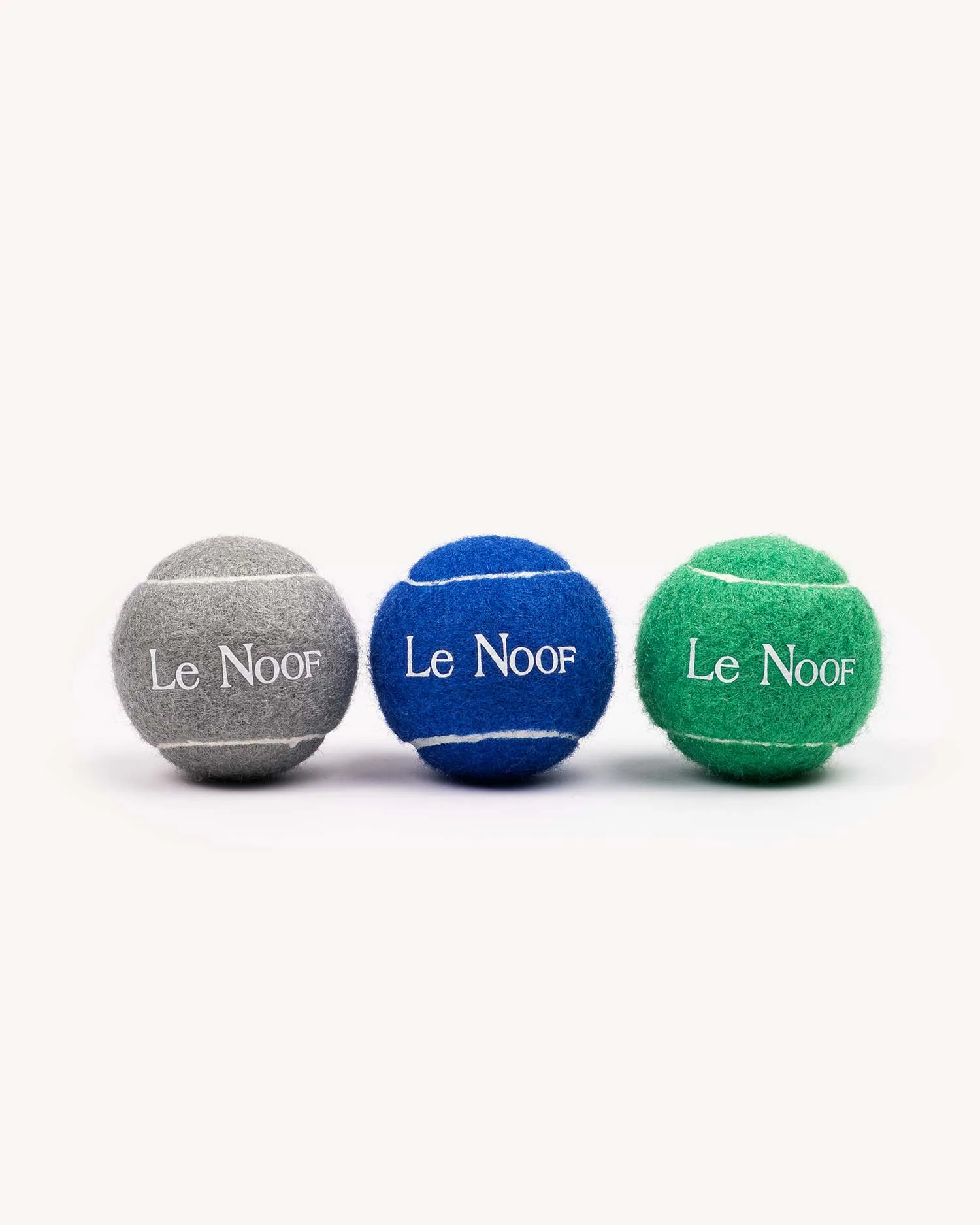
Dog Tennis Balls (Set of 3) Urban Set
Who should choose what
Best for
- Gentle fetchers who play on grass or soft surfaces
- Dogs that don't chew toys aggressively
- Pet parents who want a lightweight, easy-to-carry ball for park trips
Not ideal for
- Aggressive chewers who destroy standard balls quickly
- Dogs that play on concrete or asphalt regularly
- Very small breeds that need a ball smaller than 2.5 inches