Quick answer
For toddlers (ages 1–2), start with large, lightweight blocks that are easy to grasp and stack. For preschoolers (ages 3–5), move to sets with varied shapes and challenge cards that encourage problem-solving and creativity.
Why age matters for block play
Block play evolves quickly during early childhood. A set that delights a 2-year-old may bore a 4-year-old, while one aimed at older kids can frustrate a younger child. Matching the block set to your child's current fine-motor skills, attention span, and spatial reasoning helps them build confidence and stay engaged.
The main trade-off: simpler sets are safer and more satisfying for beginners but offer less long-term challenge. More complex sets provide extended play value but may overwhelm a child who isn't ready for them.
What to look for in toddler block sets (ages 1–2)
At this stage, children are developing hand-eye coordination and learning cause and effect. Blocks should be large enough to prevent choking (at least 1.5 inches in any dimension), lightweight, and easy to hold. Rounded edges and smooth surfaces reduce the risk of injury.
Avoid sets with small pieces, magnets, or complex interlocking mechanisms. A simple set of 10–20 blocks in basic shapes (cubes, rectangles, cylinders) is ideal. The focus is on stacking, knocking down, and simple patterns.
What to look for in preschool block sets (ages 3–5)
Preschoolers can handle more variety. Look for sets that include wedges, triangles, steps, arches, and other geometric shapes that allow for more creative structures. Challenge cards or idea booklets can extend play and introduce early problem-solving.
The trade-off: more shapes mean more pieces to manage and potentially more frustration if a child struggles to balance unusual forms. However, the payoff is richer imaginative play and better spatial reasoning development.
Decision rules for choosing wooden blocks by age
- Age 1–2: Safety and simplicity first: Choose blocks that are at least 1.5 inches in any dimension, lightweight, and have rounded edges. A set of 10–20 basic shapes (cubes, rectangles, cylinders) is enough. Avoid small pieces, magnets, or complex connectors. Check that every block is too large to fit through a toilet paper tube (choking hazard test).
- Age 3–5: Variety and challenge: Select sets with 30+ pieces that include wedges, triangles, steps, arches, and other geometric shapes. Template cards or idea booklets add problem-solving and extend play. Expect some trial and error with balancing unusual shapes. Look for sets with at least 3 different shape types beyond basic rectangles and cubes.
- Age 5+: Open-ended creativity: At this stage, children can handle larger, more complex sets with many shapes and no prescribed outcomes. Sets with 50+ pieces and no cards encourage free-form building and collaborative play. Consider combining two smaller sets to increase variety without overwhelming the child.
Two block sets that fit different ages
-
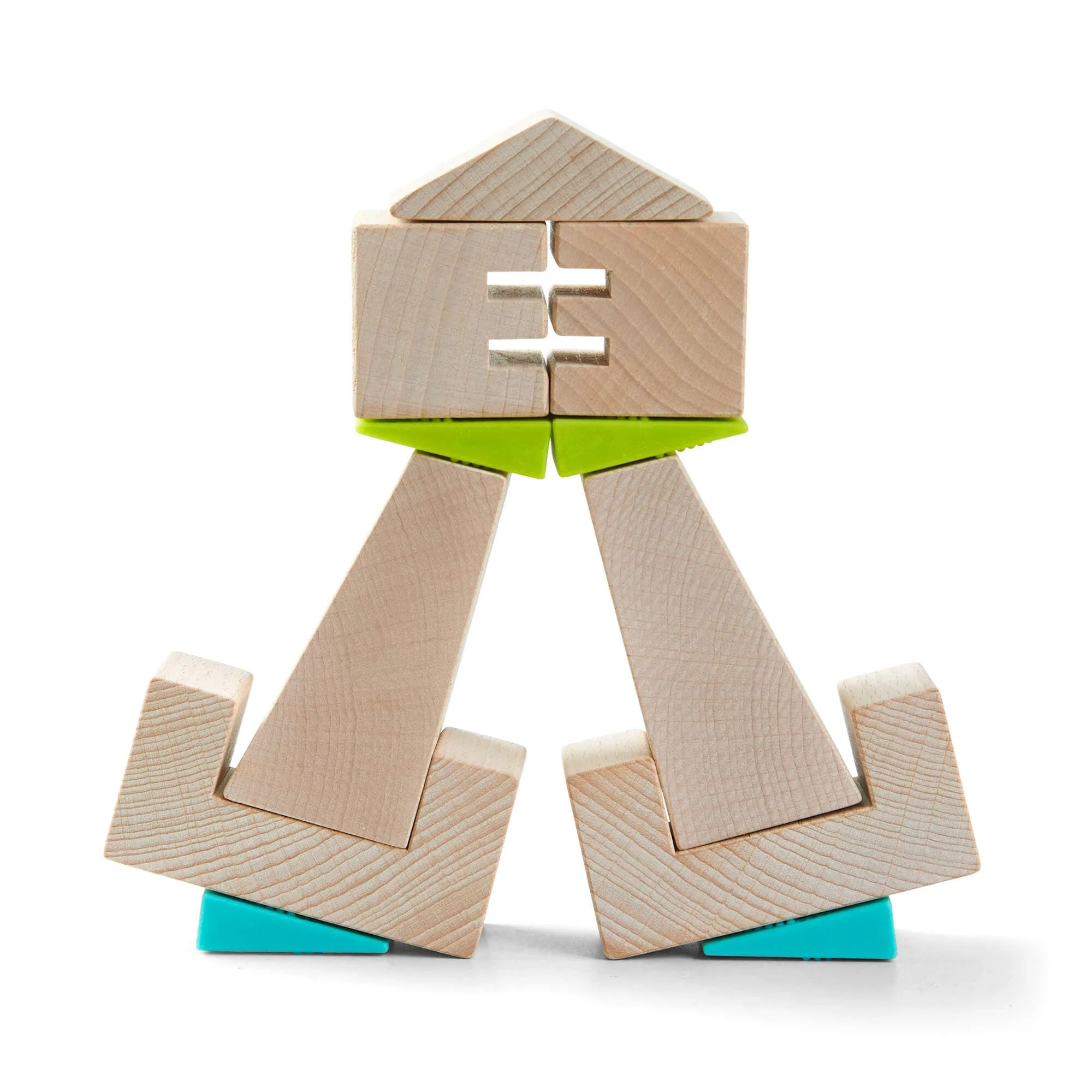
Crooked Towers Wooden Blocks: The Crooked Towers set includes interesting geometric wooden blocks, triangles, steps, and other shapes, plus template cards. The varied shapes and challenge cards make this a good fit for preschoolers (ages 3–5) who are ready to experiment with balance and design.
Crooked Towers Wooden Blocks
-
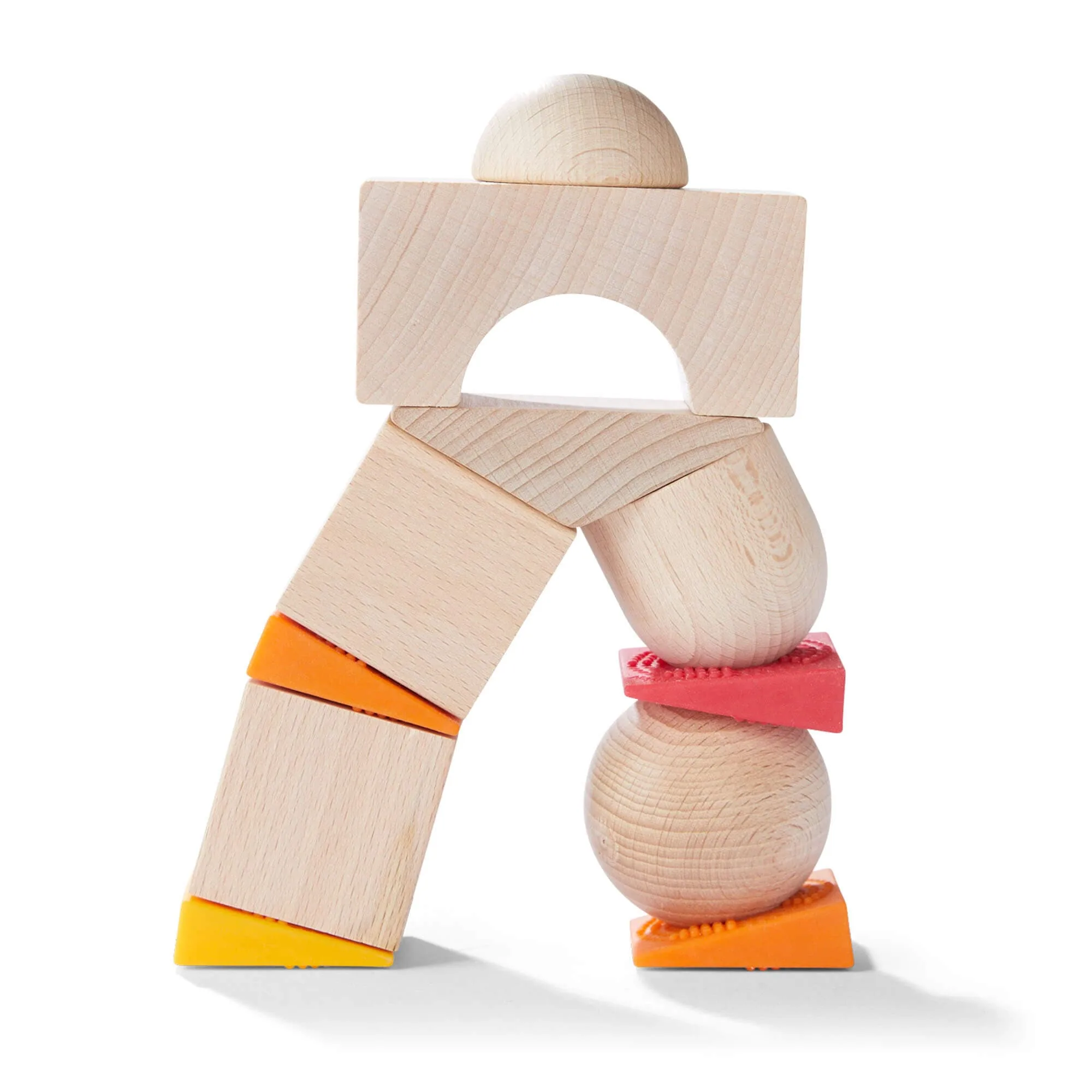
Teetering Towers Wooden Blocks: The Teetering Towers set uses wooden wedges with grip to hold round balls and wedges, and includes template cards for building wobbly structures. The grippy wedges help toddlers (ages 2–3) keep round pieces in place, reducing frustration while still offering a fun balance challenge.
Teetering Towers Wooden Blocks
Which set fits your child?
Best for
- Toddlers (ages 2–3) who are still developing fine-motor control and need grippy, forgiving blocks
- Preschoolers (ages 3–5) who enjoy following challenge cards and experimenting with balance
Not for
- Children under 18 months (any set with small pieces poses a choking risk)
- Older kids (6+) who want very large, complex building systems with many specialized pieces