Quick answer
Use compressed air first, then a lint-free lens wipe with isopropyl alcohol, wiping in one direction from center to edge. Never use paper towels or household cleaners.
Why cleaning matters for Schott longpass filters
Schott longpass filters like the RG830 are precision glass components. Dust, oil, and smudges can scatter light and degrade your near-IR or visible cut-on performance. Proper cleaning preserves both optical clarity and the filter's anti-reflective coatings.
The main trade-off is between thoroughness and safety. Aggressive rubbing or wrong solvents can scratch the glass or leave residues that are harder to remove.
Step-by-step cleaning process
- Blow off loose dust: Use a can of compressed air or a rubber bulb blower to remove dust and particles from the filter surface. Hold the can upright and use short bursts from at least 6 inches away. Never use canned air upside down — propellant can spray onto the glass.
- Apply a few drops of cleaning solution: Place 1–2 drops of isopropyl alcohol (91% or higher) or a dedicated optical lens cleaner on a lint-free lens wipe. Do not apply liquid directly to the filter — it can seep into the edge seal. Avoid acetone, household glass cleaners, or water with soap — they can leave streaks or damage any coating.
- Wipe in one direction from center to edge: With the dampened wipe, start at the center of the filter and move outward in a single straight stroke. Use a fresh section of the wipe for each stroke. Do not use circular motions. Circular wiping can redistribute oil or trap particles that cause scratches.
- Inspect and repeat if needed: Hold the filter under a bright light at an angle to check for streaks or residue. If any remain, repeat steps 2 and 3 with a clean wipe. Let the filter air dry completely before reinstalling it. If the filter has stubborn residue, a pre-moistened lens cleaning tissue may help — but avoid pre-moistened wipes that contain unknown additives.
Product facts
-
Schott RG830: Schott RG830 is a 3 mm thick, 50 x 50 mm longpass filter with a cut-on near 830 nm. Its relatively thick glass is durable, but the uncoated surfaces still need gentle handling to avoid microscratches that affect IR transmission.
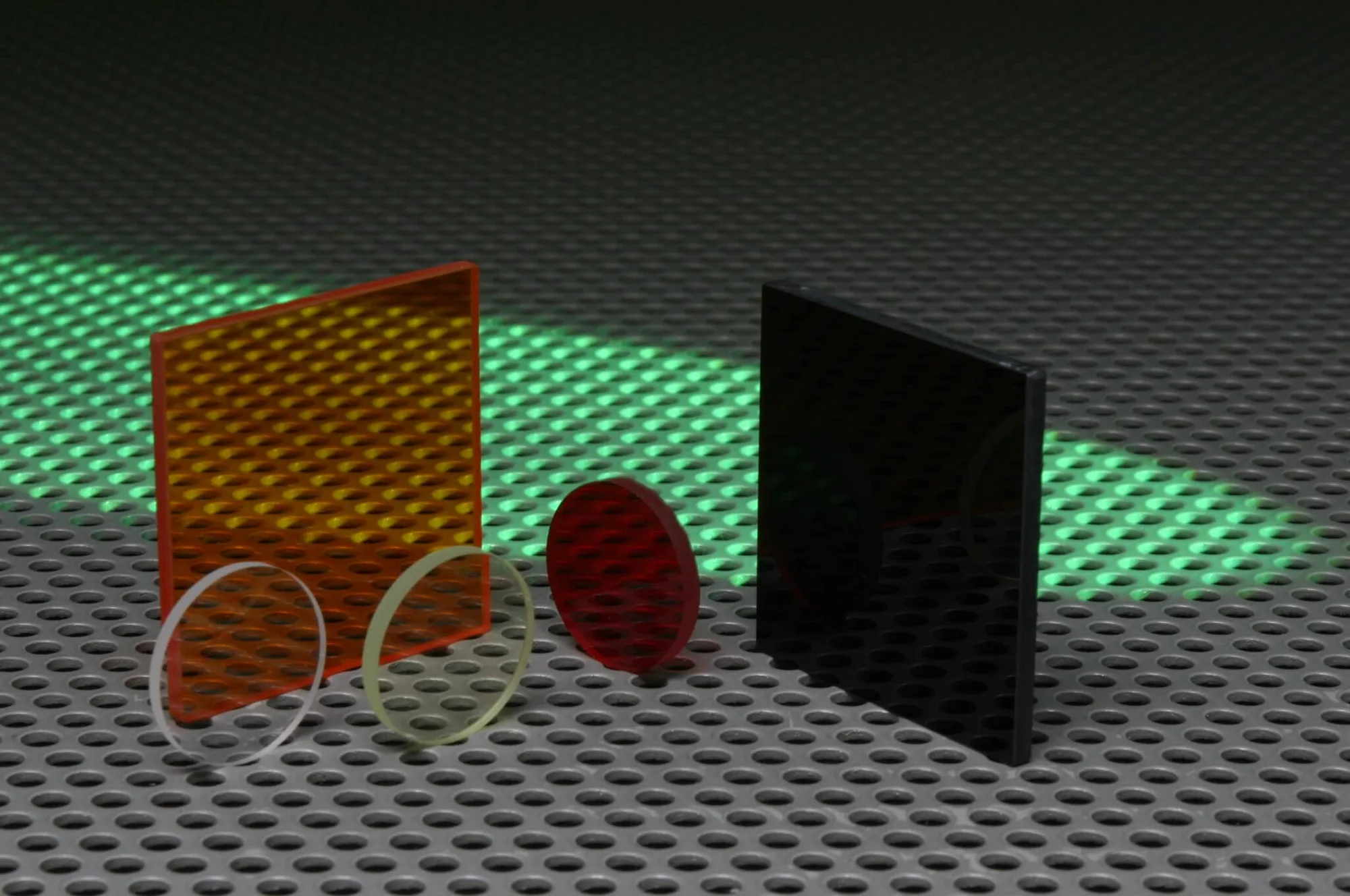
Schott RG830