Quick answer
To fit a dog rehab hock protector, measure your dog's hock circumference, choose the correct size from the available options, and secure the protector snugly but not tightly around the joint.
Why proper fit matters for hock recovery
A well-fitted hock protector supports the lower leg joint after injuries like ligament damage, osteoarthritis, or surgery. If it's too loose, it shifts and fails to stabilize the joint. Too tight, and it restricts blood flow or causes discomfort.
The KRUUSE Rehab Hock Protector is designed by ReDog of SwedenTM for dogs recovering from hock trauma, chronic arthritis, or OCD. Getting the fit right ensures the protector stays in place during movement and provides consistent compression.
Common fitting mistakes to avoid
One frequent error is guessing the size based on your dog's weight or breed instead of measuring the actual hock circumference. The KRUUSE protector comes in specific sizes, so always measure with a flexible tape.
Another mistake is positioning the protector too high or too low on the leg. The joint pad should sit directly over the hock point (the bony bump on the back of the leg), not above or below it.
How to fit the KRUUSE Rehab Hock Protector
- Measure your dog's hock circumference: Use a flexible tape measure around the narrowest part of the hock joint, just above the bony point. Write down the measurement in inches or centimeters. Common mistake: measuring over fur or at the wrong spot. Take the measurement twice to confirm accuracy.
- Select the correct size: Compare your measurement to the size chart provided with the KRUUSE Rehab Hock Protector. If your dog's measurement falls between sizes, choose the larger size for comfort. Checkpoint: The protector should feel snug but not dig into the skin. You should be able to slide one finger between the protector and your dog's leg.
- Position the protector on the leg: Slide the protector onto your dog's leg so the padded section sits directly over the hock joint (the bony protrusion on the back of the lower leg). The open side should face forward. Common mistake: positioning the pad too high or low. The joint pad must align with the hock point for effective support.
- Secure the straps evenly: Fasten the straps starting from the bottom and working upward. Each strap should be tight enough to hold the protector in place without causing wrinkles in the material. Checkpoint: After fastening, gently bend and extend your dog's leg. The protector should stay put without slipping or pinching.
- Check fit after 5–10 minutes of wear: Let your dog move around normally for a few minutes, then recheck the strap tension. Re-adjust if the protector has shifted or if your dog seems uncomfortable. Common mistake: assuming the initial fit stays perfect. Activity can loosen or shift the protector, so a re-check is essential.
Product facts
-
KRUUSE Rehab Hock Protector: The KRUUSE Rehab Hock Protector can be used before and after surgery, and for chronic conditions like osteoarthritis, OCD, ligament injuries, and arthritis. This means the same protector supports both prehab and post-op recovery, making it a versatile tool for ongoing rehab.
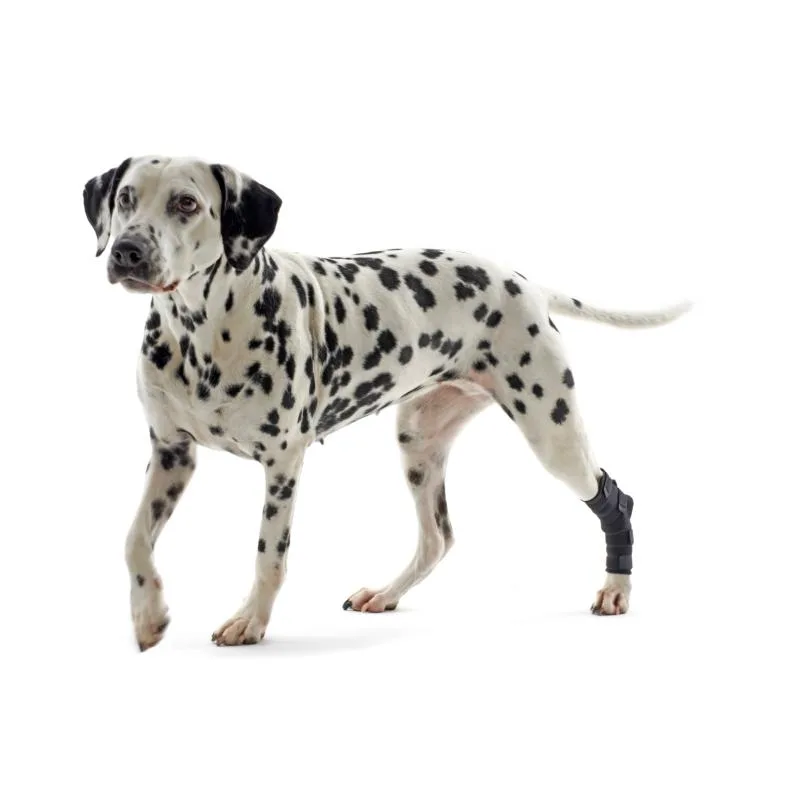
KRUUSE Rehab Hock Protector