Quick Answer
Most lingerie fit problems come from one of three sources: the band or waistband is the wrong size, the straps or closures are adjusted wrong, or the style itself does not match your shape. Fix the band or waistband first, then adjust straps and closures, and only then consider a different silhouette. If a piece digs, rolls, or slips after those two steps, it is the wrong style for you, not a flaw in your body.
A bra that rides up, straps that slide off your shoulders, a waistband that rolls down the moment you sit, wires that poke under your arm. These lingerie fit problems are common, and almost none of them mean your body is the issue. They mean one specific part of the garment is doing the wrong job.
This guide separates each symptom from its likely cause so you can fix what is fixable and stop wasting money on styles that will never sit right on you. Work through the diagnosis in order: band or waistband first, then straps and closures, then the silhouette itself.
Start With the Band or Waistband, Not the Straps
The band or waistband carries most of the garment's stability. On a bra, roughly 80 percent of support should come from a snug, level band, which is why tightening straps to fix a loose band never works. If the band climbs your back, the band size is too large or the elastic has relaxed. If it digs in and leaves red marks that linger, it is too small or the style runs firm.
On underwear and sleepwear, the same logic applies. A high-waisted short or flare pant that rolls down usually has a waistband sitting above your natural waist crease, or the elastic is too narrow for the rise. Check that the waistband sits at your crease, not above it, before you size up.
- Fasten a bra on the loosest hook when new so you can tighten it as the elastic relaxes over time.
- A band should sit level all the way around, not higher in the back than the front.
- If a waistband rolls only when you sit, the rise is too high for your torso, not the size too small.
Slipping Straps and Poking Wires: Adjustment Fixes
Bra straps slipping usually means they are over-tightened, which pulls the back band upward and lets the front drop. Loosen the straps until they sit flat without indenting your shoulder, then recheck the band. If straps still slide on a bra that fits, the strap placement is too wide for your frame, and a style with closer-set straps or a racerback conversion will solve it.
Wires that poke under the arm or sit on breast tissue almost always indicate a cup that is too small or too shallow, not a band problem. Scoop your breast tissue forward and up into the cup. If the wire still sits on tissue, go up a cup size. If the wire floats away from your ribcage, the band is too loose.
- Adjust straps while wearing the bra, not while it is off your body.
- A wire should encircle breast tissue completely, with the center front flat against your sternum.
- If the center front floats, try a smaller band size before changing cup size.
When the Fix Is a Different Silhouette
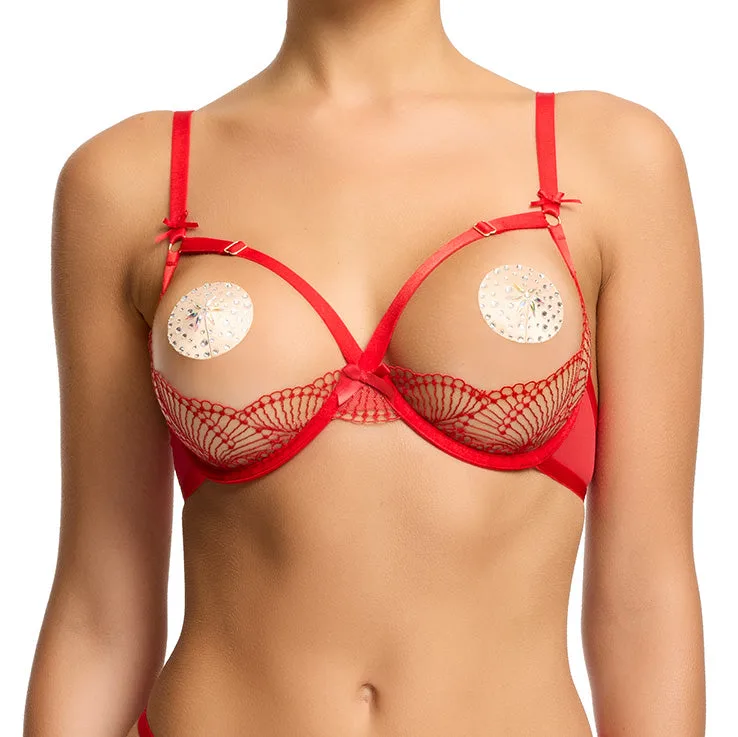
Some fit problems cannot be adjusted away because they are structural. A strapless or backless piece will always rely on band tension and internal support, so if you have a fuller bust and want lift, a bustier with underwire support does more work than a bandeau. A thong that shifts or twists usually has too little coverage at the front for your shape, and a brief or high-leg cut will stay put better.
This is also where fabric matters. Structured pieces with underwire and boning hold a shape on their own, while soft modal and cotton styles follow your body and feel looser by design. Neither is better, but choosing against the fabric's nature is a guaranteed fit problem.
- Choose structured construction when you want shaping; choose soft fabrics when you want movement.
- If a thong twists, try a higher-coverage cut rather than a different size.
- For backless or strapless looks, let the band do the work and skip styles that depend on straps.
Lingerie Too Tight: Check These Three Points
If a piece feels tight, identify where. Tightness across the band or waistband is a sizing issue. Tightness across the cups or bust is a cup or cut issue. Tightness at the straps or armholes is a proportion issue. Each has a different fix, and treating them all as one problem leads to buying the wrong size twice.
Before returning anything, test the garment over a full day of wear. Elastic relaxes slightly with body heat, and a band that feels firm in the morning often settles by afternoon. If it still digs after a few hours, size up in the band or waistband only, keeping the cup or rise the same.
- Wear a new piece for a few hours before deciding it is too tight.
- Size up in the band or waistband without changing cup or rise when only the elastic feels tight.
- If the cups or bust feel tight but the band is fine, change the cup or cut, not the size.
Symptom-to-Solution Diagnosis
- Band rides up in back: The band is too large or the straps are over-tightened, pulling the back upward. Fasten on the loosest hook, loosen the straps until they sit flat, and check that the band is level all the way around. If the band still climbs after adjusting, size down in the band. Stop adjusting straps to compensate.
- Straps keep slipping off shoulders: Strap placement is too wide for your frame, or the band is too loose and the straps are doing work they should not. Tighten the band first, then look for closer-set straps or a racerback conversion. If straps still slide on a snug band, the style is wrong for your shoulder width. Choose a different silhouette.
- Underwire digs or pokes under the arm: The cup is too small or too shallow, so the wire sits on breast tissue instead of around it. Scoop tissue into the cup and check the center front. If the wire still sits on tissue, go up one cup size. If the wire floats off your ribcage, go down one band size.
- Waistband rolls down when you sit: The rise is sitting above your natural waist crease, or the elastic is too narrow. Reposition the waistband at your crease and test sitting before deciding to size up. If it still rolls at the crease, choose a lower rise or a wider, flat elastic waistband.
- Thong twists or shifts all day: Minimal-coverage thongs move more on some shapes, and sizing up adds fabric without adding stability. Check that the front panel sits flat and the side straps are not twisted. If it still shifts, switch to a brief or high-leg cut. More coverage, not a bigger size, is the fix.
- Feels tight everywhere but nothing digs: Elastic relaxes slightly with body heat, so a firm fit in the morning often settles by afternoon. Wear it for a few hours before judging the size. If it still feels tight after a full day, size up in the band or waistband only and keep the cup or rise the same.
Fit-Friendly Pieces That Solve Specific Problems
- KILO BRAVA EMBROIDERY COLLECTION- MULTI SPARKLE/CHAMPAGNE- SWEETHEART BUSTIER: Structured cups with underwire support, sheer mesh with champagne embroidery, adjustable straps and back closure, with paillettes, sequins, and beading. The underwire and structured silhouette provide the support that strapless or backless styles cannot, making this a strong choice if you need shaping rather than a soft bralette.
- KILO BRAVA MODAL RIB COLLECTION- SCARLETT/BLACK MINI DOT- FLARE PANTS: High-waisted flare pants in modal spandex with a hidden elastic waistband, a velvet bow at the center waist, and a digitally printed black mini polka dot design. The hidden elastic waistband sits flat rather than rolling, which directly addresses the waistband-roll problem common in high-rise sleepwear.
- KILO BRAVA FLANNEL COLLECTION- DANCING BOWS- CAMI & SHORT SET: 100% cotton brushed flannel cami and short set with adjustable straps, a relaxed silhouette, and high-waisted shorts with a red satin drawstring and functional pockets. Adjustable straps let you correct slipping or digging without changing size, and the drawstring waistband gives you on-body tension control.
- KILO BRAVA EMBROIDERY COLLECTION- MULTI SPARKLE/CHAMPAGNE- THONG: Sheer mesh with embroidered overlay, minimal coverage, lightweight feel, with paillettes, sequins, and beading. This is a minimal-coverage style, so if you experience twisting or shifting in thongs, a higher-coverage cut will fit more securely than sizing up here.
Fit problems are almost always a mismatch between one part of the garment and your shape, and they are diagnosable. Fix the band or waistband first, adjust straps and closures second, and change the silhouette only when those two steps fail. That order saves you from buying the same wrong size twice.