Quick answer
First, check whether your sunglasses slide because the frame is too loose, the lenses are too heavy for the nose bridge, or sweat and sand have made the contact points slick. Tighten the fit at the nose and temples, clean the grip zones, and if they still move during a serve or dive, switch to a no-slip, no-bounce frame designed for movement. For volleyball, prioritize a snug but not pinching fit and a lens that stays put when you look up for a set.
Check the three contact points before you blame the frame
Sunglasses stay put when three areas work together: the nose pads or bridge, the temple arms behind your ears, and the frame's overall weight balance. On the court, sweat reduces friction at the nose first, so a frame that feels fine while standing still can slide the moment you jump. Wipe the bridge and temples with a dry cloth, then gently bend the temple tips inward—no more than a few millimeters—so they hug behind your ears without pressure. If the frame has adjustable nose pads, pinch them closer together so they sit higher on your nose. Avoid over-tightening; a pinching fit causes you to push the glasses up constantly, which makes sliding worse.
Manage sweat and sand at the grip zones
Sweat is the most common reason sunglasses sliding during volleyball gets worse as the game goes on. Sand makes it worse on beach courts because grit between the frame and your skin acts like tiny ball bearings. Keep a microfiber cloth in your bag and wipe the inside of the nose bridge and the temple tips between sets. If you use sunscreen, apply it before your sunglasses and let it dry—sunscreen on the nose bridge is slippery. Some players use a thin silicone nose pad or a retention strap, but a strap changes the look and can interfere with quick removal. Test any add-on during warm-ups, not mid-match.
Match the frame to the court, not just the outfit
Indoor volleyball has different demands than sand volleyball: indoor courts are usually flat and dry, so a lightweight frame with a secure bridge may be enough. Sand volleyball adds wind, grit, and more diving, so a frame with a wraparound or close-fitting temple design reduces movement. Lens choice matters too. A dark, heavy lens can pull the frame down when you look up; a lighter lens or a single-lens design can sit more securely if the fit is right. If you play both, consider a frame that is explicitly described as no-slip and no-bounce rather than a fashion frame you happen to like.
When to stop adjusting and choose a different pair
If you have cleaned the grip zones, adjusted the temples and nose bridge, and your sunglasses still slide during a normal serve or a short run, the frame is likely the wrong shape or weight for volleyball. Stop bending the frame—repeated adjustments can weaken the material or distort the lenses. At that point, choose a pair built for movement. Look for product descriptions that specifically mention no-slip or no-bounce behavior, and check whether the lenses offer UV400 protection for long outdoor sessions. If a frame does not list grip or fit features, treat that as a limitation and assume you will need to test it carefully before relying on it for a match.
Slide diagnosis: find your cause and fix it
- Symptom: glasses slide down your nose only when you sweat: Sweat has reduced friction at the nose bridge. Wipe the bridge and your nose dry, then pinch adjustable nose pads closer or add a thin silicone pad. If they stay put for a full set after drying, the frame is fine—just manage moisture.
- Symptom: glasses bounce or shift when you jump or dive: The frame is too loose at the temples or too heavy for the fit. Gently bend temple tips inward and check that the frame sits close to your face without pinching. If bending does not stop the bounce, the frame shape is wrong for volleyball.
- Symptom: glasses slide only on sand, not indoors: Sand and grit are acting as a lubricant between the frame and your skin. Rinse the frame and your face, then dry both before putting them back on. If sand still causes sliding, choose a no-slip frame designed for beach conditions.
Frames that address sliding at the source
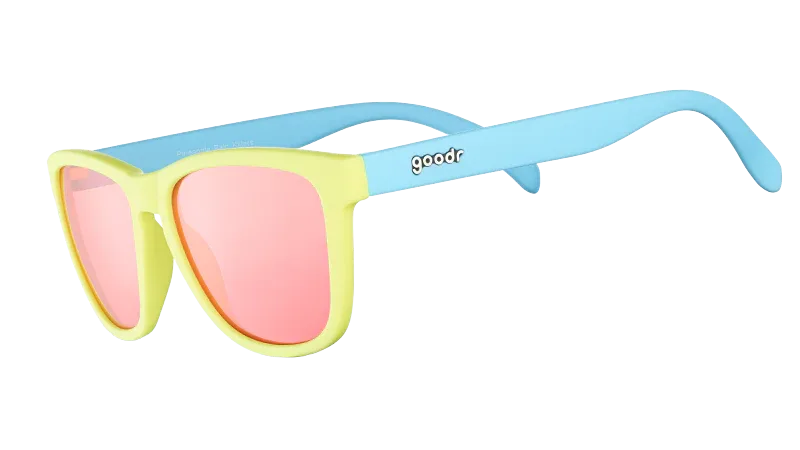
- Pineapple Painkillers: These no-slip, no-bounce pineapple party-worthy frames are non-polarized but still offer full UV400 protection. The no-slip, no-bounce build directly targets the sliding problem, and UV400 protection covers long outdoor volleyball sessions. Non-polarized lenses are a tradeoff if you want glare reduction on bright sand.
- Voight-Kampff Vision: These polarized gray and red single-lens futuristic sunglasses won’t slip when you sweat or bounce when you move, and the polarized lenses have UV400 protection. The sweat-resistant, no-bounce fit and polarized UV400 lenses make this a strong option for beach volleyball, where glare off sand and water is constant. The single-lens design also reduces the number of contact points that can shift.