Quick answer
Paint your Spitfire Mk Ia and Hurricane Mk I in authentic RAF camouflage using brush painting and careful masking to achieve a realistic World War II finish.
Choosing the right paint for RAF camouflage
The Battle of Britain-era RAF used a distinctive camouflage scheme: dark earth brown and dark green on top, with sky grey underneath. For brush painting, use acrylic or enamel paints in these shades. Acrylics dry faster and clean up with water, while enamels level better but require longer drying time and solvents. For the Spitfire and Hurricane, stick to matte finishes to avoid a plastic shine.
Masking tips for clean color separation
Before painting the camo pattern, mask the canopy, landing gear, and any markings you plan to apply later. Use low-tack tape to avoid lifting primer. For the wavy edge between the upper camouflage colors, freehand the line with a fine brush or use putty-like masking material for a softer transition. The Hurricane's fabric-covered fuselage benefits from a slightly lighter topcoat to suggest the stretched fabric texture.
Step-by-step painting guide
- Step 1: Prepare and prime the model: Clean the plastic sprues with warm soapy water to remove mold release. Apply a thin coat of grey or white primer to all parts. Primer helps paint adhere and reveals any seam lines that need sanding. Common mistake: skipping primer leads to paint peeling later. Always prime, even if you are brush painting.
- Step 2: Paint the underside Sky Grey: Using a flat brush, apply two thin coats of Sky Grey (or a mix of light grey with a hint of blue) to the underside of wings and fuselage. Let each coat dry completely before adding the next. Thin the paint with water or thinner until it flows like milk. Checkpoint: hold the model under a bright light to spot missed patches. Thin coats preserve panel line detail.
- Step 3: Mask the underside and paint the upper camouflage: Once the underside is dry, mask the lower surfaces with tape and newspaper. Paint the upper surfaces with Dark Earth (brown) first. After it dries, mask the brown areas and paint the Dark Green sections. Use a small brush for the wavy demarcation line. Common mistake: pressing tape too hard onto fresh paint can lift it. Use low-tack tape and wait 24 hours after painting.
- Step 4: Apply decals and seal the finish: After all paint is dry, apply the kit decals using warm water and a soft brush. Position them carefully and blot excess water. Once set, spray or brush a clear matte varnish over the entire model to protect the paint and decals from handling and UV light. Checkpoint: if decals show silvering (trapped air), puncture them with a pin and apply decal setting solution.
Product facts
-
Supermarine Spitfire Mk.Ia & Hawker Hurricane Mk.I: The model kit includes two iconic aircraft from the Battle of Britain: the Supermarine Spitfire Mk.Ia and the Hawker Hurricane Mk.I. You get both aircraft in one box, so you can practice RAF camouflage painting on two different airframes and compare their distinct shapes and panel lines.
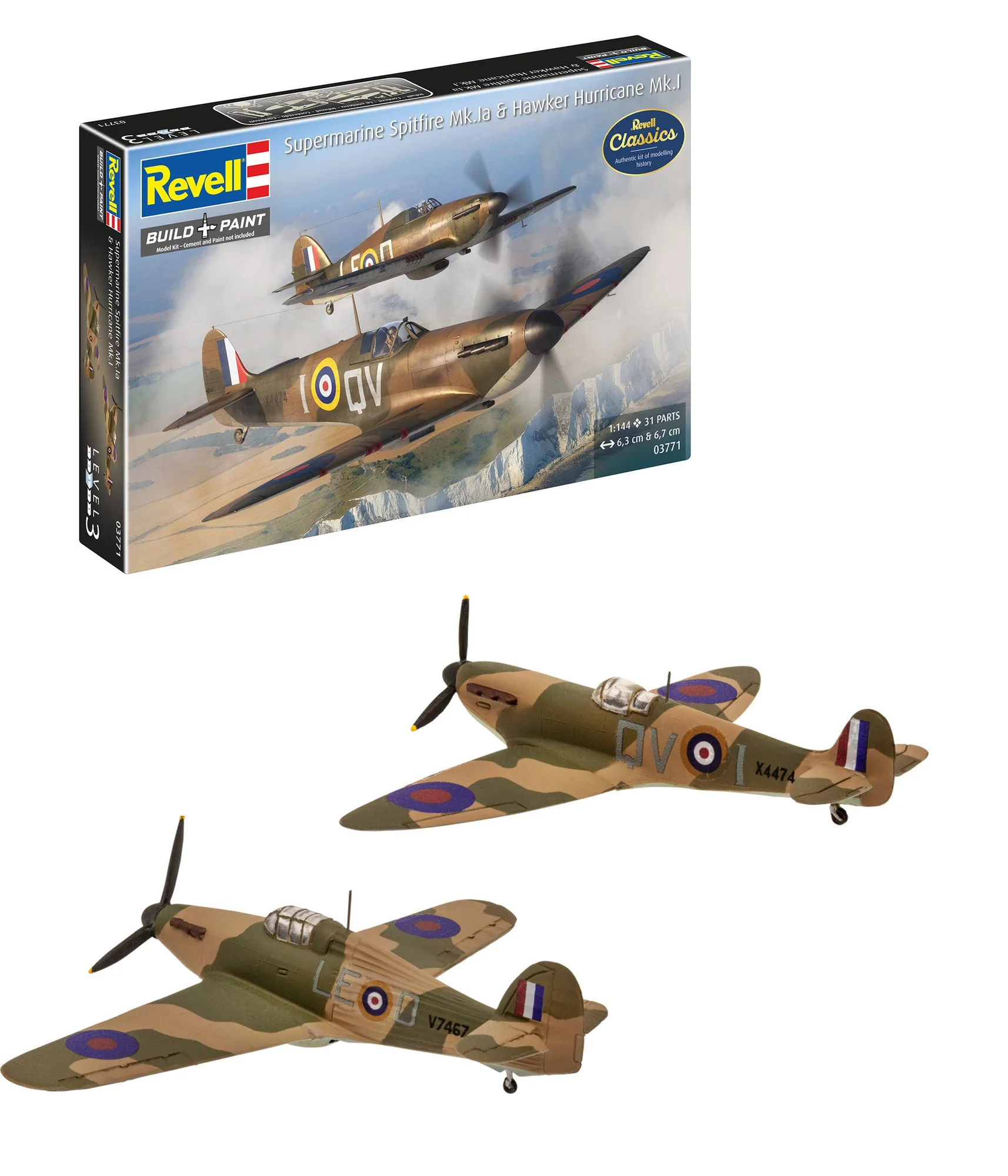
Supermarine Spitfire Mk.Ia & Hawker Hurricane Mk.I