Quick Answer
Cinemantics transforms any movie into a game: players draft cards with common movie tropes, then twist the card text to fit the scene being shown, earning points for clever wordplay and situational awareness.
What Makes Cinemantics Different from Other Party Games
Unlike trivia games that test obscure film facts, Cinemantics rewards creativity and quick thinking. You don't need to know every director or release year—just a basic familiarity with movie tropes and a willingness to play with language.
The game works with any movie, from blockbusters to obscure indie films, so no two rounds feel the same. This also means the game's difficulty scales with the group's movie knowledge, making it accessible for casual viewers and film buffs alike.
How to Play Cinemantics: Step-by-Step
- Set Up the Game: Shuffle the deck of trope cards and deal a hand of 5 cards to each player. Place the remaining cards face down in the center as a draw pile. Choose a movie to watch together—any film works, but comedies and dramas with recognizable tropes are ideal for beginners. Common mistake: dealing too few cards. Always start with exactly 5 per player to ensure enough options for the first scene.
- Start the Movie and Watch a Scene: Press play and watch a scene together. The scene should be long enough to establish characters, setting, and a recognizable trope (e.g., a character says 'I'm too old for this,' a car chase begins, or two characters meet-cute). Pause after 2–3 minutes or when a clear trope emerges. Checkpoint: if no trope is obvious after 3 minutes, fast-forward or choose a different scene. The game works best with clear, exaggerated tropes.
- Draft Your Trope Cards: Each player looks at their hand and selects one card whose text best matches the scene you just watched. For example, if a character dramatically reveals a secret, you might pick a card that says 'The Big Confession.' Place your chosen card face down in front of you. Common mistake: picking a card that fits the movie's plot but not the specific scene. The card must match what just happened on screen, not the overall story.
- Twist the Words to Fit the Scene: When everyone has chosen a card, reveal them simultaneously. Now each player must twist the words on their card to describe the scene more accurately. For example, if the card says 'The Big Confession' but the character confessed to stealing cookies, you might say 'The Cookie Confession.' You have 30 seconds to come up with your twist. Checkpoint: if a player can't think of a twist, they can pass and still earn half points. Creativity is rewarded, but the game stays fun even for shy players.
- Vote for the Best Twist: After all players share their twisted card text, everyone votes for the best one (you cannot vote for yourself). The player with the most votes earns 2 points. All other players earn 1 point for participating. The player who shared the original card earns no bonus points unless they also twist it. Common mistake: voting based on friendship rather than creativity. Encourage honest votes by reminding everyone that the goal is to reward clever wordplay, not popularity.
- Draw New Cards and Continue: After voting, each player discards their used card and draws one new card from the draw pile to maintain a hand of 5. Resume the movie and repeat steps 2–5 for the next scene. Play continues until the movie ends or a player reaches 10 points. Checkpoint: if the draw pile runs out, shuffle the discard pile to form a new draw pile. The game never stalls.
- Declare the Winner: The first player to reach 10 points wins. If the movie ends before anyone reaches 10 points, the player with the highest score wins. Ties can be broken with a single sudden-death scene: watch one more short scene and have tied players submit a new twist. Common mistake: forgetting to track scores. Use a notepad or a simple score app to avoid disputes at the end.
Product Details
-
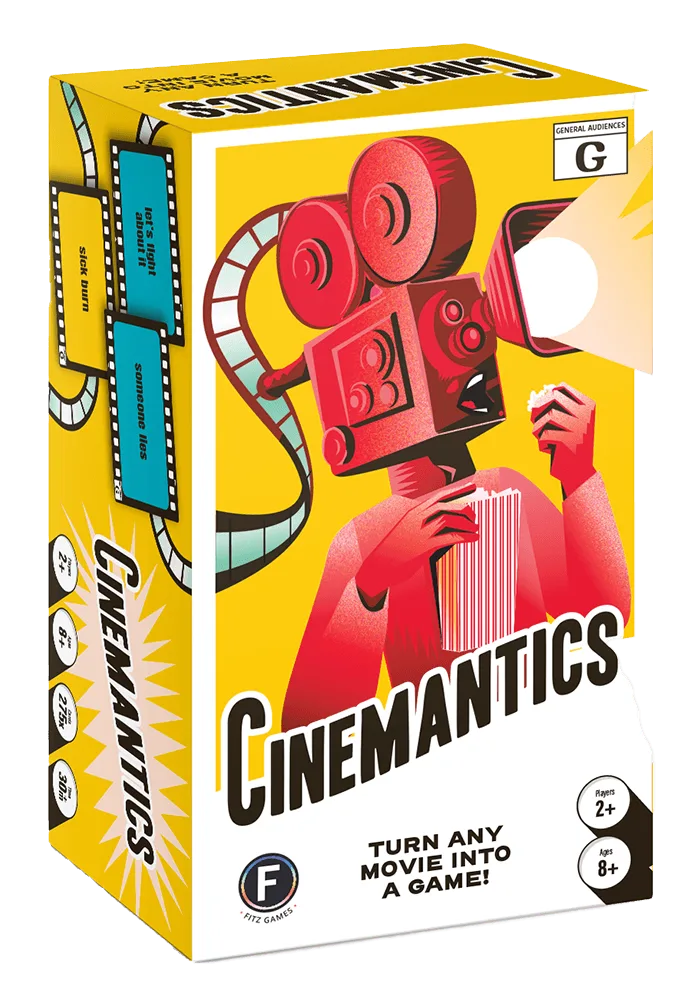
Cinemantics (G): Cinemantics magically transforms any movie into a game. Draft a collection of cards with common movie tropes and twist the words on the cards to fit the scene. You don't need a dedicated movie library—just put on any film and start playing immediately, making it a versatile addition to game night.
Cinemantics (G)