Quick answer
Start by letting your child explore the figurines freely, then introduce structured activities like storytelling, sorting, and habitat building to deepen engagement and learning.
Why wildlife figurines work so well for play
Animal figurines are open-ended toys that adapt to your child's age and interests. A toddler may simply enjoy holding and naming the animals, while an older child can build entire ecosystems or act out rescue missions. The key is to follow their lead and add gentle prompts when play starts to stall.
Common pitfalls to avoid
Resist the urge to over-direct the play. If you tell a child exactly what to do, the figurines become props for your script instead of tools for their imagination. Another mistake is storing all the animals in a bin where they get jumbled and forgotten. Rotating a small selection keeps each set fresh and interesting.
5 steps to playful learning with wildlife figurines
- 1. Free exploration: Place a small set of figurines (4–6 animals) in front of your child without any instructions. Let them pick up, examine, and arrange the animals however they like. This builds familiarity and comfort. Common mistake: adding too many animals at once can overwhelm a young child. Stick to a handful and swap them out later.
- 2. Name and describe: Ask open-ended questions: 'What is this animal called?' 'Where do you think it lives?' If your child doesn't know, offer a simple fact (e.g., 'This kangaroo lives in Australia'). This builds vocabulary and curiosity. Checkpoint: if your child loses interest, move on—forcing a lesson kills the fun.
- 3. Create a habitat: Use pillows, blankets, or a cardboard box to build a simple environment (forest, savanna, ocean). Have your child place each figurine where it belongs. This teaches basic ecology and spatial thinking. Common mistake: making the habitat too elaborate. A single blanket 'river' or a 'cave' under a chair works fine.
- 4. Tell a story together: Start a simple narrative: 'One morning, the lion woke up and found his favorite tree was gone…' Let your child continue the story by moving the figurines and adding characters. This develops narrative skills and empathy. Checkpoint: if your child gets stuck, offer a 'what happens next?' prompt or introduce a new figurine as a surprise character.
- 5. Sort and compare: Encourage your child to group the animals by color, size, number of legs, or habitat. For older kids, add categories like 'carnivore vs. herbivore' or 'diurnal vs. nocturnal.' This reinforces classification and observation skills. Common mistake: making sorting feel like a test. Keep it playful—'Let's find all the animals that have stripes!'
Product highlights
-
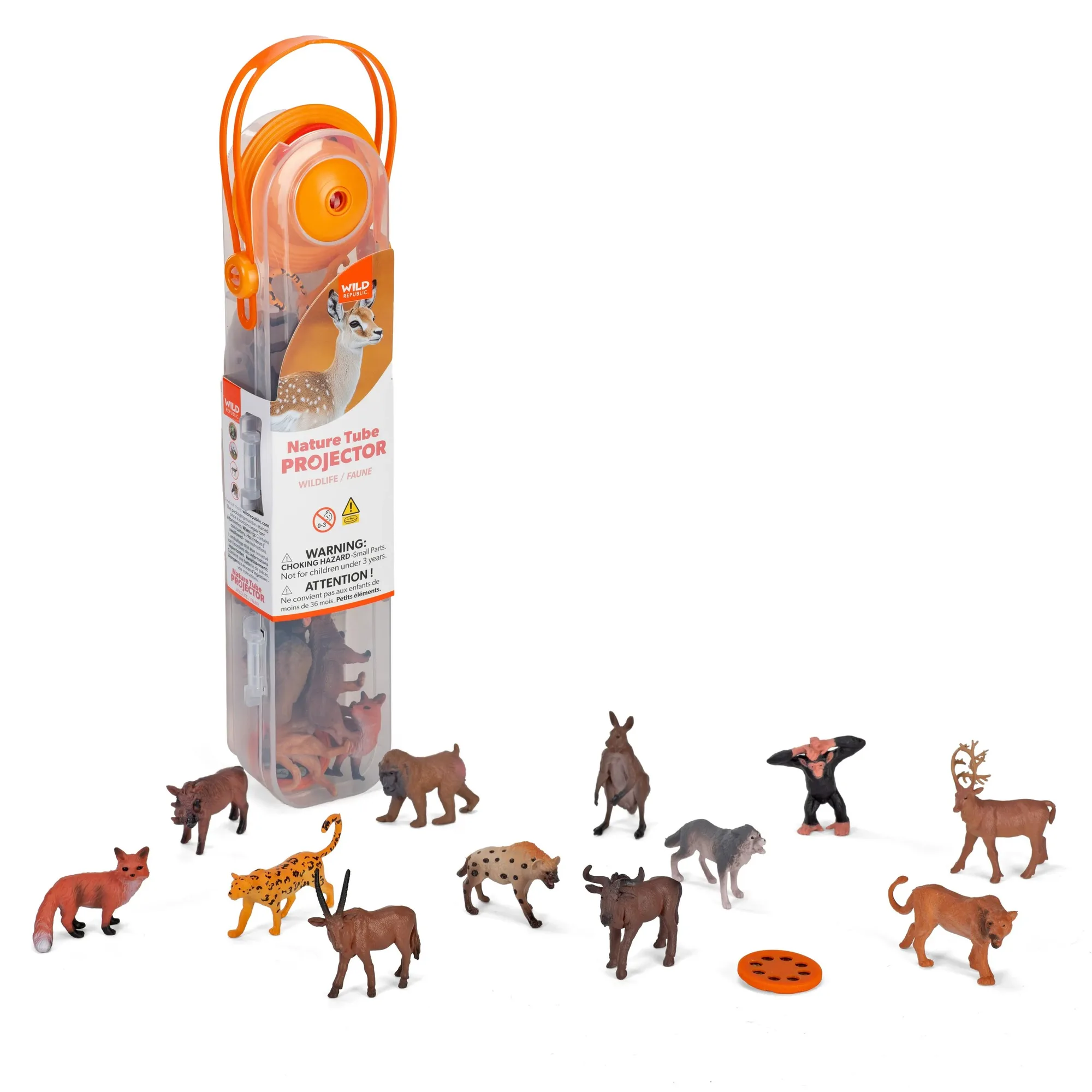
Nature Tube Projector Wildlife Figurines - 11": The Nature Tube Projector Wildlife Figurines - 11" includes a built-in projector with two image discs, each showing eight pictures that match the tube theme. This adds a storytelling dimension—kids can project images onto a wall or ceiling and create narratives around the scenes, making playtime more immersive.
Nature Tube Projector Wildlife Figurines - 11"