Quick answer
Set up your jump hurdle by choosing a flat, non-slip surface, adjusting the height to your dog's elbow, and spacing hurdles at least 15-18 feet apart for a smooth, safe training flow.
Why setup matters for hurdle jump training
Proper setup prevents injuries and builds confidence. A hurdle that's too high or placed on uneven ground can cause your dog to knock bars or land awkwardly, leading to hesitation or strain.
Consistent spacing and height help your dog learn rhythm and stride, which is essential for agility training hurdles. This is especially important when transitioning from single jumps to a full course.
Choosing the right hurdle for your dog
For dogs new to agility or those training for IGP, Schutzhund, IPO, obedience, or AKC retrieve, a sturdy, adjustable hurdle is key. Look for lightweight but durable materials like aluminum that can handle repeated use.
Consider a hurdle with a wide base for stability on grass or dirt. If you train in multiple locations, portability and easy setup are practical advantages.
Step-by-step jump hurdle setup
- Choose a safe location: Select a flat, level area with good footing (grass, rubber matting, or short turf). Avoid slippery surfaces like wet concrete or long grass that can hide uneven ground. Check for holes or debris before each session.
- Adjust the hurdle height: Set the height to your dog's elbow height or slightly lower for beginners. For most dogs, this is around 8 to 20 inches. Start low and increase gradually as your dog gains confidence. If your dog knocks bars often, lower the height by 2-4 inches.
- Position the hurdle correctly: Place the hurdle perpendicular to your dog's approach path, with the bar centered. Ensure there's at least 10-15 feet of clear space before and after the jump for a natural stride. Angle the hurdle only if you're specifically training turns or direction changes.
- Set up multiple hurdles with proper spacing: Space hurdles 15-18 feet apart for a straight line, or 18-22 feet for a curved line. This allows your dog to maintain a steady pace without rushing or stuttering. Adjust spacing based on your dog's stride length; smaller dogs need less distance.
- Secure the hurdle and inspect hardware: Make sure the hurdle is stable and won't tip over if bumped. Check that all pins, locks, and feet are tight. If using a portable hurdle, confirm it locks into place before starting. Test the hurdle by pushing it gently from the side.
- Introduce your dog to the jump: Lead your dog over the hurdle on a loose leash at a walk, then progress to a trot. Use a treat or toy to reward each successful jump. Never force your dog over. End the session after a few successful jumps to keep it positive.
Equipment that supports your setup
-
Collapsible Aluminum Dumbbell Rack: The Collapsible Aluminum Dumbbell Rack is designed for IGP, Schutzhund, IPO, obedience, and AKC retrieve training, holding up to four dog training dumbbells. Keep your jump training area organized by storing dumbbells securely, so you can focus on hurdle setup without clutter or misplaced equipment.
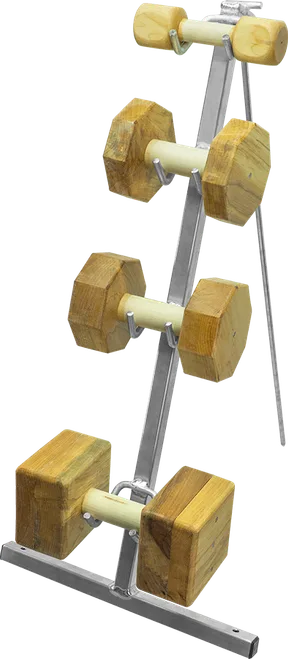
Collapsible Aluminum Dumbbell Rack