Quick Answer
Set up your giant chess board on a flat, level surface with squares that match the size of your pieces. Use standard chess rules for a 64-square board, and for checkers, place pieces only on dark squares and move diagonally.
Choosing the Right Surface for Your Outdoor Chess Board
A flat, level surface is critical for giant chess and checkers. Grass can work if it's mowed short and even, but a patio, deck, or large picnic table is more stable. Uneven ground can cause large chess pieces to tip over mid-game, which is frustrating and can damage the pieces.
If you're playing on grass, consider using a vinyl or fabric game mat that defines the squares clearly. This also helps protect the bottom of your pieces from moisture and dirt.
Understanding Piece Size and Board Scale
Giant chess sets vary widely in piece height and base diameter. The key is matching the board square size to the piece base so each piece sits comfortably within a square. A good rule of thumb: the square should be at least 1.5 times the diameter of the piece base.
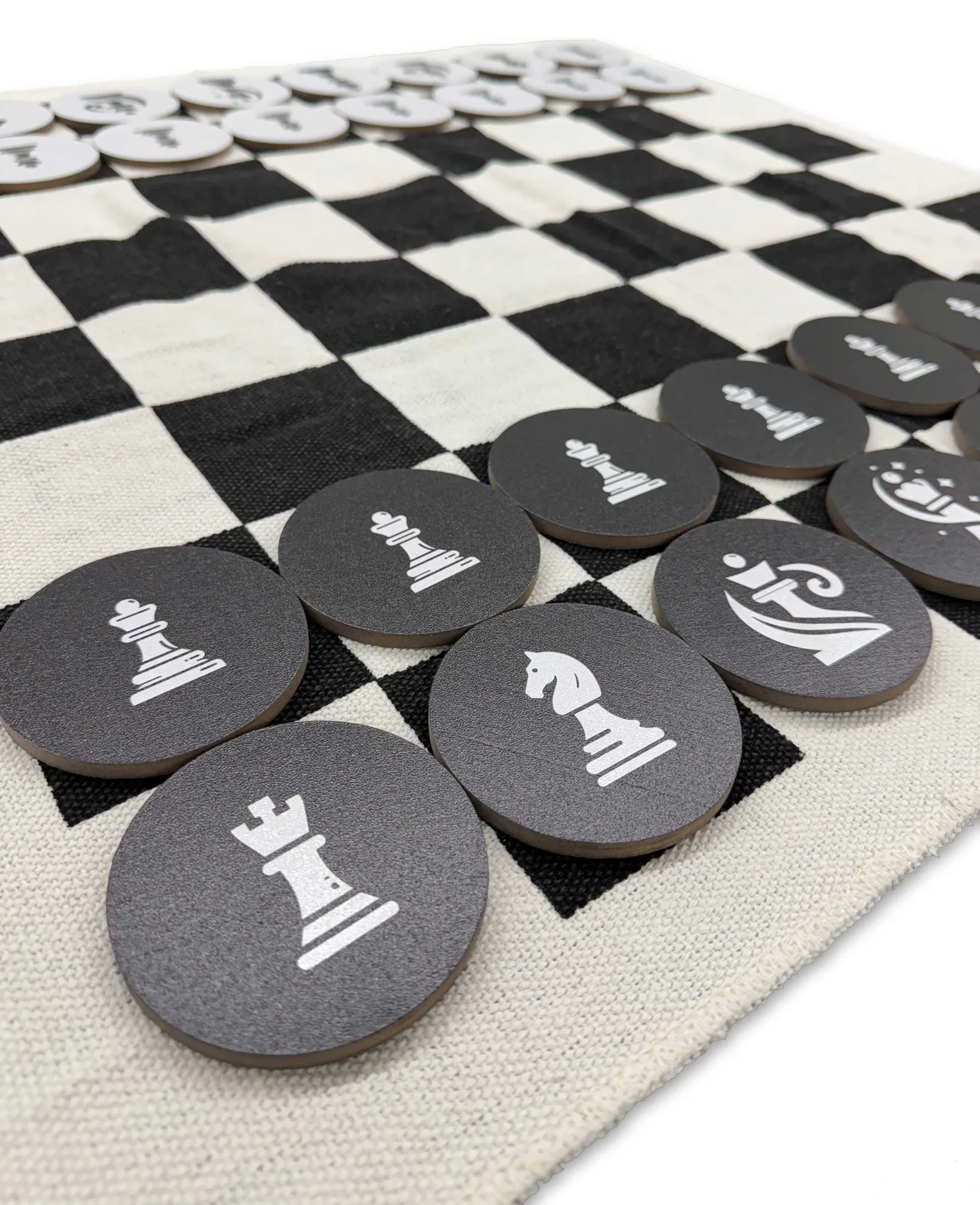
For example, the Giant Chess and Checkers set from YardGames.com features 3.5-inch wood coins. These work well on a board with squares around 6 to 8 inches. If your board has smaller squares, the pieces may crowd each other, making moves awkward.
Caring for Your Large Chess Pieces
Outdoor chess pieces face sun, moisture, and dirt. The Giant Chess and Checkers set uses UV-printed wood coins, which resist fading better than standard paint. Still, it's wise to store them in a dry place when not in use, especially if rain is forecast.
For quick cleaning, wipe the pieces with a damp cloth. Avoid harsh chemicals that could strip the print. If you leave the board set up outdoors, consider a light cover or tarp to protect it from direct sun and debris.
Step-by-Step Setup and Play
- 1. Set Up the Board: Place your board on a flat, level surface. Ensure the bottom-left corner square (from each player's perspective) is a dark square. For standard chess, the board should be oriented so a light square is on each player's right. Common mistake: placing the board sideways. Check that the bottom-right square is light for chess.
- 2. Arrange the Chess Pieces: Place the back row (closest to you) from left to right: rook, knight, bishop, queen, king, bishop, knight, rook. The queen goes on her own color (white queen on a light square, black queen on a dark square). The front row is all pawns. Common mistake: swapping king and queen positions. Remember 'queen on her color'.
- 3. Learn Basic Chess Moves: Pawns move forward one square (two on first move) and capture diagonally. Knights move in an L-shape. Bishops move diagonally. Rooks move straight. The queen moves any direction. The king moves one square any direction. The goal is checkmate—trapping the opponent's king. Common mistake: forgetting that pawns capture diagonally, not straight ahead.
- 4. Switch to Checkers (Optional): For checkers, use only the dark squares. Each player places 12 pieces on the dark squares of the three rows closest to them. Pieces move diagonally forward one square. Capture by jumping over an opponent's piece. When a piece reaches the opposite end, it becomes a king and can move backward. Common mistake: trying to move checkers on light squares. Only dark squares are used.
- 5. End the Game: In chess, the game ends by checkmate, resignation, or draw (e.g., stalemate or insufficient material). In checkers, the game ends when one player captures all opponent pieces or blocks them from moving. Declare the winner and reset the board for the next round. Common mistake: forgetting to declare a draw in chess when no legal moves remain (stalemate).
Product Spotlight
-
Giant Chess and Checkers: 3.5-inch black and white wood coins with UV-printed detail for crisp contrast and long-lasting detail. The UV printing resists fading from sun exposure, so your set stays readable and attractive even after many outdoor games.
Giant Chess and Checkers