Quick answer
Place the KEF Kube 10 MIE near a front wall, connect via the LFE input, set the crossover to 80 Hz, and run your receiver's auto-calibration for best results.
Why placement matters more than you think
The KEF Kube 10 MIE uses a sealed cabinet design, which produces tighter bass but relies on boundary reinforcement for deeper extension. Placing it too far from a wall can make the subwoofer sound weak, while corner placement may over-emphasize certain frequencies and cause boominess.
A good starting point is along the front wall, about 6-12 inches from the wall, and slightly off-center from your main listening position. This balances output and clarity without exciting too many room modes.
Connection options: LFE vs. stereo
For home theater use, connect the subwoofer to your AV receiver's dedicated subwoofer (LFE) output using a single RCA cable. This bypasses the subwoofer's internal crossover and lets the receiver handle bass management.
For a stereo music system, use the left/right line-level inputs. In this mode, the KEF Kube 10 MIE's own crossover and phase controls become active, giving you more direct control over the blend with your main speakers.
Step-by-step setup guide
- Choose the initial placement: Place the subwoofer along the front wall, 6–12 inches from the wall, and slightly off-center from your listening position. Avoid corners at first to prevent boomy bass. A common mistake is placing the subwoofer in a corner immediately — this often exaggerates low frequencies and makes calibration harder.
- Connect the subwoofer to your receiver: Use a single RCA cable from your AV receiver's subwoofer (LFE) output to the KEF Kube 10 MIE's LFE input. Ensure the subwoofer's power switch is off before connecting. Forgetting to set the receiver's speaker configuration to 'Small' for your main speakers will send full-range signals, reducing subwoofer effectiveness.
- Set the crossover and volume: On your AV receiver, set the crossover to 80 Hz (THX standard). Turn the subwoofer's volume knob to about 12 o'clock initially. Set the phase control to 0°. Setting the crossover too high (e.g., 120 Hz) can make bass localizable; too low (e.g., 40 Hz) may leave a gap between your speakers and subwoofer.
- Run auto-calibration: Run your receiver's auto-calibration (e.g., Audyssey, YPAO, Dirac). During the process, place the microphone at your main listening position at ear height. A common mistake is placing the microphone on a couch or near a wall — this skews the calibration. Use a camera tripod for accurate mic placement.
- Fine-tune by ear: After calibration, play bass-heavy content and adjust the subwoofer's volume and phase slightly if the bass sounds disconnected or boomy. Small tweaks of 1–2 dB can make a big difference. If the bass sounds 'one-note' or boomy, try moving the subwoofer a few inches or flipping the phase to 180°.
About the KEF Kube 10 MIE
-
KEF Kube 10 MIE Powered Subwoofer: The KEF Kube 10 MIE is a 10-inch front-firing active subwoofer with a sealed cabinet and 300 Watts of power. The sealed design delivers tight, controlled bass that integrates cleanly with speakers, making placement less critical than with ported subs.
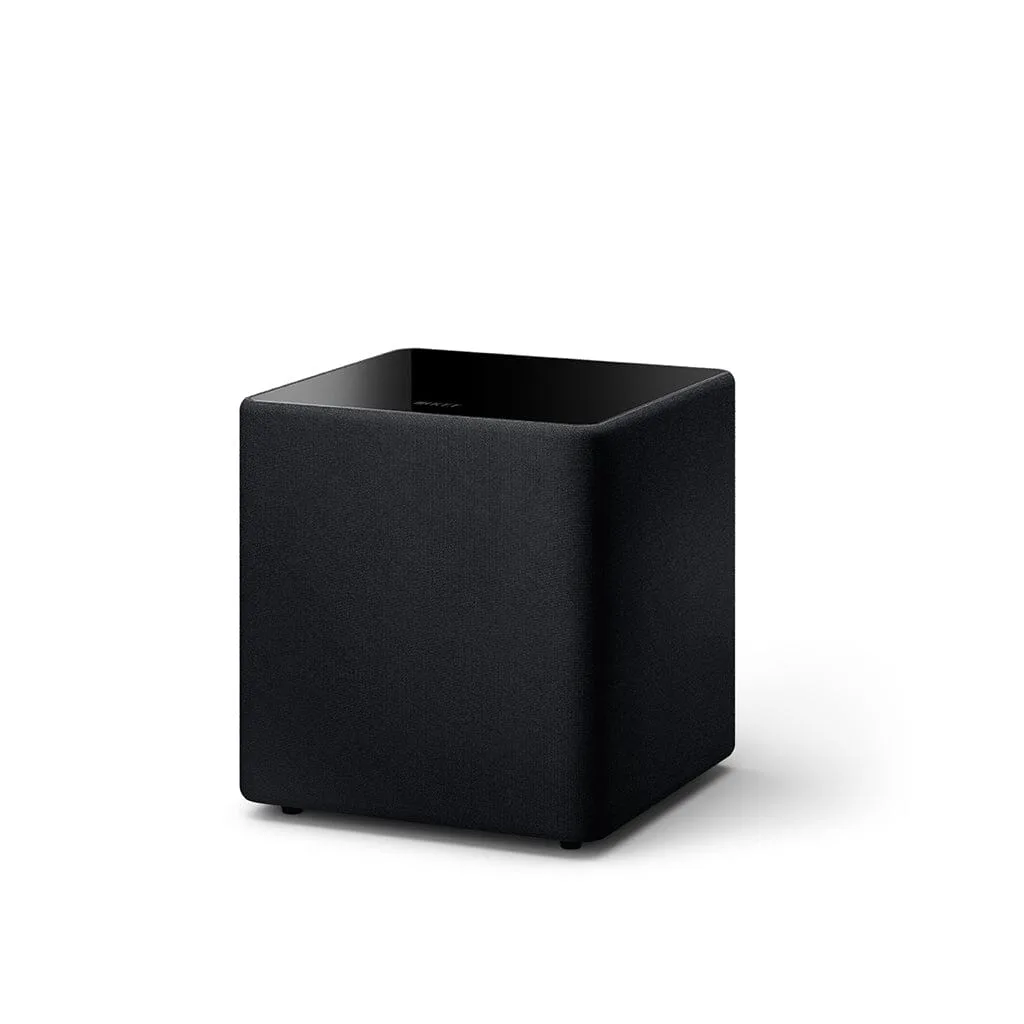
KEF Kube 10 MIE Powered Subwoofer