Quick answer
Puckering and skipped stitches on ripstop usually come from the wrong needle, too much tension, or letting the fabric feed unevenly. Switch to a 70/10 or 80/12 sharp or microtex needle, use a 40-weight polyester or nylon thread, lower your upper tension, and support the fabric on both sides. If the fabric still fights you, a lightweight tear-away or wash-away stabilizer will stop the tunneling.
Ripstop nylon is one of those fabrics that either sews like a dream or fights you every stitch. The difference is rarely the fabric itself. It is almost always the needle, the thread, or how you handle the feed.
This guide walks through the three most common ripstop sewing problems, what actually causes them, and the exact fix. You will also find a stopping point: the moment when the fabric is telling you to choose a different material for your project.
Why ripstop puckers at the seam
Puckering shows up as a rippled seam line, like the fabric is being pulled into the stitch. On ripstop, this usually happens because the needle is punching a hole larger than the thread, or because the upper tension is pulling the fabric toward the needle plate. Ripstop is thin and tightly woven, so it has almost no give. Any excess tension transfers directly into a visible wave.
Start by lowering your upper tension by one or two numbers. If that does not help, drop your needle size. A 70/10 microtex or sharp needle makes a clean, small hole that the thread can fill without dragging the fabric. If you are still seeing puckers, place a strip of lightweight tear-away stabilizer under the seam and tear it away after stitching.
- Test on a scrap first: sew a 4-inch seam and check for waves before touching your project.
- Do not pull the fabric from behind the needle; let the feed dogs move it.
- If the pucker runs along the whole seam, it is tension. If it appears only at the start, it is your starting technique.
Skipped stitches and the needle-thread mismatch
Skipped stitches look like gaps in the seam, where the needle failed to pick up the bobbin thread. On ripstop, this is almost always a needle problem. A universal needle has a slightly rounded tip that can deflect off the tight weave instead of piercing it. Switch to a sharp or microtex needle in a 70/10 or 80/12 size. If you are using a stretch or ballpoint needle, that is the culprit.
Thread matters too. A 40-weight polyester or nylon thread has enough body to form a stitch without shredding. Very fine threads, like 60-weight or monofilament, can slip out of the needle's groove and cause skips. If you have tried the right needle and still get skips, increase your stitch length slightly to 2.5 or 3.0 mm and rethread both the top and the bobbin.
- Replace the needle after every 4 to 6 hours of sewing on ripstop; it dulls faster than you think.
- Match your needle size to your thread weight: 70/10 for 50-weight, 80/12 for 40-weight.
- If the bobbin thread is not coming up, check that the bobbin is wound evenly and inserted in the right direction.
When the fabric feeds unevenly
Ripstop is slippery. It can slide sideways or get pushed down into the needle plate, especially at the start of a seam. This causes wavy edges, uneven stitch length, and sometimes a jam. The fix is to support the fabric on both sides. Do not lift it; just keep it flat and let the machine pull it through. A straight-stitch foot with a clear sole helps you see the seam line without tugging.
If you are sewing a long seam, try a walking foot or a roller foot. These feed the top and bottom layers together and stop the bottom layer from shifting. If you do not have one, place a piece of tissue paper or wash-away stabilizer under the seam and tear it away after. This gives the feed dogs something to grip.
- Start and end your seam with a small scrap of fabric under the needle to avoid the fabric being pulled into the plate.
- Do not push or pull the fabric; guide it lightly with your fingertips.
- If the fabric still slides, a small amount of temporary fabric adhesive on the seam allowance can help.
The point where you should stop and choose another fabric
If you have tried the correct needle, thread, tension, and stabilizer, and the ripstop still puckers or skips, the fabric may not be right for your project. Very lightweight ripstop, under 1.5 ounces per square yard, is difficult to sew on a standard machine without a specialized setup. If your machine lacks adjustable presser foot pressure, you may not be able to sew it cleanly at all.
In that case, consider a slightly heavier ripstop, a ripstop with a coating, or a different fabric altogether. For bag making, a 12oz waxed canvas like Sarah's OLIVE Tone Evergreen Hexatex (Yard) is far more forgiving and holds structure without stabilizer. For padded accents or straps, a 3D air mesh like SewSquish Cloud (HY) - BATTLESHIP GRAY #86 gives you cushion and breathability without the slipping and puckering of thin ripstop.
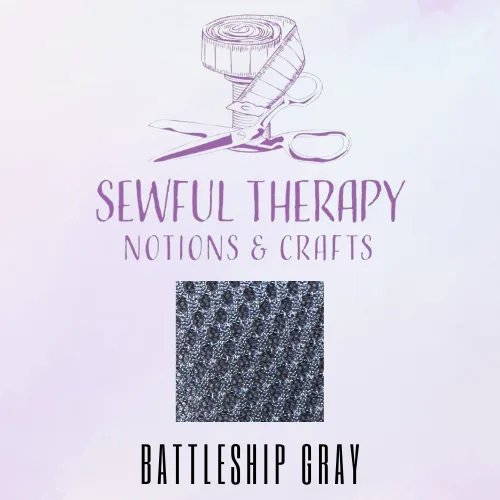
SewSquish Cloud (HY) - BATTLESHIP GRAY #86
- If your machine has no presser foot pressure adjustment, thin ripstop will always be a challenge.
- If the fabric is for a bag that needs structure, a heavier woven is often a better choice.
- Do not keep fighting a fabric that is wrong for the project; the result will look homemade for the wrong reasons.
Diagnosis: match the symptom to the fix
- Symptom: rippled seam line: Likely cause is too much upper tension or a needle that is too large. Lower tension by 1-2 numbers and switch to a 70/10 microtex needle. If the pucker disappears on a scrap, you have found the fix.
- Symptom: gaps in the stitch line: Likely cause is a universal or ballpoint needle deflecting off the tight weave. Switch to a sharp or microtex needle and use 40-weight polyester thread. If skips continue, increase stitch length to 3.0 mm and rethread completely.
- Symptom: fabric slides or jams at the start: Likely cause is uneven feeding. Use a walking foot or place tear-away stabilizer under the seam. Start with a scrap under the needle. If the fabric still fights, it may be too lightweight for your machine; choose a heavier fabric.
Materials that solve the problem
- SewSquish Cloud (HY) - BATTLESHIP GRAY #86: 2mm thick sandwich 3D air mesh, sold in half-yard cuts approximately 18"x56"-57", precut. This mesh has enough body to feed evenly without puckering, and it adds breathable padding to straps and back panels where thin ripstop would need stabilizer.
- Sarah's OLIVE Tone Evergreen Hexatex (Yard): 12oz weight waxed canvas, sold by the half yard, 18"x56", water resistant and durable. If your ripstop project needs structure and durability, this canvas sews without the tension and needle problems of lightweight nylon, and it repels water for outdoor use.
Ripstop does not have to be a battle. Match your needle and thread to the fabric, keep your tension low, and support the feed. If you have done all three and it still puckers, the fabric is telling you it is not right for this project. Switch to a material that suits your machine and your goal, and your seams will be clean again.