Quick Answer
Start with Level 1 to understand how the nine tower pieces interlock. Focus on the base courtyard shape and try each piece in different orientations. If you get stuck, set the puzzle aside for a few hours—your brain will subconsciously work on the spatial relationships.
Understanding the Ziggurat Square Puzzle
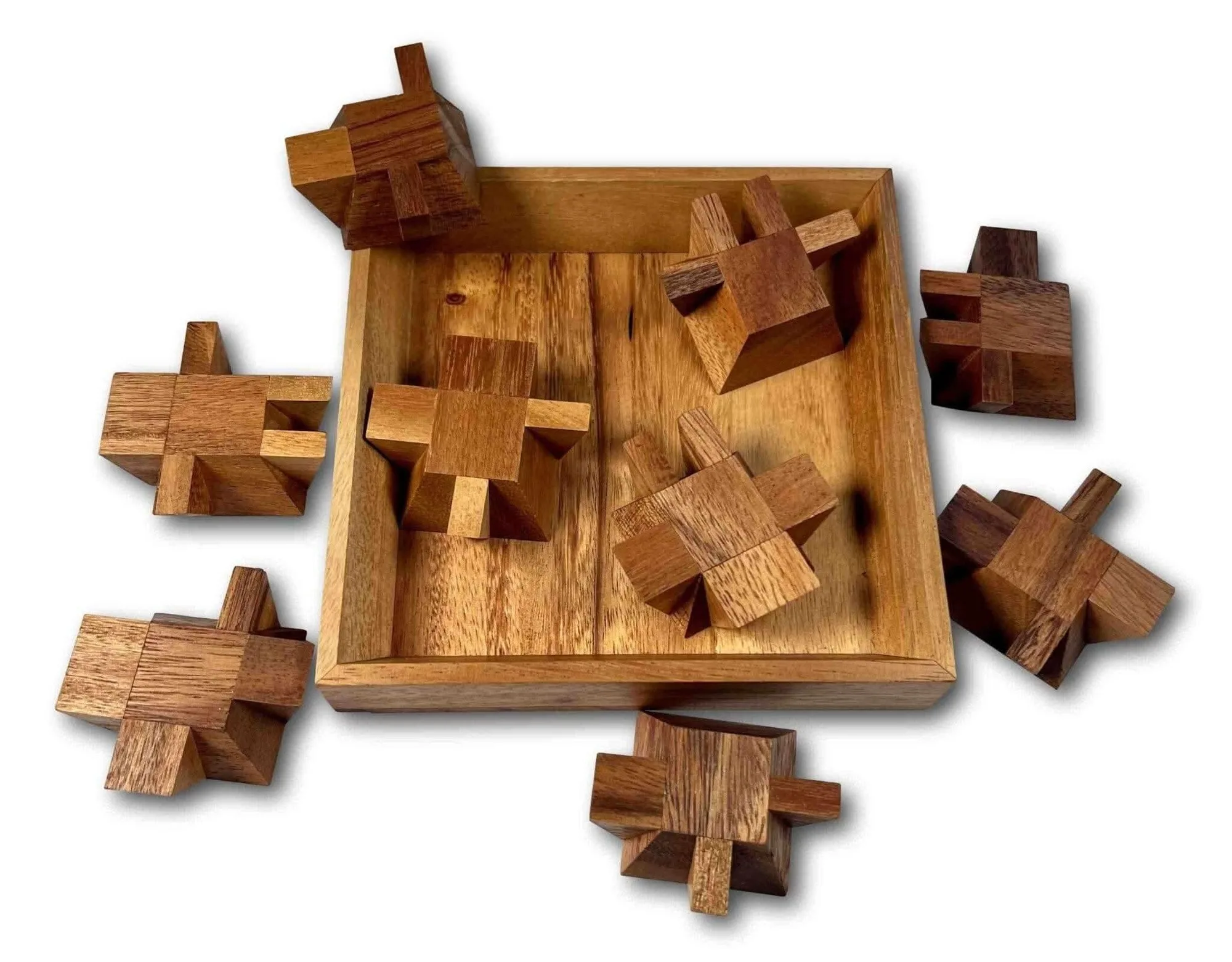
The Ziggurat Square is an extremely difficult wood puzzle for adults. It consists of nine tower-shaped pieces that must be arranged inside a wooden base (the courtyard) to form a perfect 3x3 square. The puzzle is inspired by ancient Mesopotamian ziggurats—temples with sloping sides and a flattened top. Each piece represents a tower, and your goal is to link them together so they fit flush within the base.
What makes this puzzle unique is that it offers three levels of difficulty. Level 1 uses a subset of pieces to give you a fighting chance, while Level 3 requires all nine towers to be placed in the correct orientation—a challenge that even experienced puzzlers find daunting. The puzzle does not come with a solution sheet, so you rely entirely on spatial reasoning and trial-and-error.
What You Need Before Starting
Find a flat, well-lit surface with enough room to spread out the pieces. The Ziggurat Square base is about 6 inches square, but you'll want extra space to rotate and compare pieces. Have a soft cloth or mat underneath to prevent the wood from sliding. No tools or glue are needed—this is a pure packing puzzle.
Step-by-Step Solving Process
- Step 1: Sort and Study the Pieces: Empty all nine tower pieces from the base. Examine each piece's shape—notice that some have wider bases, others have angled tops, and a few are nearly symmetrical. Group pieces by general shape: wide, narrow, and those with a distinctive notch or protrusion. Common mistake: Assuming all pieces are identical. They are not—each has a unique profile that fits only in specific positions.
- Step 2: Start with Level 1: Select the pieces that appear simplest (usually the ones with fewer angles). Try to arrange them in a small cluster that fits inside the courtyard. The goal here is not to solve the full puzzle but to understand how pieces interlock. Use the base as a guide—if a piece overhangs the edge, it's in the wrong spot. Checkpoint: If you can fit 3-4 pieces flush against each other and the base edge, you're on the right track.
- Step 3: Rotate and Flip Each Piece: For every piece, try all four rotations (0°, 90°, 180°, 270°) and also flip it over. The puzzle pieces are not symmetric, so orientation matters. Place a piece in the base, then see if adjacent pieces can slide next to it without gaps. Common mistake: Forgetting to flip pieces. Many puzzlers get stuck because they only rotate, not flip.
- Step 4: Build from the Corners Inward: Identify pieces that have a straight edge or a right angle—these are likely corner pieces. Place them first in the base's corners. Then fill in the edges, and finally the center. This approach reduces the number of possible arrangements. Checkpoint: If the center piece doesn't fit after placing corners and edges, you may have chosen the wrong corner pieces. Swap them out.
- Step 5: Use the 'Empty Space' Test: After placing a few pieces, look at the remaining empty area. Mentally compare its shape to the remaining pieces. If the gap is too small or oddly shaped for any leftover piece, you need to backtrack. Remove the last piece and try a different orientation or a different piece. Common mistake: Forcing a piece into a gap where it clearly doesn't belong. If it requires pressure, it's wrong.
- Step 6: Take Breaks and Come Back: If you've been working for 20 minutes without progress, set the puzzle aside. Your brain continues to process spatial problems subconsciously. When you return, you may see the solution immediately. Checkpoint: Many solvers report that the solution 'clicked' after a short break. Patience is key.
The Puzzle Used in This Guide
- The Ziggurat Square Brain Teaser | Extremely Difficult Wood Puzzle for Adults: An extremely difficult puzzle to solve at the highest level, but there are 3 levels so some success is likely. A Ziggurat was an ancient Mesopotamian temple with sloping sides and a flattened top. Your goal is to link 9 of these towers together to form a 3x3 square in the courtyard (base) provided. The three difficulty levels mean you can start with a simpler challenge and gradually build up to the full puzzle, making it accessible even if you're new to brain teasers.