Quick Answer
Nine times out of ten, a sliding camping mattress pad is a floor-contact problem, not a mattress problem. Clean and dry the tent floor, add a non-slip rug pad or silicone grip dots under the pad, and match the pad footprint to your tent so it presses gently against at least two walls. If the pad still migrates every night after those fixes, the surface is too slick or too sloped for a loose pad, and you should change how the pad is supported rather than fight it.
You inflate the pad, crawl in, and wake up two hours later with your feet on the tent wall and your head on bare floor. Camping mattress sliding is one of the most common sleep complaints we hear, and it is almost never solved by tightening the pad or buying a heavier one. The fix depends on why the pad is moving.
This guide separates the symptom from the cause, gives you corrective steps in the order you should try them, and tells you honestly when a slippery pad is a sign that your tent floor or campsite is the wrong match for that setup. HEST memory foam pads are designed for flat, dry sleeping spaces, so most movement traces back to the surface underneath them.
Symptom Check: How Is It Actually Moving?
Before you buy anything, watch how the pad behaves for one night. Does it slide as a single unit toward the low corner of the tent? That points to a sloped or slick floor. Does it fold, bunch, or creep only under your hips and shoulders? That usually means the pad is over-inflated or too small for the sleeper, so your body rolls it instead of resting on it. Does it only move when you roll over quickly? That is a friction problem, and it is the easiest one to fix.
Write down three things: which direction it moves, whether the movement happens on the first night or after several, and whether the tent floor was damp. Those three answers narrow the cause to one of the fixes below instead of guessing.
- Movement toward one corner: check for slope or a stretched floor.
- Bunching under hips or shoulders: check pad inflation and footprint size.
- Movement only on fast rolls: add friction between pad and floor.
Cause 1: The Tent Floor Is Slick or Damp
Most tent floors are coated nylon or polyester, which is deliberately smooth and water-resistant. That is great for weather protection and terrible for friction. Add condensation from your breath and body heat, and the floor becomes a low-friction surface overnight. Wipe the floor dry before you lay anything down, and if you camp in humid conditions, leave a small vent open to reduce condensation buildup.
The corrective action is to add a grippy layer between the tent floor and the pad. A thin non-slip rug pad cut to the pad footprint works well. So do silicone grip dots or strips placed under the corners and center. Avoid putting a plastic tarp directly under a memory foam pad; it traps moisture and makes the sliding worse.
- Dry the floor completely before setup, not just at bedtime.
- Use a non-slip rug pad or silicone grip dots, not a smooth ground sheet.
- Vent the tent to cut condensation, which is a hidden cause of camping pad movement.
Cause 2: The Pad Footprint Does Not Match the Tent
A pad that is much smaller than the tent floor has room to wander. A pad that is slightly wider than the floor will bow up at the edges and slide as it tries to flatten. The sweet spot is a pad that fills the sleeping area with a small margin and touches at least two walls or corners, which gives it nowhere to travel. Measure your tent's usable floor space before you assume the pad is the problem.
HEST sizes its mattresses in specific footprints rather than one universal size, and the size names reflect that. The Dually comes in Dually Long 50"x78", Dually Wide 60"x72", Dually Short 50"x64", and Dually Queen 60"x78", so you can match the pad to the space instead of forcing a fit. A pad that genuinely matches your tent footprint needs far less grip help.
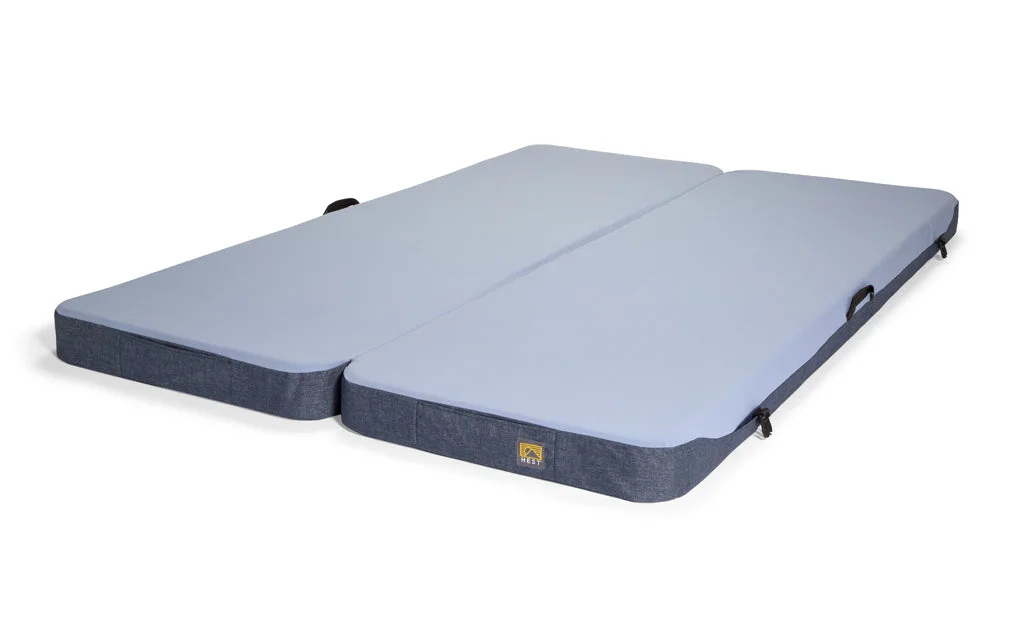
The Dually
- Measure usable floor space, not the tent's advertised dimensions.
- Aim for a pad that touches two walls or corners.
- If you are between sizes, size down rather than up for a tighter fit.
Cause 3: The Pad Is Over-Inflated or Under-Supported
Memory foam pads need a flat, dry surface to do their job. If you add extra air for firmness, the pad becomes a rounded, low-friction object that rolls under a moving sleeper. Let some air out and give the foam a chance to conform. This is also why HEST describes the Dually as designed for flat and dry sleeping spaces in truck bed campers, rooftop tent pop-ups, and tents; the design assumes a level base.
If your sleeping area is not flat, do not compensate with more air. Instead, look at whether an extension or a different configuration makes more sense. The Dually Extend expands the sleeping area of the Dually and attaches to Dually models, with Dually Extend 72 for the Dually Wide and Dually Extend 78 for the Dually Long or Queen. It can also be used alone on benches or other narrower spaces, which is useful when the full pad will not sit flat.
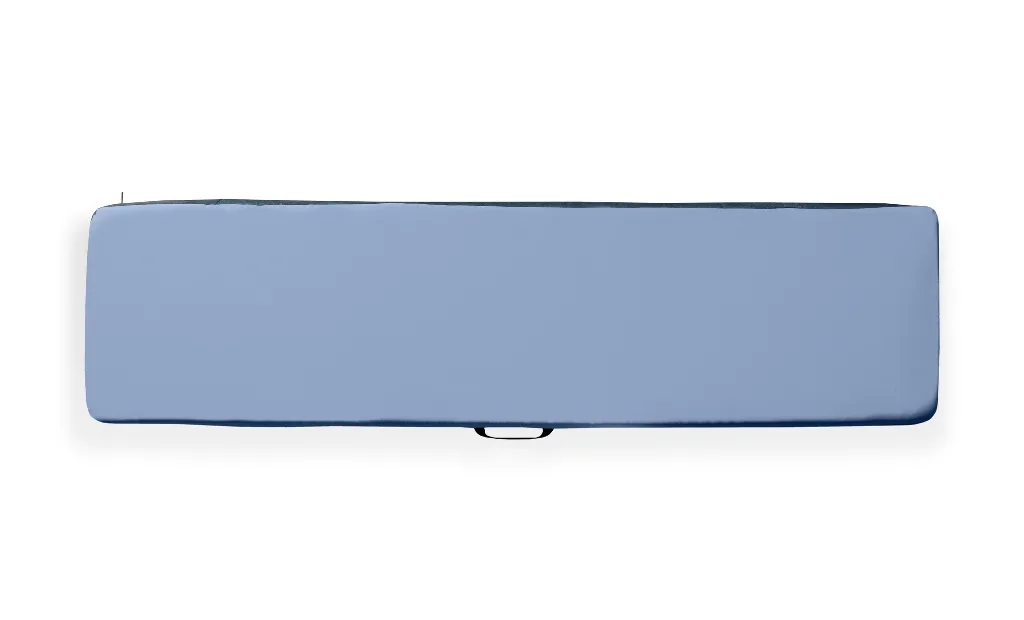
Dually Extend
- Release air until the pad feels flat, not firm.
- Never use extra inflation to fix a sloped floor.
- For slide-outs, larger rooftop tents, and RVs, an extension may fit better than a full second pad.
Cause 4: Gear and Bedding Are Pulling the Pad
Pillows, blankets, and duffels resting on the pad edge act like handles. Every time you roll, you tug the bedding and the bedding tugs the pad. Keep heavy gear off the sleeping surface and store it at the foot or beside the pad. A fitted sheet sized to the pad also helps because it holds the sleeping surface together instead of letting layers slide independently.
Small accessories matter here too. The HEST Non-Locking Wire-Gate Carabiner is designed for attaching items like HEST pillows to your backpack, so it keeps a pillow off the pad and clipped to something stable instead. Note that this carabiner is not intended for critical-load use, so treat it as an organizer, not a safety device.
- Keep duffels and shoes off the pad; they drag it when you move.
- Use a fitted sheet to bind the sleep surface into one layer.
- Clip loose pillows to a stable point instead of letting them roam.
Slide Diagnosis: Match the Symptom to the Fix
- Pad slides as one unit toward a corner: The floor is sloped, slick, or damp. Dry the floor, add a non-slip rug pad or silicone grip dots, and reposition the tent so your head is on the high side. If it still slides after drying and adding grip, the slope is too steep for a loose pad.
- Pad bunches under hips and shoulders: The pad is over-inflated or too small for the sleeper. Release air so the foam can conform, and check the footprint against your body length and tent width. If bunching continues at correct inflation, the pad size is the problem, not the floor.
- Pad moves only during fast rolls: This is pure friction loss. Add a grippy layer and bind the sleep surface with a fitted sheet so bedding does not tug the pad. This is the easiest case to fix and rarely requires a new pad.
- Pad moves on a floor that is not flat or dry: HEST pads are designed for flat, dry sleeping spaces. If your site cannot provide that, use the pad alone on a bench or narrower flat surface, or add an extension to create a supported footprint. Stop adding grip here. Change the surface or the pad configuration instead.
HEST Products That Help With Pad Stability
- The Dually: The Dually is a two-person camping mattress pad designed for flat and dry sleeping spaces found in truck bed campers, rooftop tent pop-ups, and tents, and it comes in Dually Long 50"x78", Dually Wide 60"x72", Dually Short 50"x64", and Dually Queen 60"x78". Matching one of these footprints to your tent floor reduces the empty space a pad needs to slide into, which is the most durable fix for camping mattress sliding.
- Dually Extend: The Dually Extend expands the sleeping area of the Dually and attaches to HEST Dually models, with Dually Extend 72 for the Dually Wide and Dually Extend 78 for the Dually Long or Queen, and it can also be used alone on benches or other narrower spaces. If your tent floor is an odd shape, an extension can fill the gap so the pad is supported edge to edge instead of resting on a partial surface where it can shift.
- Carabiner: The HEST Non-Locking Wire-Gate Carabiner is designed for attaching items like HEST pillows to your backpack, and it is not intended for critical-load use. Keeping pillows clipped to a pack or a fixed point stops them from dragging across the pad and pulling it out of place overnight.
Start with the cheapest fix: dry the floor, add a non-slip layer, and match the pad to the tent footprint. If the pad still travels on a flat, dry floor, the issue is the surface or the size, and no amount of grip tape will solve it. Fix the base, and the pad stays put.