Quick answer
Clean your veil before storing it, then fold it around a padded roll or acid-free tissue and keep it flat in a breathable, acid-free box away from light, heat, and humidity. Never seal a veil in a plastic bag or hang it by the comb, because trapped moisture, pressure, and gravity cause the yellowing and stretched lace you are trying to prevent.
Your veil is one of the few wedding pieces you can realistically keep for decades, but it is also the most fragile. Tulle and lace hold onto skin oils, hairspray, and moisture long after the ceremony, and those invisible residues are what turn a veil yellow or brittle over time.
The good news is that preserving a wedding veil takes one afternoon and very little equipment. The steps below cover how to handle a veil before storage, how to fold it without creating permanent creases, and where to keep it so it survives a move, a renovation, or twenty years in a closet.
Start with clean hands and a clean surface
Before you touch the veil, wash and dry your hands and clear a table or bed of anything that could snag tulle. Remove rings with prongs, watches, and bracelets. Tulle catches on the smallest rough edge, and a single pull in a fine mesh can run.
Lay a clean white sheet or a large piece of unbleached muslin over the surface. This gives you a neutral background so you can spot stains, and it prevents dye transfer from a wooden table or a printed tablecloth. Work in a room with soft, indirect light rather than direct sun.
- Checkpoint: if your hands feel lotioned or tacky, wash again. Oils transfer to tulle instantly and attract dust.
Inspect the veil in good light before you store it
Turn the veil over and look at the comb, the lace trim, and the tulle near the hem. Common trouble spots are the area that touched your neck and shoulders, the bottom edge that brushed the floor, and any place where hairspray settled.
Note what you find before cleaning, not after. Some marks, like a faint water ring on silk tulle, can be made worse by home treatment, and knowing where they are helps a professional cleaner focus. If you see dark spots that could be mildew, isolate the veil from other keepsakes until it is assessed.
- Common mistake: storing first and inspecting later. Once a veil is boxed, small problems are easy to forget for years.
Decide between professional cleaning and careful spot treatment
For a veil with visible soiling, a textured lace trim, or any beading, a textile conservator or a cleaner experienced with bridal wear is the safer choice. Tell them the fibers if you know them, and ask them to return the veil unfolded and unboxed so you can store it your way.
If your veil only touched your hair and looks clean, you may not need wet cleaning at all. In that case, air it in a shaded, well-ventilated room for a day or two, then proceed to folding. Do not iron tulle directly, and do not steam lace with a metal nozzle pressed against it.
- Checkpoint: if you are unsure whether the trim is silk or synthetic, treat it as delicate and let a professional handle it.
Fold around a padded roll instead of creasing flat
Sharp folds are what create the lines you see in old veils. Instead of folding the veil in quarters, roll it loosely around a tube covered in acid-free tissue or washed cotton, then lay the roll in the box. This distributes the bend across a curve rather than a single line.
For a long veil, fold it in half lengthwise first, then roll. For a shorter blusher style, layer acid-free tissue between the tulle and the lace trim so the heavier trim does not press into the mesh. Keep the comb flat and supported rather than bent underneath the roll.
- Common mistake: folding along the same line every time you open the box. Rotate the fold position slightly each time you re-pack.
Choose a breathable, acid-free box and the right location
Use a storage box made of acid-free, lignin-free board, or a clean cotton pillowcase inside a sturdy box as a lower-cost option. Avoid vacuum-seal bags, dry-cleaning plastic, and ordinary cardboard, all of which trap moisture or release acids that yellow fabric.
Store the box flat, not on its side, in a cool interior closet. Aim for a stable environment away from exterior walls, attics, basements, and bathrooms. Light, heat, and fluctuating humidity do more damage over ten years than a single handling ever will.
- Checkpoint: if the storage spot feels damp or smells musty, it is the wrong spot, even if the box is sealed.
Re-check the veil once a year
Once a year, open the box in a shaded room, unfold or unroll the veil gently, and look for new discoloration, pest damage, or creases that have set. Let it breathe for an hour, then re-roll it with the fold in a slightly different position.
This yearly check is also the moment to refresh tissue that has wrinkled or shifted. If you notice a smell or active pest activity, remove the veil from the box and get advice before returning it to storage.
- Common mistake: never opening the box. Problems caught in year two are far easier to fix than problems found in year fifteen.
Your veil storage sequence
- Clean your hands and prep a covered surface: Wash and dry hands, remove jewelry, and lay a clean white sheet or muslin over a flat table before the veil touches anything. Checkpoint: no lotion, no rough surfaces, no direct sun.
- Inspect the comb, trim, and hem in soft light: Look for soiling at the neckline, floor contact, and hairspray residue, and note anything that might be mildew before cleaning. Common mistake: boxing the veil before you have actually looked at it.
- Clean or spot-treat, then air fully: Use a bridal-experienced cleaner for beading, silk, or visible stains; otherwise air the veil in a shaded, ventilated room for a day or two. Checkpoint: the veil should be completely dry before it goes into any box.
- Roll around a padded tube instead of folding flat: Fold lengthwise, layer acid-free tissue over lace trim, and roll loosely around a tissue-wrapped tube, keeping the comb flat and supported. Rotate the fold position slightly each time you re-pack.
- Store flat in an acid-free, breathable box: Place the roll in an acid-free box or a cotton pillowcase inside a sturdy box, and keep it in a cool interior closet away from light and damp. Never use vacuum bags, dry-cleaning plastic, or plain cardboard.
- Re-check once a year: Open the box in shade, unroll gently, look for new discoloration or pests, let the veil breathe, then re-roll with a shifted fold. Early catches are easy fixes; late ones usually are not.
What veil construction means for storage
- Amelie Lux French lace scallop blusher veil - style V73b: Made of soft Italian Lux tulle and trimmed all around in sheer Alencon lace made exclusively for the brand in France, with delicate cording throughout. The cording and lace trim are the heaviest, most snag-prone parts, so pad the trim with acid-free tissue and never let it press into the tulle.
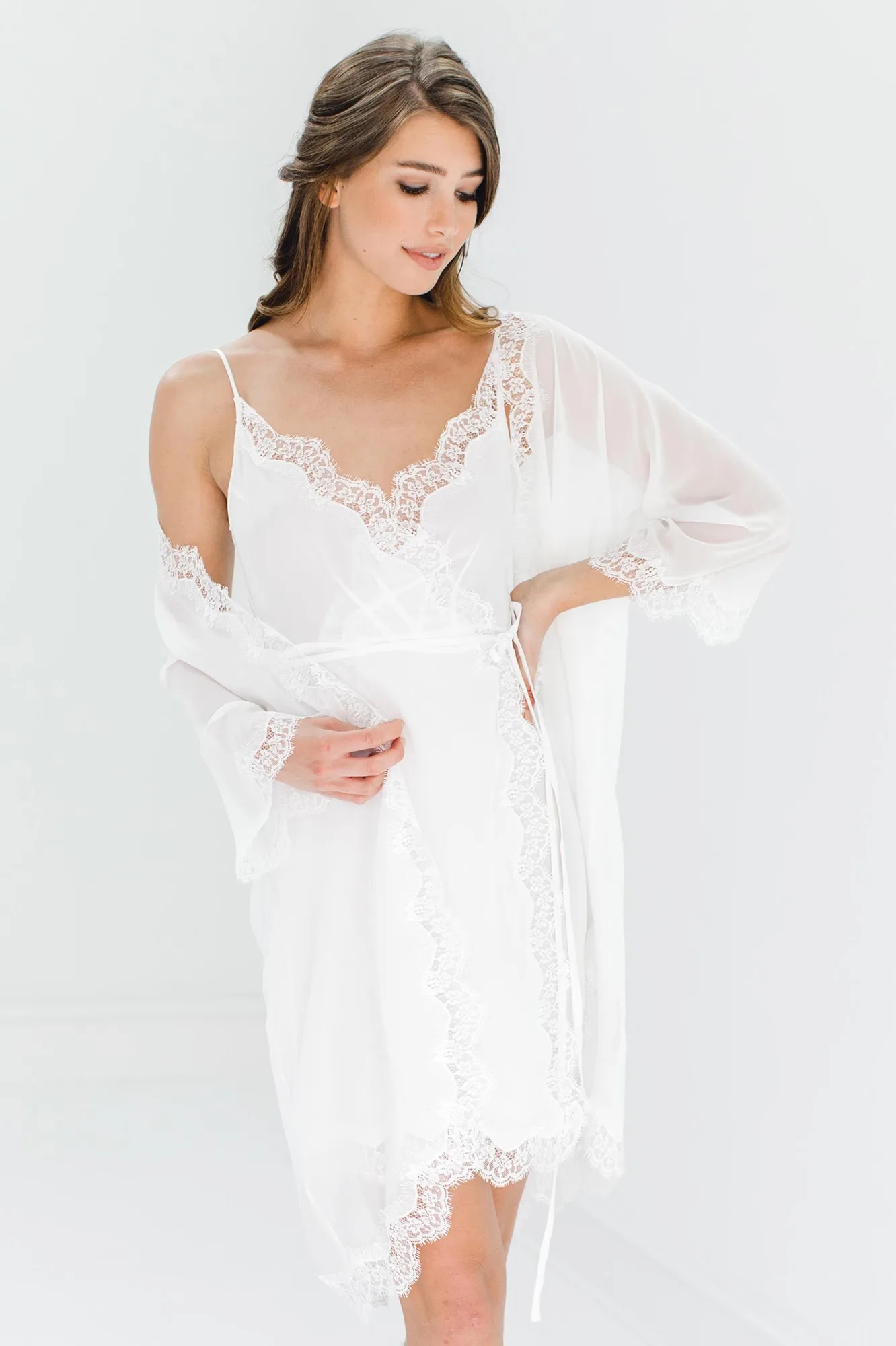
- Kate French Lace robe wedding wrap in off white: Hand-cut in French Leavers lace with a floral design, scalloped edges along the hem and sleeves, and an attached French grosgrain tie belt. If you store a lace robe alongside your veil, keep the grosgrain belt rolled separately so its stiffness does not crease the softer lace.
Storing a wedding veil well comes down to three habits: clean it before it goes away, roll rather than crease it, and keep it flat in a breathable box in a stable room. Do that, and the veil you wore down the aisle will still be wearable, or at least displayable, decades from now.